
Trade has grown steadily since 2004, before flattening out in the past couple of years.
The one-year bank deposit and the 10-year government bond finished at the bottom in terms of returns for 10-year and five-year horizons, respectively. Surprisingly, property was the worst performing asset class for the 15-year period.

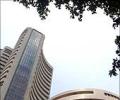
The number of stocks trading below their paid-up values is increasing rapidly after the Bombay Stock Exchange Sensex corrected 44 per cent from its all-time high.
Refineries, information technology, banks, realty, telecom and power stocks fuelled the Sensex's second largest single-day gain of 714 points this year, taking investor wealth to Rs 178,688 crore (Rs 1786.88 billion). The benchmark had advanced by 928 points on March 25.
The market cap of the listed firms on the Bombay Stock Exchange and the National Stock Exchange on Monday declined by a whopping Rs 125,000 crore (Rs 1,250 billion) to Rs 43,75,020 crore (Rs 43,750 billion), thereby falling below the GDP of Rs 46,93,000 crore (Rs 46,930 billion) at current market price, as per the real economy data released by the Reserve Bank of India on April 28 this year.
With the listing of Reliance Power, the market cap of Anil Ambani group aggregated to Rs 307,112 crore (Rs 3,071.12 billion), almost Rs 100,000 crore (Rs 1,000 billion) below expectations of Rs 400,000 crore (Rs 4,000 billion) capitalisation.
The Mukesh Ambani-led Reliance group ended 2007 by overtaking the Tata group in market capitalisation stakes and this despite the latter's acquisition of Corus steel. Last year's number one, the Tata group, is now a distant number two with a market capitalisation of Rs 3.20 trillion.
Higher net interest income and lower provisioning have helped banks to post record net profit growth in the last five quarters.
The stock markets are seen taking temporary support at 12,500 for the Sensex and 3600 for the S&P Nifty before heading lower in the coming days.
 © 2026 Rediff.com - Advertise with us - Disclaimer - Privacy Policy - Sitemap - Feedback - About us - Terms of use - Grievances