
Western Digital is offering a one-time scholarship of up to Rs 75,000 to persons with disabilities and transgender students pursuing graduation, post-graduation and PhD degrees in STEM-related fields.

In the technology (tech) world, especially storage, Sanjay Mehrotra is a well-known name. Co-founder of SanDisk, a flash memory storage company in 1988, it was eventually acquired by Western Digital in 2016 for a whopping $19 billion. For a boy from Kanpur, who went on to pursue higher studies in the US, becoming the chief executive officer of Micron Technology, Inc - one of America's largest memory chip makers - and now setting up the company's first plant in India, it has been quite a ride.

The Indian government is keen to woo major semiconductor players, but a global race to attract them to countries where there is already an ecosystem is making it difficult for India to attract the biggies in the business. On Wednesday the government decided to throw open the doors to more players to participate in its semiconductor scheme. It is now looking at not only 28 nanometre (nm) chips and below, but higher nodes like 40 nm.

Micron plans an assembly testing, marking and packaging project of $1 billion, and talks are on to set up a memory chip plant for captive requirements.

Finance Minister Nirmala Sitharaman on Monday held a meeting with representatives of the semiconductor industry of the US and invited them to make further investments in India. The finance minister spoke about opportunities for companies situated in Silicon Valley and about the government of India's commitment to be a reliable player in the entire semiconductor value chain with dedicated incentive for the sector in mission mode through the Indian Semiconductor Mission. Last year, the government approved a Rs 76,000-crore scheme to boost semiconductor and display manufacturing in the country in a bid to position India as a global hub for hi-tech production, and attract large chip makers.
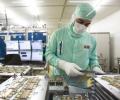
Mumbai-based Indian Semiconductor Manufacturing Company (ISMC) and Singapore-headquartered IGSS Ventures have one strategy in common: They have told the government in their application for semiconductor fabrication plants that they will export the bulk of the chips they make in India in the initial five or 10 years. The third applicant, Vedanta-Foxconn, which is also building a fab plant, has said it will concentrate on the needs of consumer electronics and mobile device markets, and earmark 80 per cent of output for domestic consumption, but has not specified its customers. Finding a viable domestic market could well be the biggest challenge for India's renewed tryst with semiconductors. Fab plants do not sell directly to end users but to intermediary chip design companies - such as Qualcomm or MediaTek.

These little set-top boxes are the one-stop answer to view data.
Nearly 5,000 workers in Malaysia, including foreigners, will be retrenched by 137 employers in the next three months as the global economic recession hits the country, Human Resources Minister S Subramaniam said in Kuala Lumpur.
 © 2026 Rediff.com - Advertise with us - Disclaimer - Privacy Policy - Sitemap - Feedback - About us - Terms of use - Grievances