
India's maiden moon mission Chandrayaan-1 has captured a halo around the site where US spacecraft Apollo-15 had landed on the lunar surface nearly four decades ago.

Chandrayaan-2 will explore a region of the moon where no mission has ever set foot. The spacecraft consists of an orbiter, a lander, and a rover together referred to as "composite body".

Director of Indian Space Research Organisation's Space Applications Centre based in Ahmedabad, Dr Ranganath R Navalgund said the terrain mapping camera, an Indian instrument on the lunar mission, has found "new types of rocks" and hollow tunnels.
Indian Space Research Organisation Chairman G Madhavan Nair met Dr Singh in Delhi on Friday afternoon and briefed him on the lunar mission launched on October 22.
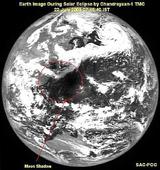
The images were captured by the Terrain-Mapping Camera (TMC) on board the 514-kg spacecraft, which is orbiting at 200 km above the lunar surface.

"Chandrayaan-2 has really incorporated many new features in its instruments which are taking the observations carried out on Chandrayaan-1 to a newer and higher level," added Kiran Kumar, a former ISRO Chairman.
 © 2026 Rediff.com - Investor Information - Advertise with us - Disclaimer - Privacy Policy - Sitemap - Feedback - About us - Terms of use - Grievances