
India's economy experienced a growth of 7.8 per cent during the October-December quarter of 2025-26, according to the new series of national accounts with 2022-23 as the base year.

The Indian economy is likely to grow at 7.4 per cent in 2025-26, up from 6.5 per cent in the previous fiscal, mainly on account of better performance of manufacturing and services sectors, as per the government data released on Wednesday.
The Indian economy recorded a six-quarter high growth of 8.2 per cent in July-September, as factories churned out more products in anticipation of a consumption boost from the GST rate cut, according to government data.

Indian economy grew by 7.8 per cent in April-June -- the highest in five quarters -- before the disruptive US tariffs were imposed.

Headline growth was quite weak heading into the Covid period but averaged 6.4 per cent and 6.7 per cent in the five years between FY16 and FY20 for GVA and GDP respectively, points out Abhishek Upadhyay.

India's economic growth rate is estimated to slip to a four-year low of 6.4 per cent in 2024-25, mainly on account of poor showing by the manufacturing and services sector, according to government data released on Tuesday. The gross domestic product (GDP) rate of 6.4 per cent will be the lowest since the Covid year (2020-21) when the country witnessed a negative growth of 5.8 per cent.

India's economic growth slowed to near two-year low of 5.4 per cent in the July-September quarter of this fiscal due to poor performance of manufacturing and mining sectors, but the country continued to remain the fastest-growing large economy, data showed on Friday. The gross domestic product (GDP) had expanded by 8.1 per cent in the July-September quarter of 2023-24 fiscal. The previous low level of GDP growth at 4.3 per cent was recorded in the third quarter (October-December 2022) of financial year 2022-23.

Investment growth moderated slightly in the economy during the first quarter (Q1) of the current financial year (2023-24, or FY24), notwithstanding the front-loading of capital expenditure (capex) by the Centre. This was also the case despite a pick-up in demand during the period after two dismal consecutive quarters. Although growth in gross fixed capital formation (GFCF), representing investment, fell to a five-quarter low of 7.96 per cent, the comparison with the first two quarters of the previous year is a bit askew due to the low year-on-year (Y-o-Y) base of those periods.

'A cutback in hiring and compensation growth by IT companies will have a significant impact on consumer demand, especially in the urban sector of the economy.'

As a percentage contributor to nominal GDP, PFCE's share was 60.1 per cent in FY23, compared with 59.6 per cent and 60.8 per cent in the two preceding fiscal years. "Although PFCE is expected to grow 7.7 per cent in FY23, we believe it is still short of a broad-based recovery. "The current consumption demand is highly skewed in favour of goods and services consumed largely by the households falling in the upper income bracket. "A broad-based consumption recovery, therefore, is still some distance away," said Sunil Kumar Sinha, principal economist with India Ratings.

The critical information in the first quarter (Q1) gross domestic product (GDP) data relates to the proximity of real and nominal GDP growth rates at 7.8 per cent and 8 per cent, respectively. The implicit price deflator (IPD)-based inflation is only 0.2 per cent. This phenomenon has repeated after fifteen quarters.

India's economic growth accelerated to 8.4 per cent in the third quarter of 2023-24, mainly due to good performance by the manufacturing, mining & quarrying and construction sectors. The Indian economy recorded a growth of 8.4 per cent in the third quarter of this fiscal (October-December 2023), according to data released by the National Statistical Office (NSO) on Thursday.

Lamborghini has sold 10,112 cars worldwide -- so India's 100 is certainly a big deal for them. But how big a deal is it for us to peg our consumption theories around, asks Rama Bijapurkar.
India Inc could be embarking upon a new phase of capital expenditure (capex) cycle, observed analysts, and suggest its revival would lead to a rerating of industrial stocks. Assisted by a property upcycle, analysts at Jefferies said several government initiatives were likely to drive capex. Indicators, they said, include a private project announcement at Rs 25 trillion for 2022-23 (up 150 per cent from pre-pandemic levels) and credit growth at about 16 per cent, which is closer to pre-pandemic highs.

Since January 2021, the inflation rate in health has stood in the range of 6.08-8.44 per cent.

The biggest headwind to the consumption story in FY23 is a sharp decline in government subsidies on food, fertiliser and fuel, and overall decline in revenue expenditure net of interest payments. This, analysts say, will adversely impact purchasing power of households at the lower end of the income pyramid, translating into lower spending on consumer goods and services.

India recorded economic growth of 7.8 per cent in the April-June quarter of 2023-24 against 13.1 per cent in the year-ago period, as per the National Statistical Office (NSO) data released on Thursday. India remains the fastest-growing major economy as China's GDP growth in the April-June quarter was 6.3 per cent.

India's economy grew 6.1 per cent in the fourth quarter of 2022-23, pushing up the annual growth rate to 7.2 per cent, official data showed on Wednesday.

India's per capita income, a gauge for assessing standard of living, for 2013-14 is up at Rs 6,699 per month for 2013-14 as against the earlier estimate of Rs 6,198.33 after the government updated the base year for measuring national accounts.

After navigating the turbulent pandemic waves, the recovering Indian economy is now sailing through unchartered waters of rising coronavirus cases, spiralling commodity prices and spiking inflation though the lighthouse of sustainable growth remains visible. As 2022 begins, a raft of developments, ranging from Budgetary announcements to continuation of stimulus measures to monetary policy, will set the tone for the domestic economy, which is projected to grow more than 9 per cent in the current fiscal ending March 2022. The country's continuing massive vaccination drive and 'precaution' doses starting for select categories of people this month will provide a firewall against any steep spike in coronavirus cases amid the emergence of the Omicron variant.

RE of GDP for 2015-16 show that the economy grew 7.9% in 2015-16, rather than the earlier estimate of 7.6 per cent.

India's growth slowed in three months through December from a revised 7.4% expansion in the previous quarter, but it was much stronger than expected.

The survey, however, said that GDP is expected to revert to growth terrain next year, when it is likely to grow by 7.2 per cent.

This time there has been a rather peculiar criticism of the latest GDP numbers.

Indians face COVID-19 with record debt, stalled income.
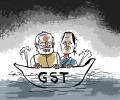
The collections stood at Rs 98,202 crore in the month, against Rs 1.02 trillion in July. The figures indicate continuation of economic slow down which was reflected in the gross domestic product (GDP) growth which plummeted to a 25-quarter low of 5 per cent in the first quarter of 2019-20, experts said.
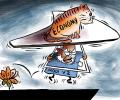
India's growth outlook has weakened sharply this year, with a crunch that started with the non-banking finance institutions spreading to retail businesses, car-makers, home sales and heavy industries.

Historically, there has been no correlation between growth in bank credit to industry and lower benchmark interest rate

Manufacturing sector grows at 3.5%; agriculture sector at 3.8%

While India's GDP growth slowed to five-year low of 5.8% in Q4, China grew at 6.4%.
 © 2026 Rediff.com - Investor Information - Advertise with us - Disclaimer - Privacy Policy - Sitemap - Feedback - About us - Terms of use - Grievances