
The Department of Telecommunications (DoT) will finalise its internal view on the Telecom Regulatory Authority of India (Trai's) recommendations, which was given in May last year, on mergers and acquisitions, spectrum allocation, spectrum sharing and other licencing aspects by the end of this month, a senior official from the department said.

Telecom users will be able to avail free roaming and keep their phone numbers even if they switch service providers anywhere in the country, as per the draft New Telecom Policy unveiled by the government said on Monday.

With the import bill of telecom equipment rising, the government on Wednesday said preferential treatment would be given to its indigenous production in the New Telecom Policy, which is under formulation.

Reports that the government is considering seeking a review of that judgment are worrying.

The government has approved mergers between telecom companies with a combined market share of 35 per cent and rejected spectrum-sharing among 3G operators while restricting it for 2G operators.

The Department of Telecommunications is planning to give more powers to the telecom regulator, Telecom Regulatory Authority of India, in the new telecom policy, including the power to impose financial penalties on the erring telecom service providers.
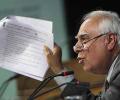
Delinking spectrum from the licences in the aftermath of the 2G scam, Sibal said, "In future, the spectrum will not be bundled with licence. The licence to be issued to telecom operators will be in the nature of 'Unified Licence' and the licence holder will be free to offer any of the multifarious telecom services."

Amidst the controversy over the allocation of spectrum and grant of telecom licences, the government on Monday said all licences are proposed to be renewed after 10 years instead of the 20-year period earlier.

The department is planning a complete overhaul of the archaic Indian Telegraph Act.
India has become the world's fourth largest market for optic-fibre cable after Japan, the US, and China following adoption of new telecom policy, a new study has said.
Far from benefitting consumers, the new rules on roaming charges have opened another front in the battle between large and small operators.

Till now the telecom companies can share only passive infrastructure such as towers. In active infrastructure the players would be able to share antenna and mobile exchanges among others.

The Finance Ministry, which is under immense pressure to meet the fiscal deficit target during the current financial year, has also written a letter to the department of telecommunication to auction spectrum to earn additional revenues.

The new telecom policy-2011 is also expected to come out with new norms for mergers and acquisitions, enhancing rural coverage, and spectrum allocation, among other things.
Several of the proposals may be part of New Telecom Policy.

In a setback to telecom service providers, the Supreme Court on Thursday allowed the Centre's plea to recover adjusted gross revenue (AGR) of about Rs 92,000 crore from them.
The petition filed by a host of GSM operators along with COAI also sought quashing of department of telecommunication's decision, dated October 19, to allow enhanced subscriber-linked criterion for spectrum allocation. They also sought non-implementation of these decisions terming them unfair, unjust, illegal, arbitrary and violative of level-playing field and principles of natural justice.
The government will introduce a unified licensing regime, covering operators either on an all-India scale or circle-wise with an aim to increase competition in the long distance segment. \n
Contrary to recommendations in the draft of the New Telecom Policy prepared by it, the Department of Telecom is not in favour of number portability
The new telecom policy draft has paved the way for stoking competition and allowing customers to select their long distance operators by calling for introduction of carrier access code immediately.

To make the scheme attractive, the government has announced a rate structure wherein the operators may take the optical fibre on lease and provide broadband connectivity to customers.
The Telecom Regulatory Authority of India on Monday issued an addendum to its consultation paper on unified license regime and said it was ready to consider all suggestions in this regard.\n\n

As part of the national telecom policy, which is likely to be released next month, various levies and charges including SUC would be reviewed in line with the input tax credit available.

Modelled loosely around the National Highway System of the US, he in 2001 launched the Golden Quadrilateral and the North-South & East-West Corridor projects to build 4/6 lane highways between four top metropolitan cities of Delhi, Mumbai, Chennai and Kolkata as well as from Srinagar to Kanyakumari and Porbandar to Silchar.

Vodafone had contended in its plea that DoT instead of signing and executing the ULs had at the last moment informed them that their request for deletion of 'restrictive' clauses in licence pertaining to roaming cannot be accepted.

The big advantage that Jio is able to garner currently is its low cost of operations.

Telecom regulator Trai on Monday announced reduction in the national mobile phone roaming charges, but said there will be no free national roaming as of now.

The marketplace was simply not conducive to the extension and evolution of broadband networks, particularly for less dense rural markets, so connectivity and services suffered.

It's time the government accepts that Digital India is too distant.

'We referred the case to the attorney general.' 'I told Mukul Rohatgi, "mujhe aap ka honest opinion chahiye".' 'He too said those were different offers.' Trai could not have stopped Reliance even if the Jio offers had been the same, Trai chief Ram Sewak Sharma tells Subhomoy Bhattacharjee.

A basic problem is that the cost of spectrum and licences relative to earnings is too high.
 © 2026 Rediff.com - Advertise with us - Disclaimer - Privacy Policy - Sitemap - Feedback - About us - Terms of use - Grievances