
'I would want all positions of power, be it that of the prime minister, chief minister or any other important post, to be handed over to women now.'

The colour has been rendered to activities that would have astonished Swami Vivekananda, says Sunanda K Datta Ray.

'James Crabtree ignores the emergence of a nexus between business and politics going back to the 1920s and talks of it as a new child of 21st century India,' says Shivanand Kanavi.
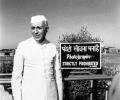
'His contributions in setting up transparent precedents of governance are still basically intact despite the cynicism of several of his successors,' notes Jamini Bhagwati.

India's freedom, its rambling but working Constitution, its parliamentary democracy, its lumbering administrative machinery all have many a father, but its greatest claim to fame, especially today, that of being a modern state, is due to but one person: Its first and longest-serving prime minister, Nehru, says Shreekant Sambrani.

If indeed the issues involved between the government and RBI are of immense public interest, why not make public the arguments of both the government and the RBI, irrespective of the outcome of the process, says Tamal Bandyopadhyay.However, the Act is silent on what happens if the governor's views differ from that of the government. If Patel does not want to budge from his stance the government can either see merit in the Governor's arguments and decide against going ahead with its plan or overrule him. My guess is that the issues raised by the government need to be sorted out not at the November 19 board meeting but between the Governor and the government, says Tamal Bandyopadhyay.

The NDA candidate tells the Election Commission that the Maoists plan to kidnap him.

The Tata empire turns 150 this year. R Gopalakrishnan, former director, Tata Sons Ltd, imagines a conversation among the group's founder Jamsetji, his son Dorabji, his successor, Nowroji Saklatwala, and his successor, J R D Tata.
 © 2026 Rediff.com - Investor Information - Advertise with us - Disclaimer - Privacy Policy - Sitemap - Feedback - About us - Terms of use - Grievances