
The medium range nuclear capable Agni-II missile was on Sunday successfully test-fired with a strike range of more than 2,000 km from the WheelerIsland off Odisha coast.

India has tested a 1,000 kg indigenously-developed glide bomb, which successfully hit a target 100 km away, in the Bay of Bengal off the Odisha coast, making the country self-reliant in guided precision bombs.
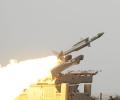
The missile targeted a floating object supported by the pilot-less target aircraft 'Lakshya', defence officials said.

It was the third user trial in the Agni-III series carried out to establish the repeatability of the missile's performance.

India on Monday test-fired its nuclear-capable Agni-III ballistic missile with a strike range of more than 3,000 km as part of a user trial by the Army from Wheeler Island off Odisha coast, defence sources said.

Describing the launch of the sophisticated missile as a complete success, ITR Director M V K V Prasad said all the mission parameters were met during the trial. "The missile was randomly chosen from the production stock and the launch activities were carried out by the specially formed Strategic Force Command and monitored by scientists of Defence Research and Development Organisation as part of training exercise," sources said.

India on Tuesday successfully test-fired for the second time in two days its indigenously developed nuclear-capable Prithvi-II missile, which has a strike range of 350 km, from a test range at Chandipur.

The indigenously made Agni V missile was test-fired from off the Odisha coast.

An Indo-French proposed joint venture expected to be worth around Rs 30,000 crore to develop short range air defence missiles seems to have run into rough weather as Indian Air Force feels that its requirements could be met by indigenous Akash surface-to-air missile weapon system.
 © 2026 Rediff.com - Advertise with us - Disclaimer - Privacy Policy - Sitemap - Feedback - About us - Terms of use - Grievances