
'This strike has certainly enhanced your image.' 'Otherwise, people would have called you a damp squib, capable of doing nothing except talking big.'
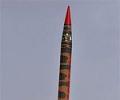
Officials said the launch of the Hatf-IV, also known as the Shaheen-1, would strengthen the country's deterrence capabilities "manifold".

Pakistan on Monday test-fired the nuclear-capable Hatf-II short range surface-to-surface ballistic missile that can hit targets in India as part of the process of validating its land-based missile systems.

The test of the Hatf-II or Abdali short range surface-to-surface ballistic missile was part of the "process of validation of land-based ballistic missile systems", the military said in a statement.

As the test was conducted, a top Pakistani military official said the country had developed a "strong nuclear deterrence capability" and was fully capable of thwarting any aggression.

Pakistan on Monday successful test fired the short-range surface-to-surface Hatf IX missile.
"A major additional feature of Thursday's test was the effective employment of the National Command Authority's fully automated Strategic Command and Control Support System," the statement said.
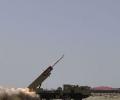
The military described the test of the "indigenously developed short range, surface-to-surface multi-tube missile Hatf-IX" or Nasr as successful.
The indigenously developed low-flying stealth design missile, which can carry a nuclear or a conventional warhead, was tested at an undisclosed location.
The missile tested today was 'an improved version of Shaheen-1 with improvements in range and technical parameters'. The military did not specify the range of the missile though the original version of the Hatf-4 had a reach of 750 km. The missile, capable of carrying nuclear and conventional warheads, can reach targets deep within India
The test of the Hatf-VIII or Raad missile, which has a range of 350 kilometres, was part of a 'continuing process of validating the design parameters of the weapon system', said a statement from the military. The statement did not say where the missile was tested. Pakistan has conducted a series of missile tests in the past few months. The test of the Raad came a day after India successfully launched ballistic missile Agni-III which has a range of 3,500 km.

"We estimate that Pakistan now has a nuclear weapons stockpile of approximately 170 warheads. The US Defense Intelligence Agency projected in 1999 that Pakistan would have 60 to 80 warheads by 2020, but several new weapon systems have been fielded and developed since then, which leads us to a higher estimate," the Nuclear Notebook column published in the Bulletin of the Atomic Scientists on September 11 said.
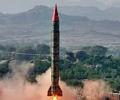
Pakistan on Wednesday tested the Hatf-V nuclear-capable ballistic missile with a range of 1,300 km, with the military saying that the launch was aimed at strengthening the country's deterrence capability.
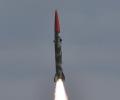
Pakistan on Tuesday successfully test-fired a short-range surface-to-surface ballistic missile Hatf III (Ghaznavi), capable of carrying nuclear and conventional warheads to a range of 290 kilometres, that could cover parts of India.

In the confrontation in Doklam, where Indian and Chinese soldiers were lined up eyeball-to-eyeball, senior Indian commanders recount they could sense the uncertainty in the Chinese. While Indian soldiers had to be restrained from pushing the Chinese troops back, our chief interpreter heard the Chinese officers threatening to open fire on PLA soldiers who wavered or withdrew, reveals Ajai Shukla.
This was the third launch of a ballistic missile in as many weeks.
The missile is a new version of an existing nuclear capable missile.
Pakistan on Friday test fired nuclear-capable Hatf-7 cruise missile with a range of 700 km that can hit targets in India. The test of the "indigenously developed multi-tube" cruise missile system was successful, said a statement issued by the military. The Hatf-7 or Babur missile has stealth capabilities and can carry nuclear and conventional warheads, the military said. The test was witnessed by Chairman Joint Chief of Staff Committee Khalid Shameem Wyne.

Pakistan on Monday successfully test-fired a nuclear capable ballistic missile with a range of 900 kilometers, days after testing a similar missile capable of hitting targets as far as 1,500 kilometers, bringing many Indian cities under its range.
This was the second missile test carried out by AFSC this month.
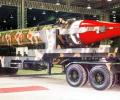
For the world and India, one of the most enduring challenges of the times is for Pakistan's nukes to be neutralised, before they are ever used by the State, their sponsored non-State actors or any rogue elements from the many terror tanzeems dotting Pakistan's unstable landscape, says Lieutenant General Kamal Davar (retd).
Pakistan on Thursday test-fired its 1,300 km range nuclear-capable ballistic missile Hatf V, a day after it reached an agreement with India on nuclear risk reduction.
"We are also enough nuclear capable," Defence Minister A K Antony said.
Hatf IV is a nuclear capable missile.

Pakistan has a nuclear weapon stockpile of 110 to 130 warheads, a rise from an estimated 90 to 110 in 2011, a US think-tank said on Wednesday.
Nuclear-tipped missiles don't give security, says Praful Bidwai
Pakistan on Tuesday successfully test fired the nuclear-capable Hatf-VII cruise missile with a range of 700 km, the latest in a series of tests of missiles that can hit targets deep within India.
Pakistan on Tuesday test-fired a newly developed short-range surface-to-surface missile capable of carrying a nuclear warhead, the military said. The Hatf-9 missile, with a range of 60 km, can "carry nuclear warheads of appropriate yield with high accuracy," the military said in a statement. The "multi-tube ballistic missile" system had been developed to add "deterrence value to Pakistan's strategic weapons development programme at shorter ranges," it said.

The test, conducted at an undisclosed location, was witnessed by the Joint Chiefs of Staff Committee Chairman Gen Shamim Hyder Wyyne.
Pakistan on Tuesday fired the nuclear-capable Ghauri ballistic missile with a range of 1,300 kilometres that can hit targets in India.
Pakistan on Saturday test-fired a long-range ballistic missile capable of carrying nuclear and conventional warheads and hitting targets within India. The test-firing of the Shaheen-II or Hatf-VI surface-to-surface ballistic missile the first missile test since Pakistan's new government assumed office last month was witnessed by Prime Minister Yousuf Raza Gillani.
The Babur or Hatf VII missile can carry conventional as well as non-conventional nuclear warheads.
Pakistan on Friday test-fired the nuclear-capable, medium-range 'Ghauri' missile.
The short range ballistic missile has a range of 290 km.
Pakistan on Friday test-fired a 700-km-range nuclear-capable ballistic missile which could hit targets inside India as its Army Chief dismissed as an "irresponsible alarm" concerns about the country's atomic weapons falling into the hands of terrorists.
The nuclear capable Haft-II Abdali missile has a range of 200 km.
Pakistan on Monday test-fired the Shaheen-II long-range ballistic missile for the second time in three days, which can carry nuclear and conventional warheads and hit targets within India. The Shaheen-II or Hatf-VI surface-to-surface ballistic missile, which has a range of 2,000 km, was launched for the first time during a field training exercise by the army's Strategic Forces Command, the military said in a statement.
The missile also known as Hataf VI has a range of 200 km and can carry all types of warheads, state-run PTV reported.
 © 2026 Rediff.com - Investor Information - Advertise with us - Disclaimer - Privacy Policy - Sitemap - Feedback - About us - Terms of use - Grievances