
Sitharaman took charge of the Finance Ministry on May 31, 2019, and has steered the economy through the COVID-19 pandemic and geopolitical turmoil, making India the fastest-growing major economy in the world.

Finance Minister Nirmala Sitharaman on Sunday makes history as she presents a record ninth consecutive Budget that is expected to unveil measures to sustain growth momentum, maintain fiscal discipline, and contain reforms that could buffer the economy from global trade frictions, including US tariffs.
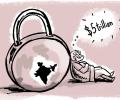
India will become the world's third largest economy by 2026 as its GDP in current dollar terms will reach $5 trillion in that year and further rise to $5.5 trillion in 2027, former Niti Aayog vice chairman Arvind Panagariya said on Friday. Delivering the 18th C D Deshmukh Memorial Lecture titled 'India at 125: Reclaiming the Lost Glory and Returning the Global Economy to the Old Normal', he said it is unlikely that GDP in current dollar terms of either Germany or Japan will cross $5 trillion-mark in the coming three years. Japan will have to sustain a growth rate of 3.5 per cent in current dollar terms to reach $5.03 trillion in 2027 from its 2022 level of $4.2 trillion, he said.

Finance Minister Nirmala Sitharaman will present her sixth straight Budget ahead of the Parliamentary elections, matching the record of former Prime Minister Morarji Desai. Sitharaman in her pre-election Budget, which technically is a vote on account and popularly termed an interim Budget, will seek Parliament's nod for a grant in advance to meet the central government's essential expenditure for the first four months of the new fiscal year that starts in April. A new government elected after the April/May general elections will present the full Budget, likely in July.
Javed Akhtar says he has to write Hindi dialogues in the Roman script for the new generation of actors today because 'they can't read anything else'.

Uddhav Thackeray and his followers have the option to stop riding a tiger and commence work around a more meaningful and enduring political ideology. It is an option Eknath Shinde's side may not have, supported as they were by the BJP, to maintain continuity of the old Sena, argues Shyam G Menon.
India is much better placed today to deal with future waves of the pandemic relative to the first wave, RBI deputy governor Michael Patra said.

The speed at which he led the central bank in different areas -- ranging from internal reorganisation to inflation fighting, stabilising the currency, taking on rogue corporations, cleaning up bank balance sheets, and opening the sector -- makes one believe that Rajan knew he had only three years to do his job. A fascinating excerpt from Tamal Bandyopadhyay's MUST-READ Roller Coaster: An Affair with Banking.

Former Union Finance Minister C D Deshmukh was the only Marathi leader in New Delhi with self-respect, Shiv Sena chief Bal Thackeray has said.

IMF's Chief Economist Gita Gopinath on Thursday said it would be damaging for India to start tightening policy support in the midst of the COVID-19 pandemic and also stressed on reducing wasteful expenditures in the upcoming Budget. Delivering NCAER's '9th C D Deshmukh Lecture' virtually, Gopinath said there is scope for the Indian government to provide more direct support to people.

This will help expand the distribution channels, said Subhash Chandra Khuntia, chairman of the insurance regulatory and development authority of India.
Shiv Sena chief Bal Thackeray, who has issued a diktat to his partymen to greet Rahul Gandhi with black flags for his "Mumbai for all Indians" remark, on Friday attacked Marathi ministers at the Centre for "not protesting Rahul's anti-Mumbai statement".
Union Finance Minister Pranab Mukherjee on Friday presented his fifth budget in Parliament on Friday but Morarji Desai holds the record of doing so 10 times.

This is Jaitley's first overseas visit since his kidney ailment was confirmed in April last year.
Take the Rediff Biz Quiz and find out how much you know about the governors of the Reserve Bank of India.

'An era of fiscal pessimism is setting in, which, if not countered intellectually, is going to have the same effect as export pessimism has had,' notes T C A Srinivasa Raghavan.

Tension between the government, specially the finance ministry, and RBI is as old as the central bank itself.
It was better to first build a single-rate GST with a low rate, achieve full mastery of this, and then consider more complex possibilities such as high rates and multiple rates.

'There was no need for opting for such an elaborately and expensively organised spectacle,' says B S Raghavan, the distinguished civil servant.

If indeed the issues involved between the government and RBI are of immense public interest, why not make public the arguments of both the government and the RBI, irrespective of the outcome of the process, says Tamal Bandyopadhyay.However, the Act is silent on what happens if the governor's views differ from that of the government. If Patel does not want to budge from his stance the government can either see merit in the Governor's arguments and decide against going ahead with its plan or overrule him. My guess is that the issues raised by the government need to be sorted out not at the November 19 board meeting but between the Governor and the government, says Tamal Bandyopadhyay.

'Galbraith had a powerful ally in Washington -- not as blunt and direct as the ambassador -- but committed to see Krishna Menon go.' 'This was President Kennedy himself.'

India has gone through this exercise twice, and here's what happened then.

With a sole mandate of inflation targeting, RBI wears many hats.
 © 2026 Rediff.com - Advertise with us - Disclaimer - Privacy Policy - Sitemap - Feedback - About us - Terms of use - Grievances