
It is hardly surprising that the Reserve Bank of India's decision to revive a plan, first mooted in 2007, to introduce credit default swaps (CDSs) in India has met with considerable apprehension.

Manic Monday, Tragic Tuesday, Black Friday. We are not short of monikers to describe the current financial market meltdown that has dragged the world into recession. But everyone is suffering from a short-to-medium term memory loss and a failure to learn from past mistakes.

The Insurance Regulatory and Development Authority of India's (Irdai's) decision to allow insurers to hedge risks through equity derivatives will help them manage market volatility and protect policyholder returns. However, this move is unlikely to alter their investment strategies.
European Commission charges follow a two-year investigation.

The decision to allow a product or not, should depend on its economic value addition and not on its mere availability and wide usage in the "sophisticated" markets.
India ranks as the 22nd riskiest sovereign country, seen as most likely to default on debt and unable to honour its debt obligations.
In its draft guidelines issued on Wednesday, the Reserve Bank of India has allowed banks and primary dealers to act as market makers of credit default swaps.

Finance Minister Nirmala Sitharaman on Friday announced a slew of measures to boost economic growth and address distress in various sectors
Reserve Bank of India said on Thursday that banks would be allowed to use credit derivatives to manage risks relating to lending, including buying protection on loans and investments, to reduce risk.

India allows foreign investors to buy upto $81 bn

The Reserve Bank of India (RBI) has increased its gold purchases, as part of its foreign exchange (forex) reserves. In the first half (H1) of calendar year 2021 (CY21), the addition of gold to India's forex reserves has been the highest - on a half-yearly basis -at 29 tonnes. Now, the RBI's gold holding - as a proportion of its forex reserves - has for the first time crossed 700 tonnes.
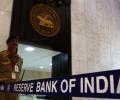
The new hire, Gangadhar Darbha, joined as a consultant
Global private equity major KKR has ranked India second among the emerging markets on external risks, citing the high fiscal and current account deficits.

The government planned to borrow 10-15 per cent of the total borrowing offshore. That works out to at least Rs 71,000 crore, or about $10.4 billion at Friday's exchange rate.


There's a long way to go before human beings are replaced by machines -- in banks at least.

'If such inflows materialise, what will be the effect on the rupee's value -- and therefore on exports growth, the only sustainable path to recovery?', asks Mihir S Sharma.

India plans to launch trading of government bond futures within the next two months as part of efforts to deepen its financial markets, according to several sources involved in the discussions with the central bank.

Although there are serious risks facing the US economy in the coming year, there is also a good chance that growth will be substantially stronger than it has been since before the recession began.
.jpg)
The rupee tumbled past 63.00 to the dollar, down about 2 per cent on the day and breaching the previous low of 62.03 hit on Friday despite a spate of measures in recent weeks by the central bank and government to defend it.

'The 'Off-with-Rajan's-head' brigade bases its arguments on mistaken beliefs, erroneous causalities, and even downright prejudice.'
 © 2026 Rediff.com - Advertise with us - Disclaimer - Privacy Policy - Sitemap - Feedback - About us - Terms of use - Grievances