
The Centre has supported the restriction on women of menstruating age entering Kerala's Sabarimala temple, arguing that the Supreme Court's 2018 judgement assumes male superiority.

The Supreme Court of India has dismissed the use of information from 'WhatsApp University' as evidence in a case concerning religious freedom and discrimination against women at religious sites, including the Sabarimala Temple.

The Supreme Court questioned the chief priest of the Sabarimala Ayyappa Temple regarding the constitutionality of preventing believers from touching the deity, during hearings on discrimination against women at religious sites.
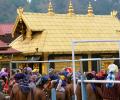
The Travancore Devaswom Board (TDB), managing the Sabarimala temple, argued in the Supreme Court that religious beliefs should be judged subjectively by the community, as the court hears petitions related to discrimination against women at religious places.
The Supreme Court is hearing petitions related to discrimination against women at religious places, including the Sabarimala temple. A nine-judge bench is examining the scope of religious freedom and the exclusion of women based on age and menstrual status.
The Centre has asked the Supreme Court to reconsider its judgements decriminalising adultery and same-sex relationships, arguing they were based on a subjective application of 'constitutional morality'.

The Supreme Court of India has asserted its jurisdiction to determine what constitutes a superstitious practice within a religion, during a hearing on petitions related to discrimination against women at religious sites.
The Supreme Court of India questioned the Centre regarding the eligibility of non-devotees to challenge the customs of the Sabarimala temple in Kerala, during a hearing on religious freedom and discrimination against women at religious sites.
A nine-judge Supreme Court bench has commenced hearing on petitions related to discrimination against women at religious places, including the Sabarimala temple, and the scope of religious freedom across faiths.

The Centre has informed the Supreme Court that the restriction on women of menstruating age entering Kerala's Sabarimala temple is a matter of religious faith and denominational autonomy, falling outside the purview of judicial review. Solicitor General Tushar Mehta argued that courts should not apply 'secular standards of reason' to religious practices.

Harish Rana, the first person in India to be granted passive euthanasia, has died at AIIMS-Delhi after being in a coma for over 13 years. His case led to a landmark Supreme Court judgment allowing passive euthanasia and sparked discussions about the right to die with dignity in India.

The Supreme Court of India has emphasised the importance of open access to all temples and 'maths' for everyone, warning that excluding any denomination would negatively impact Hinduism and divide society. This statement was made during hearings on petitions related to discrimination against women at religious sites and the scope of religious freedom.
The Supreme Court of India has granted permission for passive euthanasia for a 32-year-old man who has been in a coma for over 12 years, authorising the withdrawal of his artificial life support.

Harish Rana, the first person in India to be granted passive euthanasia, has died at AIIMS-Delhi after being in a coma for over 13 years. His case led to a landmark Supreme Court judgment allowing passive euthanasia and sparked discussions about the right to die with dignity in India.

Chief Justice of India Surya Kant has recused himself from hearing petitions challenging the constitutional validity of the 2023 law regarding the appointment of election commissioners, citing a potential conflict of interest.

'My argument was straightforward: If the Constitution allows this reservation and SC/ST and OBC candidates are already getting reservation in private institutions -- backed by Constitution Bench orders -- then not extending the same to EWS candidates directly violates the 103rd Amendment and Article 14, which guarantees the right to equality.'
The Supreme Court has agreed to list for final hearing the pleas challenging the validity of certain provisions of the Places of Worship (Special Provisions) Act, 1991.

The Supreme Court has announced that a nine-judge bench will begin final hearings on petitions related to discrimination against women in religions, including the Sabarimala Temple case, starting April 7.

Kerala Chief Minister Pinarayi Vijayan accused Governor Rajendra Vishwanath Arlekar of omitting portions of the state cabinet-approved policy address, specifically criticizing the Union Government's fiscal policies and the pending status of state bills.
The Sabarimala temple women's entry issue has resurfaced in Kerala, leading to a political debate between the ruling CPI(M) and the opposition Congress, as the Supreme Court is scheduled to consider review petitions related to its 2018 verdict.
The father had approached the Supreme Court in 2024 seeking passive euthanasia for his son. The court had then declined to grant relief.
The Supreme Court of India has ruled that the actions of governors and the President in granting, withholding, or reserving assent to bills are not subject to judicial review, emphasizing the separation of powers.
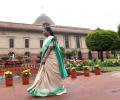
The Supreme Court of India has ruled that a governor has discretion under Article 200 to refer a state bill to the President or return it to the legislature, and is not bound by the advice of the council of ministers. The court clarified that a governor cannot simply withhold a bill.
Supreme Court judge Surya Kant expressed his reluctance to order urgent listing of cases on the same day, except in extreme circumstances, highlighting the workload and sleep deprivation of judges.
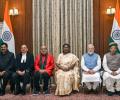
The Supreme Court's opinion on the presidential reference can impact on any number of cases if and when governors, if not the President, take a literary view of the Supreme Court's 'ppinion' on their 'discretionary powers' without reference to the rider on 'reasonable time', points out N Sathiya Moorthy.
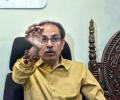
The Supreme Court has scheduled a hearing for January 21 on pleas challenging the Election Commission's decision to allot the 'bow and arrow' symbol to the Eknath Shinde faction of the Shiv Sena. The court will also hear arguments on a similar dispute concerning the Nationalist Congress Party (NCP) on January 22.
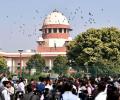
The Supreme Court of India has ruled that no timelines can be imposed on governors and the president to grant assent to bills passed by state assemblies, clarifying the extent of their powers under Article 200 of the Constitution.

The Supreme Court of India has expressed concern over a growing trend of litigants and lawyers making scandalous allegations against judges when court rulings are unfavorable. The court cautioned against such conduct, emphasizing the duty of lawyers to uphold the integrity of the judicial system.

The Supreme Court on Thursday held that the Governor can reserve a bill for consideration of the President even in the second instance, when the bill is again sent by the state assembly to him whether in its amended or unamended form.

A bench comprising Chief Justice D Y Chandrachud and justices P S Narasimha and Manoj Misra said the detailed order referring the case to a larger bench will be uploaded on the apex court website later in the day.

The Madhya Pradesh high court has dismissed a petition filed by Shah Bano Begum's daughter seeking to stop the release of the Hindi film Haq, inspired by her mother's famous legal battle, holding that a person's right to reputation or privacy is not heritable.

The Madhya Pradesh High Court dismissed a petition seeking a stay on the release of the Hindi film 'Haq', which is inspired by the life and legal struggle of Shah Bano Begum. The court found the petition devoid of merit, clearing the way for the film's release.

'Repeated adjournments are one of the largest contributors to lengthy litigation cycles.'
The Supreme Court Monday hinted that it was contemplating referring to a constitution bench for adjudication the Delhi government's petition against the Centre's recent ordinance on control of services.
The Supreme Court on Monday referred to a five-judge Constitution bench a suit filed by the Kerala government raising the issue of ceiling on net borrowing.
A five-judge constitution bench of the Supreme Court is scheduled to commence hearing from October 31 a batch of pleas challenging the validity of the electoral bond scheme for political funding of parties.
The Supreme Court of India has stayed several key provisions of the Waqf (Amendment) Act, 2025, citing potential violations of the Constitution. The court emphasized that laws should only be stayed in rare cases where provisions are manifestly unconstitutional or violate fundamental rights.
In a first, the Supreme Court on Tuesday began live-streaming its Constitution bench proceedings.

The Supreme Court on Tuesday took note of the Eknath Shinde faction's claim about the Uddhav Thackeray camp stalling the proceedings before the poll panel where the former's application staking claim over the Shiv Sena and its symbol is pending, and said it will consider listing its plea before a Constitution bench.
Calling itself the "custodian of the Constitution", the Supreme Court on Thursday asked if it could "sit idle" if a constitutional functionary like governor failed to discharge duties, as it reserved its verdict on the presidential reference on grant of assent to bills.
 © 2026 Rediff.com - Advertise with us - Disclaimer - Privacy Policy - Sitemap - Feedback - About us - Terms of use - Grievances