
One hundred years ago, a group of 10 revolutionaries carried out an operation that shook the British Empire.
Utkarsh Mishra revisits the 'Kakori Conspiracy Case', a turning point in the armed struggle for independence.
When Mahatma Gandhi launched the non-cooperation movement in 1920, to protest against the Rowlatt Act and the Jallianwala Bagh massacre, a number of old revolutionaries participated.
Even those who had no faith in Gandhi's movement joined it, suspending all revolutionary activities. However, the suspension of the movement in 1922 was followed by their revival, mostly in Bengal and the United Provinces (now Uttar Pradesh).
Soon, the revolutionaries in both these provinces joined ranks to form the Hindustan Republican Association in 1924, with an aim to establish the 'Federated Republic of the United States of India through an armed revolution'.
While the organisation was still nascent, 10 of its members executed an operation that was to etch their names in history forever.
On August 9, 1925, exactly 100 years ago, they stopped a train from Shahjahanpur to Lucknow at Kakori and took away trunks of money that were being transferred to the British government treasury.
The primary aim of their action was to obtain money to buy weapons that had 'arrived on a ship'. But they also wanted to end the perpetual scarcity of funds for organisational work.
However, all of them were arrested in a matter of weeks, which proved to be a big setback for the movement.
Nonetheless, their sacrifice inspired a number of young revolutionaries -- including Bhagat Singh -- who would go on to earn their own places in the history of the freedom struggle.
The Plan
Most revolutionary leaders were behind bars during the Great War. Those who evaded arrest, like Ramprasad Bismil, went into exile.
After the Montagu-Chelmsford reforms of 1919, a general amnesty was granted to political prisoners, even to those who were detained under the Defence of India Act.
Thus, prominent revolutionaries like Shachindra Nath Sanyal and Jogesh Chandra Chatterjee were released from prison, while Bismil returned from exile.
Revolutionary activities once again started gaining momentum, mainly in Bengal, Punjab and UP. In 1924, the Hindustan Republican Association was born.
The party was later renamed by Bhagat Singh as the Hindustan Socialist Republican Association in 1928.
In UP, the party centres were Agra, Allahabad, Benares (Varanasi), Cawnpore (Kanpur), Lucknow, Saharanpur and Shahjahanpur.
Bismil, Ashfaqullah Khan, Thakur Roshan Singh and others operated from Shahjahanpur. Sanyal, Rajendranath Lahiri, Shachindra Nath Bakshi, Manmath Nath Gupta and Rabindra Mohan Kar were based in Benares.
Sanyal and Bismil wanted to 'flood the country' with revolutionary literature. They wanted to publish multiple copies of the party's constitution, called the 'Yellow Paper', and its manifesto 'Revolutionary'. However, money was hard to come by.
Initially, the members contributed their own resources, but it was far from adequate. Members had to raid a few villages for money. While many had reservations against operating like bandits, the spoils also proved inadequate for revolutionary work.
The revolutionaries had to struggle for every single penny to carry out their activities. Wearing rags and eating only one meal a day became routine.
Bismil recounts in his autobiography that he once saw government money being transported in trunks on a train and decided to rob one such train to raise funds.
But Khan advised against this plan. He asserted that it would be a direct challenge to the government and the organisation was not yet strong enough to withstand the crackdown that this action would provoke.
As per Manmath Nath Gupta, a few members wanted to execute this plan precisely for this reason, that it would be a direct challenge to the government. Their voice prevailed.
The Action
The 8-down passenger train travelled from Saharanpur to Lucknow.
On August 9, 1925, it was carrying railway cash bags, apart from some additional cash that was guarded by armed police.
Ten HRA members -- Bismil, Khan, Lahiri, Gupta, Bakshi, Chandra Shekhar Azad, Keshab Chakravarty, Mukundi Lal, Murari Lal Khanna, and Banwari Lal -- boarded the train at Shahjahanpur in the evening.
Khan, Lahiri and Bakshi got into a second-class compartment; the others were travelling third class. They had four Mauser pistols with 50 cartridges each.
As the train left Kakori for Alamnagar, the three in the second-class compartment pulled the chain to stop the train.
Here's how Gupta describes the incident in his book History of the Indian Revolutionary Movement.
'The guard went towards the second-class compartment. There was still a little daylight left. The guard was pinned down and four revolutionaries kept watch on the railway track. The rest rushed for the cash bags and pushed one huge box out of the guard’s compartment. They had difficulty opening the box. Ashfaqulla, one of the four on guard duty, saw the situation and gave his pistol to Manmath Nath, who rushed to take charge of the hammer. He was the strongest of the lot. The cash bags were removed and tied up in a bedsheet.
'Just then, they saw a train from the Lucknow side approaching. Everybody held their breath. But the train sped past. The job was finished in record time, and the revolutionaries rushed into the bushes. From there, they walked to Lucknow. The money and the arms were taken to safe places. One by one, all of them went to their respective towns.'
The revolutionaries kept shouting at the passengers to stay inside, telling them they were there to take government money and would not harm them. To prevent the armed guards from retaliating, they kept firing in the air.
However, a middle-aged man got down to reach his wife in the female compartment and was hit by a stray bullet. He was the only casualty of the incident.
The looted cash bags contained about Rs 8,000.
The Arrests
As the revolutionaries had anticipated, the action provoked swift and strong response from the government. The CID was pressed into action.
Three currency notes looted from the train were recovered in Shahjahanpur and the police immediately made a connection to Bismil.
They also came to know that Bismil was not in town from August 8 to 19.
To confirm his involvement, they traced a student from the Government High School who had received letters for Bismil.
Intercepting those letters, the police found addresses for all his associates.
Based on this information and other intelligence, the police arrested 40 people in the province on September 26, including Bismil, Gupta, Thakur Roshan Singh and others.
Sanyal, Chatterjee and Lahiri were arrested earlier in Calcutta (now Kolkata).
Ashfaqullah and Bakshi were arrested later and were tried in a separate case.
Of the main participants, only Azad escaped arrest.
The Trial
Of the arrested persons, about half were let off because their involvement could not be established. A few others turned government approvers, notably Banarsi Lal and Banwari Lal. Their confessions helped the police collect crucial evidence that would have been very difficult for them otherwise.
The trial against 21 accused commenced in the court of special magistrate. In his memoirs, Chatterjee recalls that the magistrate was a biased and shrewd person who left no stone unturned in getting the accused convicted even when the evidence against many of them was scanty.
Before the trial began, Congress leader Motilal Nehru had requested noted barrister Jagat Narain Mulla to defend the accused. Mulla told him that he was ready but quoted a very high fee.
Nehru then helped form a defence committee consisting of Gobind Ballabh Pant, R F Bahadurji, Mohanlal Saxena and Chandra Bhanu Gupta.
Nehru subsequently learned that Mulla had accepted the government's offer to argue for the prosecution. 'His nationalism vanished in thin air before his lust for money,' writes Chatterjee, adding, 'Pandit Motilal resented this so much that he ceased to have anything to do with his family anymore'.
The case was called the 'Kakori conspiracy case'. It was not conducted simply as a dacoity case, but as a conspiracy case because it was linked with 'the entire secret revolutionary activities in the whole of northern India between 1923 and 1930'.
During the trial, the accused were also not given proper treatment as political prisoners. They decided to protest against it by going on a hunger strike.
While the hunger strike of Bhagat Singh and his comrades during the Lahore Conspiracy Case is famous, the hunger strike that the Kakori accused undertook in the Lucknow jail is relatively little known.
The Verdict
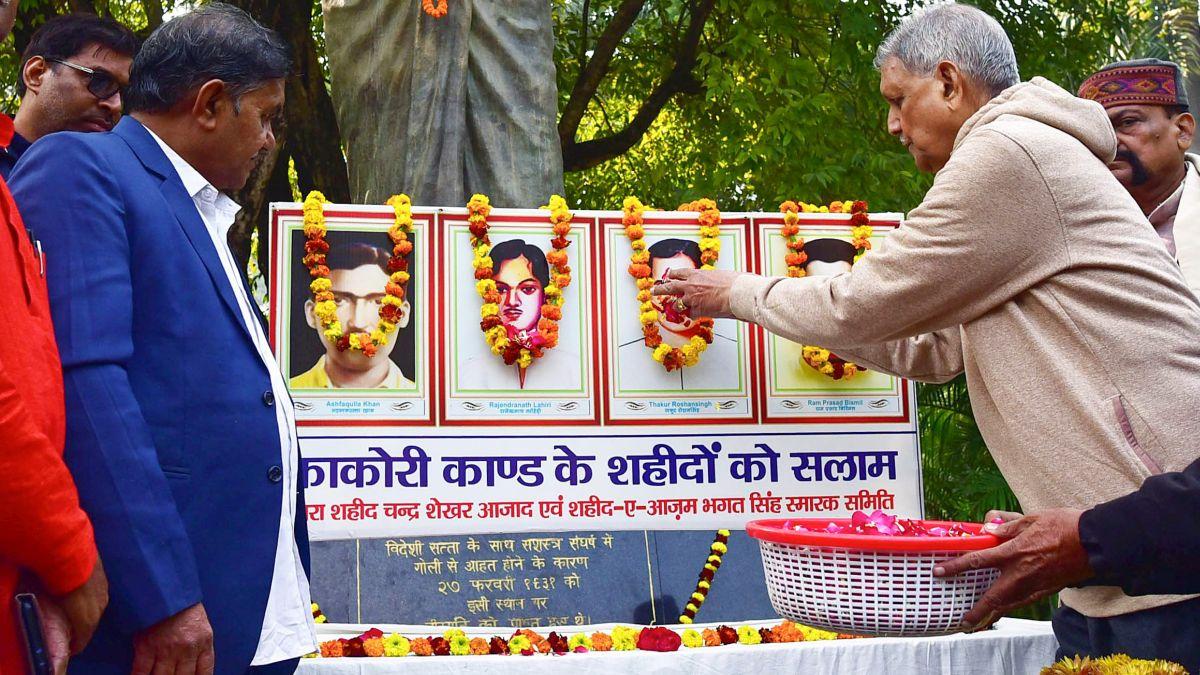
The trial went on for 18 months. Bismil, Lahiri, Ashfaqullah Khan, and Roshan Singh were sentenced to death.
Sanyal and Bakshi were sentenced to life imprisonment. Gupta got a 14-year sentence while Chatterjee, Mukundi Lal, Govind Charan Kar, Raj Kumar Sinha and Ram Krishna Khatri were sentenced to 10 years of imprisonment.
Others were sentenced to prison terms ranging from seven years to five years.
There were widespread protests against the death sentences of the four revolutionaries.
Petitions from members of the Central Legislature to commute the sentences were rejected by the Viceroy. Clemency appeals to the Privy Council were also rejected. However, their execution was postponed twice.
A final mercy appeal to the King-Emperor was sent. But the government had already decided to hang them.
Lahiri was hanged on December 17, 1927, in Gonda Jail.
Bismil, Khan and Roshan Singh were hanged on December 19, 1927. Bismil was lodged in Gorakhpur Jail, while Khan and Roshan Singh were in Allahabad Jail.
Bismil's last words on the gallows were: 'I wish the downfall of the British Empire.'
Looking back at the Kakori case, Gupta writes in his memoirs that perhaps Ashfaqullah Khan was right. 'If we had waited longer to act on our plans, perhaps our group would not have been uprooted so soon.'
Chatterjee, on the other hand, writes in his memoirs that the case had a 'very great significance in the revolutionary activities of northern India'.







 © 2025