
On his 200th birth anniversary, Utkarsh Mishra/Rediff traces the life, thought, and legacy of Dadabhai Naoroji, the Grand Old Man of India.
Several years ago, Congress leader Shashi Tharoor's speech at the Oxford Union, supporting the argument that Britain owes reparations to its former colonies, went viral on the Internet. The 15 minute speech was packed with data and numbers giving the magnitude of economic exploitation of India by the Empire.
Although Tharoor's speech got the appreciation it deserved for its eloquence, it was not the first time that Britain was told that it owes reparations to India for bleeding the country dry during 200 years of colonial rule.
A century-and-a-half earlier, an Indian leader did the same in the House of Commons, the British parliament.
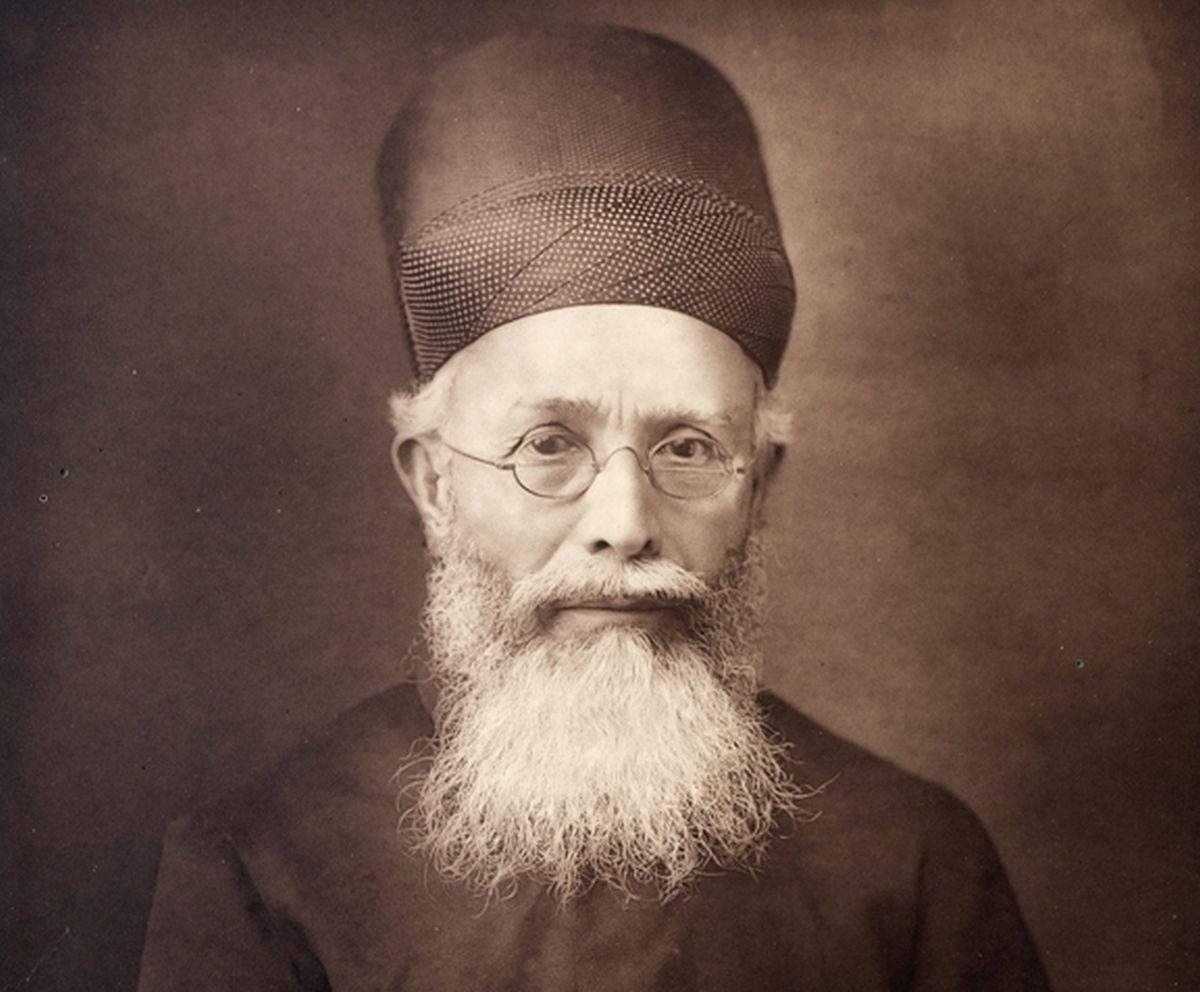
He was the 'Grand Old Man of India,' the man whom Gandhi referred to as 'Mahatma' and 'Father of the Nation.' Who was admired not only by Gandhi but also by Mohammed Ali Jinnah, and was the only acceptable leader to both the moderate and extremist factions of the Indian National Congress.
Dadabhai Naoroji was born on September 4, 1825, in a humble Zoroastrian family. Although his birthplace is widely believed to be Navsari in Gujarat -- from where his family hailed -- his most recent (and most authoritative) biographer Dinyar Patel notes Bombay as his birthplace.
After completing his education at Elphinstone College, Naoroji grew from a religious reformer to a provincial and then a national leader who co-founded the Indian National Congress and went on to be the representative of India in the world by getting elected to the British parliament in 1892.
His writings were not only admired in India, Europe, and other British colonies, but also reached the United States and South America.
Naoroji was the first to give a call for swaraj (self-rule) for India, and advocated for Indianisation of administration and bureaucracy to 'stop the drain of wealth' from India to Britain.
Even in retirement at Bombay's Versova, Naoroji lived a life of study and vigorous correspondence, still immersed in Blue Books and official reports. Though physically withdrawn, he remained intellectually active -- guiding Congress leaders and urging constitutional reform.
He never stopped reminding both Indians and British officials that only self-government could end India's poverty, thus becoming 'the most significant Indian nationalist leader before Gandhi.'
A Religious Reformer
In the early 1850s, Naoroji emerged as a reformer in Bombay's Parsi community. He challenged conservative leadership and pushed for social change. Through his newspaper Rast Goftar and the Rahanumae Mazdayasnan Sabha, he aimed to simplify Zoroastrian practices and modernise the Panchayet.
He supported women's rights and education, encouraging fathers to send their daughters to school.
He also advocated for equality in daily life, like men and women dining together. His biographer Dinyar Patel writes that these reform efforts, influenced by his education at Elphinstone College, marked the start of his lifelong commitment to progressive change.
A Man of Many Firsts
In October 1852, Naoroji was appointed acting professor of mathematics and natural philosophy at Elphinstone College and became the full professor of mathematics and natural philosophy at the college in 1854, the first-ever Indian to hold this rank at a British-administered institution of higher education.
He left Bombay in June 1855 to help start the first Indian mercantile firm in Great Britain, along with the Camas, a wealthy Parsi business family. He resigned as a partner from Cama & Co in 1858 on 'ethical grounds' and established his own cotton trading company, Dadabhai Naoroji & Co, the next year.
Patel argues that in England, Naoroji's focus expanded from Parsi reform to political issues across India. He faced the harsh realities of imperial exploitation, which ranged from the textile industry to opium trade.
Engaged in Liberal politics, he also recognised how little the British public understood about India. This awareness shaped his role as the country's main spokesperson overseas.
In 1859, he took on the case of Rustamji Hirjibhai Wadia, the first Indian student excluded from the Indian Civil Service examination. The Charter Act of 1853 had just opened the doors of the ICS to Indian candidates. However, a sudden change in the age limit made Wadia ineligible for the exam.
Additionally, an arbitrary rule had blocked Indian students from the Medical Service. Mancherji Byramji Colah was the young man affected in this case; he was kept from competing for the position of assistant surgeon in the Army Medical Department.
Colah was advised to submit a petition to the secretary of state for India, Lord Stanley. He was also told to reach out to the War Office, the House of Lords, and the House of Commons, gathering signatures from several Indian residents in London. The ban was eventually lifted.
In Wadia's case, Naoroji wrote to Lord Stanley himself. He gathered support from British friends like Sir Erskine Perry and John Bright. Through his relentless efforts, he obtained a promise that no future changes to the Civil Service rules would be made without proper public notice.
Along with M H Cama, Naoroji founded the Zoroastrian Trust Funds of Europe in 1861. This was the first Asian religious organisation created in the United Kingdom.
His experiences made him believe that 'the road to Indian political reform went through Westminster as well as Whitehall'. He thus aspired for a seat in the House of Commons, which he eventually won in 1892, the first Indian to be elected to British parliament.
Apart from Gandhi in Durban, South Africa, Jinnah in London, and Lokmanya Tilak and Lala Lajpat Rai in India, Naoroji's victory was hailed by 'British agricultural laborers, Indian villagers, female suffragists, Irish nationalists, and Indian emigrants' in several other countries.
Showing A Mirror to the Raj
Throughout the decades before his election to the House of Commons, Naoroji spared no effort to highlight the economic exploitation of India by the British.
His lectures, speeches and writings during these decades were later published as his magnum opus Poverty and Un-British Rule in India in 1901. It was the result of decades of careful research, during which he developed his famous Drain Theory. This theory claimed that British rule continuously took India's wealth through one-sided transfers, such as salaries, pensions, profits, and revenues. This process enriched Britain while leaving India poor.
The theory highlighted how British rule took wealth from India to England without providing anything in return.
Naoroji outlined five main ways this drain occurred: The large salaries, pensions, and allowances of British officials in India; the profits made by British companies that were sent back to London; the high interest on loans taken in Britain but paid for with Indian revenues; the purchase of British goods and services at inflated prices instead of supporting local industry; and the costs of imperial wars in places like Afghanistan and Persia, which were charged to Indian accounts even though they served British interests.
The effect of this constant outflow of resources was that India, despite its wealth of production, stayed trapped in chronic poverty and frequent famines. Traditional industries fell apart under the surge of British imports, agriculture struggled with heavy taxes, and the lack of capital meant little investment in education, infrastructure, or modern industry.
To strengthen his argument, Naoroji used official statistics to illustrate the decline in national and per capita income. He provided not just an economic critique but also a moral challenge.
He claimed Britain was failing its own stated principles of justice and fair governance by maintaining such an exploitative system that was 'Un-British.'
As his biographer Rustom Pestonji Masani writes, the Revolt of 1857 made Naoroji 'very pessimistic about the future, but the transfer of the administration from the East India Company to the Crown and Queen Victoria's memorable Proclamation, promising equality of treatment to her Indian subjects, buoyed him up.
'That Proclamation became his Bible. He quoted it repeatedly with as much reverence as a Christian divine would have quoted the Scriptures'.
Even in Poverty and Un-British Rule in India, Naoroji acknowledged that British rule had brought some benefits -- notably the abolition of inhuman practices, the spread of English education, and the introduction of liberal political ideals that inspired Indians with aspirations of true citizenship.
However, he maintained that the colonial State functioned primarily to benefit Britain at India's expense and unless the drain was stopped, India could never develop economically.
In his view, the remedy lay in greater Indian participation in governance, fair economic policies, and ultimately self-government.
A Call for Swaraj
Patel writes that Naoroji delivered a speech in Bombay in November 1884, to mark the retirement of the viceroy, Lord Ripon, where he invoked, for the first time in public, the idea of self-government for India.
However, his version of Swaraj, at least initially, was 'specifically under British paramountcy. That is, he sought dominion or commonwealth status within the empire.' Nonetheless, he also questioned how Indians could remain 'loyal' in the face of such gross injustice.
In the late 1880s and early 1890s, Naoroji eagerly entered British politics. His first bid for a seat in parliament from Holborn was unsuccessful, he was later elected from Central Finsbury in 1892.
From this position, he campaigned tirelessly for Indian interests. He called for civil service exams to be held simultaneously in India and England, aimed to reduce the outflow of wealth, and advocated for representative institutions.
Outside parliament, he built a strong coalition of supporters. His efforts showed his deep belief in the fairness of the British people and the power of constitutional methods, despite criticism from sceptics.
However, as per Patel, after his defeat in 1895 and amid famine, plague, and government indifference in India, Naoroji started to shift toward a more radical position. Frustrated with parliament's lack of action, he began to advocate for self-government as India's only hope.
His connections with British socialists and international anti-imperialists influenced this new perspective.
Naoroji began to view Swaraj not just as a political demand but as a moral necessity and a way to make amends for years of economic exploitation.
As president of the Congress in 1906 he made a clear statement, declaring that the nationalist movement's aim should be 'self-government, or Swaraj.' This declaration, coming from the Grand Old Man of India, held great weight. It united moderates and radicals and defined a clear goal for the freedom struggle in the years ahead.
Leaving Britain 'for Good'
Naoroji's first visit to England had been cut short in 1863 by unfounded rumours spread by Cama that he was going to convert to Christianity and marry an English woman. When he went back in 1865, he took with him his wife, children, and mother.
From the 1860s till 1907, Naoroji divided his time between India and Britain.
In October 1907, after months of ill health, Naoroji resolved to return to India 'for good' and left London; he arrived in Bombay on November 7 and began his retirement in Versova. His home turned into a spot for fans and politicians, even as he faced personal loss with the death of his wife in 1909.
In his final years, Naoroji was visited by Gandhi who had just returned from South Africa. Just a year before his death, Naoroji received an honorary doctorate from Bombay University and after the ceremony, he was taken on one final public procession through his beloved city.
He passed away on June 30, 1917, in Bombay.
Patel refers to a conversation R P Masani had with Gandhi years after Naoroji's death. In December 1931, Masani asked Gandhi if the so-called 'mendicant policy,' often mocked by the younger generation, was the right approach for Naoroji's time.
Gandhi answered without hesitation that it had been, adding that if Naoroji were alive then, he would have followed the same path Gandhi had taken in recent years.
This acknowledgment showed the link between Naoroji's constitutionalism and Gandhi's mass struggle. It highlighted how the 'Grand Old Man of India' laid the intellectual and moral foundation for the movement that would eventually bring freedom to the nation.







 © 2025