
Will Mamata's bhasha andolan campaign sway Bengal's bhadralok before the 2026 election in the TMC's favour?

The political temperature in West Bengal is rising, with state elections scheduled for next year.
At the heart of the brewing storm is the Bengali language, as reports of alleged harassment of Bengali-speaking migrant workers surface from various parts of India.
As emotions simmer, the issue has struck a chord in the state where identity politics is at the centre stage for some time.
On July 21, during the annual Martyrs' Day rally held by the ruling Trinamool Congress, Chief Minister Mamata Banerjee announced a bhasha andolan -- a language movement -- invoking memories of the 1952 campaign in East Pakistan, which later became Bangladesh in 1971.
Speaking at the rally, widely seen as setting the tone for the 2026 election campaign, Banerjee declared: 'If people are tortured and arrested for speaking Bengali, then this fight will reach Delhi.'
She added: 'I am not someone who gives up easily.'
Three days later, on July 24, the chief minister raised fresh concerns over the treatment of Bengali-speaking individuals.
She referred to growing instances of detentions and mistreatment of people from various districts of West Bengal in places such as Gurugram.
'West Bengal police is receiving these reports from Haryana police in the name of requests for identity searches. Have been separately and increasingly receiving reports from other states like Rajasthan about illegal 'pushbacks' of West Bengal citizens with all proper documents to Bangladesh directly!! Our officers have received copies of their appropriate documents!' she posted on social media platform X.
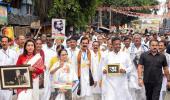
The TMC has since stepped up its efforts, with protest marches highlighting what Banerjee has described as 'violence and disrespect' against the Bengali language.
A new WhatsApp helpline has also been launched by the West Bengal police for migrant workers facing issues in other states.
The backdrop
Reports of large-scale detentions and, in some cases, deportations have emerged from several regions, including Maharashtra, Assam, Rajasthan, Odisha, Gurugram and Delhi.
In Gurugram, hundreds of individuals were reportedly detained on suspicion of being 'illegal migrants'.
Many of those affected were employed as domestic workers or sanitation staff, and some were later identified as Bangladeshi nationals.
The crackdown comes amid a nationwide operation to identify illegal immigrants from Bangladesh and Myanmar, as outlined in a May notification from the Union ministry of home affairs.
West Bengal Bharatiya Janata Party President Samik Bhattacharya has maintained that those being detained are Bangladeshi infiltrators.
"They have collected identity cards from Barasat, Madhyamgram and Siliguri -- that are epicentres of fake ID cards. Our intention is very clear: Detect and deport illegal immigrants."
He went on to claim that demographic shifts were underway in border districts of West Bengal.
"A silent demographic invasion is going on," he said, dismissing Banerjee's stance as being unrelated to any legitimate 'bhasha andolan'.
The language card, analysts suggest, Banerjee's reference to bhasha shontrash -- or linguistic terrorism -- could be a potent poll plank, especially amid heightened identity politics across the country.
Banerjee's focus on language reflects a calculated appeal to regional sentiment, political observer Sabyasachi Basu Ray Chaudhury said.
"The detention of Bengali-speaking workers -- including individuals with identity documents, and some could well be Bangladeshi nationals -- has triggered concerns around profiling and regional sensitivities ahead of the polls," noted Basu Ray Chaudhury, adding that the messaging may work well with Banerjee's vote bank -- the underclass, which includes migrant workers.
Around 2.2 million migrant workers across India belong to West Bengal.
He suggested Banerjee's message may also sway part of educated Bengali middle class, known locally as the bhadralok.
The TMC's efforts to reach out to the bhadralok are seen as timely, following a spate of urban backlash over the RG Kar rape case and a recent incident at South Calcutta Law College.

The bhadralok influence
The bhadralok -- often viewed as the state's opinion makers -- have played a decisive role in past political movements.
Their influence was most prominently seen during the Singur and Nandigram land acquisition protests, which ultimately upended the Left Front government's long-standing hold on the state.
While those agitations had already gathered momentum, it was the intervention of the Bengali intelligentsia -- particularly after the police firing in Nandigram on March 14, 2007 that killed 14 people -- that gave the movement a critical push.
According to Basu Ray Chaudhury, both the TMC and the BJP are likely to compete fiercely for the support of this influential section of voters in 2026.
Bhattacharya, since taking over as BJP state president, has sought to localise the party's appeal.
He has referenced not only Syama Prasad Mookerjee but also Acharya Debaprasad Ghosh and Haripada Bharati -- key figures of the Bharatiya Jana Sangh who had largely faded from public memory.

Battle of narratives
Despite Banerjee's campaign, Bhattacharya insists that the BJP will not engage in a counter-narrative around the bhasha shontrash agitation.
"Our narrative is clear - we want industrialisation in Bengal so that the migrant workers can return home. And detect and deport infiltrators," he said.
CPI-M state Secretary Mohammed Salim added another dimension, attributing the alleged targeting of Bengali-speaking migrant workers to a broader class issue.
"The attack is not on IT sector workers in other parts of the country, but on the marginalised who are compelled to move out of their home town due to lack of opportunities. And they are being attacked in the rest of the country in the name of language and religion," Sali noted.
"Our movement is against landlessness and joblessness," he added.
At the Martyrs' Day rally, Banerjee made a direct appeal to migrant workers to return. 'We do not lack jobs here,' she said.
As the 2026 assembly elections approach, the question remains: Will the politics of language provide the TMC with a decisive edge for a fourth term, or will the BJP manage to shift the focus to issues of corruption and unemployment?
Feature Presentation: Aslam Hunani/Rediff










 © 2025