
'Whenever present-day politics do get involved, history sinks to the level of a morality play, with advocates for this or that cause seeking to praise their heroes or condemn their villains.'
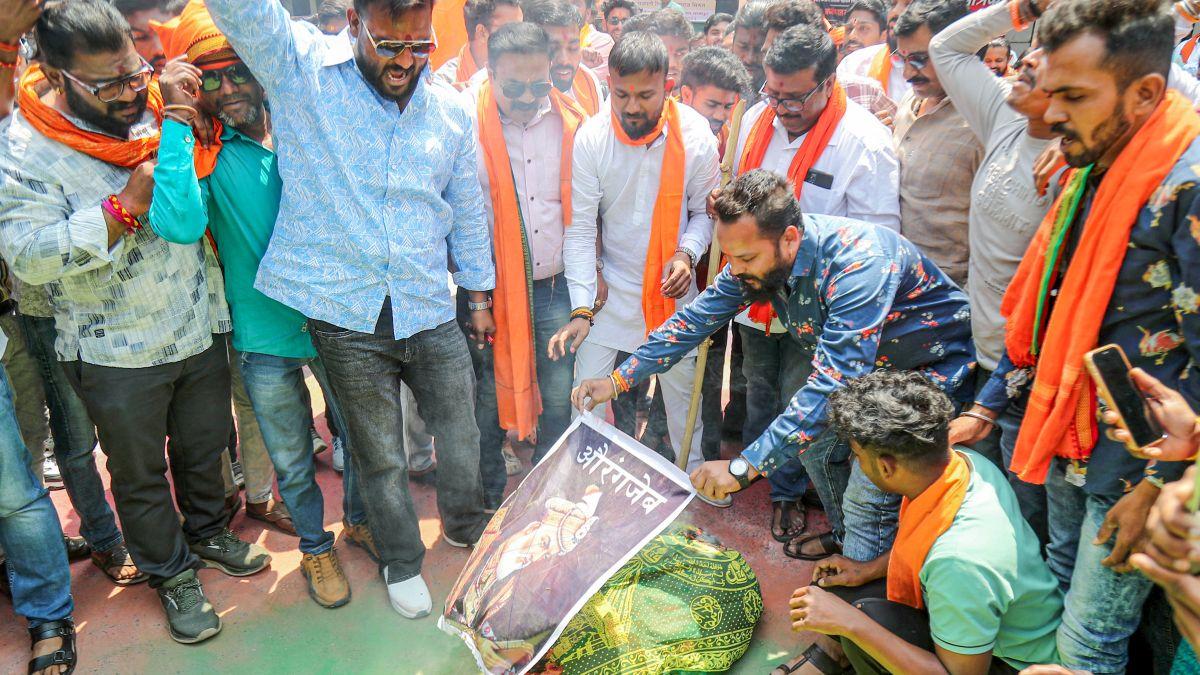
Recent changes by the NCERT to the history section of the Class 8 textbook have reignited long-standing debates over the portrayal of India's medieval past -- especially the Mughal period.
The new textbook highlights 'many instances of religious intolerance' during the Mughal era and introduces students to the Delhi Sultanate, the Marathas, and the colonial period.
The changes have sparked a vociferous debate -- with one side calling it 'the end of Mughal glorification,' while another argues that the line between education and propaganda is beginning to blur.
To understand the implications of these revisions on broader historical understanding and the political motives they -- wittingly or unwittingly -- serve, Rediff's Utkarsh Mishra spoke to Professor Richard M Eaton of the University of Arizona.
Professor Eaton is the author of several books on the history of India before 1800, including India in the Persianate Age: 1000-1765.
"If history were really treated like an academic discipline, it would not be a political football at all," Professor Eaton says in the first part of an e-mail interview.
While the right wing in India often claims, as you have also noted, that Hindus experienced 1,200 years of 'slavery', their focus appears to be disproportionately on the three centuries of the Mughal empire.
Why is that the case? Is it because the Mughals are more widely known among the public, unlike the Lodis or Tughlaqs? Or are they singled out for some other reason -- even though the Mughals were arguably more tolerant and inclusive than earlier dynasties of the Delhi Sultanate?
It is true that the right wing in India focuses on the Mughals more than on their Delhi Sultanate predecessors, and that the Mughals are more widely known among the public.
I would agree that the reason for this is simply that the Mughals are closer in time to the present day. But I doubt that they were any more or less 'tolerant' with their subject populations than the Delhi sultans had been with theirs.
Like all Indo-Muslim states, rulers were keenly aware of their minority status and had to rule accordingly, meaning that they accommodated with their subjects when possible and applied force when necessary.
Of course, there were always differences in policy from ruler to ruler, or even in how the same ruler governed at different points in his reign.
But in general, despite periodic pressures from conservative clerics, rulers stayed away from distractions like religion and focused on efficient governance.
Like all Indian rulers, both the Delhi sultans and Mughals focused on three principal goals: Revenue, loyalty, and stability.
In India in the Persianate Age, you write that 'India's medieval history has become a political football.' Is this because people in the subcontinent don't treat history as an academic discipline, but rather as a tool to be imposed on the present?
Perhaps that's why the new NCERT textbook under discussion also includes the disclaimer: 'No one should be held responsible today for events of the past.'
If history were really treated like an academic discipline, it would not be a political football at all.
Properly speaking, professional historians strive for the impartial establishment of truth according to established rules of evidence, logic, and argument, while also keeping the politics of their own day out of the picture.
But whenever present-day politics do get involved, history sinks to the level of a morality play, with advocates for this or that cause seeking to praise their heroes or condemn their villains.
That said, history as a 'political football' is found not only in India, since ruling authorities anywhere seek to justify their policies by promoting a certain understanding of the past.
I have a vice president who promotes the notion that America is not and has never been an idea (as I was taught to believe), but rather a land and a people with a particular past, with the corollary that certain people have a greater claim to belonging in that land than do others, who are construed as 'outsiders'.
We already have within our borders over 200 detention centres, some of which can hold over a thousand unwanted people, recalling Nazi concentration camps.
With the rise of social media, a growing number of Indians believe that the Mughal period occupies a disproportionate space in the history syllabus, and that post-Independence historians -- particularly those influenced by Marxist historiography -- glorified the Mughals. What is your response to this view?
It would seem difficult to believe that the Mughal period occupies a disproportionate space in the history syllabus, in view of the government's attempts to reduce the Mughal presence in that syllabus nearly to the vanishing point.
In any event, Marxist historiography is known not so much for glorifying the Mughals as for blaming them for crushing India's cultivating classes with their oppressive taxes.
That said, for several decades now, we have passed the heyday of Marxist historiography.
The more historians tried to fit India's historical data into rigid Marxist categories, the less explanatory power those categories had, and the less the endeavour was attempted.
After all, theory can explain data only when it can be aligned with those data.
The new textbook claims to 'go beyond familiar narratives' by highlighting 'forgotten heroes' who resisted Mughal rule.
However, critics argue that the book does so by presenting a black-and-white portrayal of good versus evil, ignoring the nuances of medieval politics. The larger public discourse seems to favour the new narrative.
Does this resonate because people believe they were previously denied access to these stories of resistance?
It is important to understand the nature and causes of resistance to any established state, since such an analysis can help us understand the nature of the states themselves.
In my India in the Persianate Age (pp. 252-59), for example, I carefully examined resistance to Jahangir's expansion in eastern Bengal, since doing so could shed light on the nature of Mughal politics in Jahangir's time.
So, I would support the new textbook's position that those taking part in resisting Mughal rule, or any rule, should never be forgotten.
The problem, however, lies with identifying anyone who resists state power as a 'hero'.
If one is going to take sides in the matter, one might just as legitimately call them 'terrorists'. After all, that is how most states identify those who resist their authority.
Abu'l-fazl famously characterised both Hindu and Muslim zamindars who resisted Akbar's expansion of Mughal frontiers as the 'weeds and rubbish of opposition' (khas-o-khashak-i mukhalif).
His was a value judgment, obviously reflecting the perspective of the State.
Similarly, by calling 'heroes' those who resisted the imposition of Mughal rule, as the new textbook does, one is making the opposite value judgement -- namely, that since the Mughals were evil, rebels against them were naturally acting nobly and virtuously.
But one man's 'terrorist' is another's 'freedom fighter'. Value judgements have no proper place in the study of history.
As you mention in your work -- such as in the case of Akbar and Rao Surjan Hada -- both sides of this historical debate often cite medieval sources to support their contrasting narratives.
In such a scenario, how do we prevent historical understanding from becoming the casualty in a broader war of ideologies?
The case of Surjan Hada's submission after Akbar's conquest of Ranthambhor fort illustrates the point made in the previous question.
While historians should avoid making value judgements, we must record and account for the different perspectives of the actors we study.
From the Mughals' perspective, Surjan Hada respectfully and honorably submitted to imperial rule, as is wonderfully depicted in the Mughal painting of that event (reproduced in Fig. 11 in India in the Persianate Age).
On the other hand, a Sanskrit biography of the same chieftain, Surjanacarita, argued that Akbar was so pleased with Surjan Hada's courageous conduct that he offered him three territories in return for just the one fort of Ranthambhor.
The implication was that the outcome of the siege of that fort had actually been a victory for Surjan Hada.
Indeed, as a consequence of the fall of Ranthambhor, Surjan Hada became a loyal and respected Mughal mansabdar, serving successively and prestigiously as the governor of Garha, the commander of Chunar fort, and a participant in Akbar's campaigns against his own half-brother, Mirza Hakim.
I see no 'war of ideology' here. Each side understandably sought to portray the same event in as favourable light as possible.
This is simply the old game of politics, and how different actors viewed the exercise of power.
- Part 2 of the interview: 'Writing History Is Like Solving A Jigsaw Puzzle With A Third Of The Pieces Missing'









 © 2025