
'IndiGo will receive a sharp rap on the knuckles -- a punishment, a huge penalty.'
'I look towards them creating a compensation fund.'
'I would like to think they would do that for all the passengers who are affected on every single day since cancellations began.'
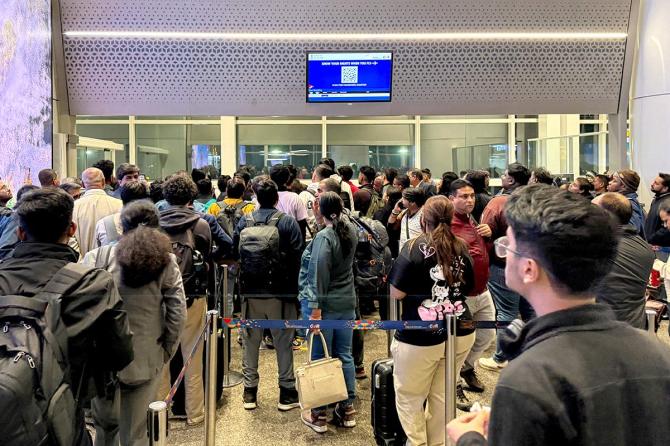
"We are the third-largest aviation market, the fastest-growing on earth -- if we cannot handle this kind of situation, then how do we expect to handle 300 airports and 2,000 more aircraft?" aviation consultant and Avialaz Consultants CEO Sanjay Lazar asks Prasanna D Zore/Rediff in the concluding segment of a two-part interview.
- Part 1 of the Interview: 'Biggest Meltdown In Indian Aviation History'
Who should be held accountable for the inconvenience caused to lakhs of ordinary Indian citizens -- the airline, the regulator, or the civil aviation ministry?
All three, I am sorry to articulate. The buck stops at the top. If the ministry has allowed such a rampant dominant position -- there is a case for the Competition Commission of India to intervene. There is a monopolies issue.
Below 50% is ideally what they (IndiGo) should be. At 63%, you must reallocate slots and distribute them to other smaller carriers.
The (civil aviation) ministry slept. The DGCA office -- whether it is one joint director general or one junior clerk or one senior official -- somebody in that office has also slept on this. They have witnessed the fire alarm ringing and thought it was somebody's mobile phone alarm.
IndiGo itself took it so lightly, so casually, and then they realised this is a 9.0 Richter scale earthquake. By then, the cracks had already appeared in the earth.
It is collective responsibility of all three entities. I am stating it is a collective responsibility that has made our country look like the laughing stock of the world aviation market.
I articulate this with all the seriousness I can muster. I am a very proud nationalist Indian. We are the third-largest aviation market, the fastest-growing on earth -- if we cannot handle this kind of situation, then how do we expect to handle 300 airports and 2,000 more aircraft?
Can you imagine if we were five years down the road with 2,000 aircraft and this transpired? We would be in the wilderness.
For this to have occurred when the Russian president was visiting and people getting all international attention on India -- people getting dislocated, people who wish to travel to Delhi stuck elsewhere.
There has been so much embarrassment, it is farcical.
There are already people planning to file public interest litigation...
Public interest litigation is transpiring. Numerous passengers have messaged me. This is my grievance, and I have articulated this over the last year or two, not just today.
We do not possess a passenger charter in our country. Rather, we have something so flimsy that rag would not even wash properly. It is so pathetic.
We need to have a REAL Passenger charter. We require a passenger charter like the European Union, like the United Kingdom, where the compensations, the regulations are set in stone -- you cannot modify them. The appeals mechanism, everything is established.
We have a nonsensical system. We need to upgrade that, and I hope the government examines this and addresses it. Because they are going to discover that unless you implement consumer protection, consumer trust will be very difficult to rebuild.
Shouldn't this also be of concern that the court-mandated stricter FDTL rules for pilot rest have been relaxed now, especially for IndiGo (this has been relaxed only for IndiGo's A320 fleet)? Doesn't that place both passenger safety and pilot health at risk?
Before I address passenger safety and pilot health, I address something called legal jurisprudence. Do you possess that right to undo what the court has mandated? I believe sooner or later somebody is going to articulate it, and somebody is going to approach the court.
In order of gravity, that is number one. You have directly overridden an order of the (Delhi) high court, and then you have added fuel to the fire and suspended everything. You have now assumed the power of a high court where you possessed none.
A civil servant of the Government of India and a minister of the President's council has now suspended orders of the (Delhi) high court where they did not possess the powers to do so.
My concern is: Do you possess this power to issue a directive to suspend the directive which has been brought in by the court? You possess the power to suspend the DGCA's orders? Yes. But do you possess the power when you are aware that it is a high court order?
Unless they have taken opinion from the solicitor general or the attorney general and they have stated, 'It is acceptable, proceed. We will explain to the court' -- perhaps that is acceptable.
They may plead a national emergency and escape court censure, but this action is extrajudicial in my opinion.
Now, whether it dilutes passenger safety and pilot safety, it is a moot point, frankly. There is an element of passenger safety involved. But truth be told, we have operated with the same rules, lower standards, for numerous years.
What the minister attempted to articulate that day was: We have operated with lower standards for many years; let us continue for a few months more.
He has also stated there will be punishment. How much and what kind? We shall observe. That is all very well, but I would think that somebody as enlightened and educated as our honourable minister would comprehend the import of words that we are incorporating into a government order. Because there should be a commencement date and an end date.
You must have a fallback provision, as to what rule is now applicable, since you suspended these rules. Law is a very precise subject. You cannot simply improvise your way around it.
What would be your advice or message to the pemople in the aviation industry who matter -- be it the ministry, the regulator, or the airline operators?
We need to place the passenger first, build passenger safety and safeguards that are long-term. Airlines exist, but it is the passenger who makes this entire ecosystem function.
Let us all remember: Governments come and governments go. But we must keep the structure prepared and strong; that is paramount.
The second matter is I think we need to commence looking beyond having one big boss (IndiGo) and one small boss (Air India) and all the rest running about as airlines.
What we require is a fair playing field. We have heard airlines like Akasa complain extensively over the years. This is an opportunity for the government to correct this. Offer it first to the smaller airlines.
You cannot keep building a monopoly simply because somebody possesses a huge wallet. From 35% to 45% to 50% to 55%, now 63% -- 65% is their market share. It signifies two out of three people who fly in this country are on IndiGo.
How can anybody influence the way this aviation system is constituted? It is going to be -- India is IndiGo, IndiGo is India.
I do believe, and I hope, that IndiGo finds its way back. I say this as an aviation analyst and commentator, a traveller and an investor.
They (IndiGo) will receive a sharp rap on the knuckles -- a punishment, a huge penalty. I anticipate that, and I look towards them creating a compensation fund.
I would like to think they would do that for all the passengers who are affected on every single day since cancellations began. The ridiculous fares that people paid -- there were some individuals whose flight A was cancelled. They were asked to rebook on B or C and pay the difference on Indigo.
Then they discovered B and C were also cancelled...
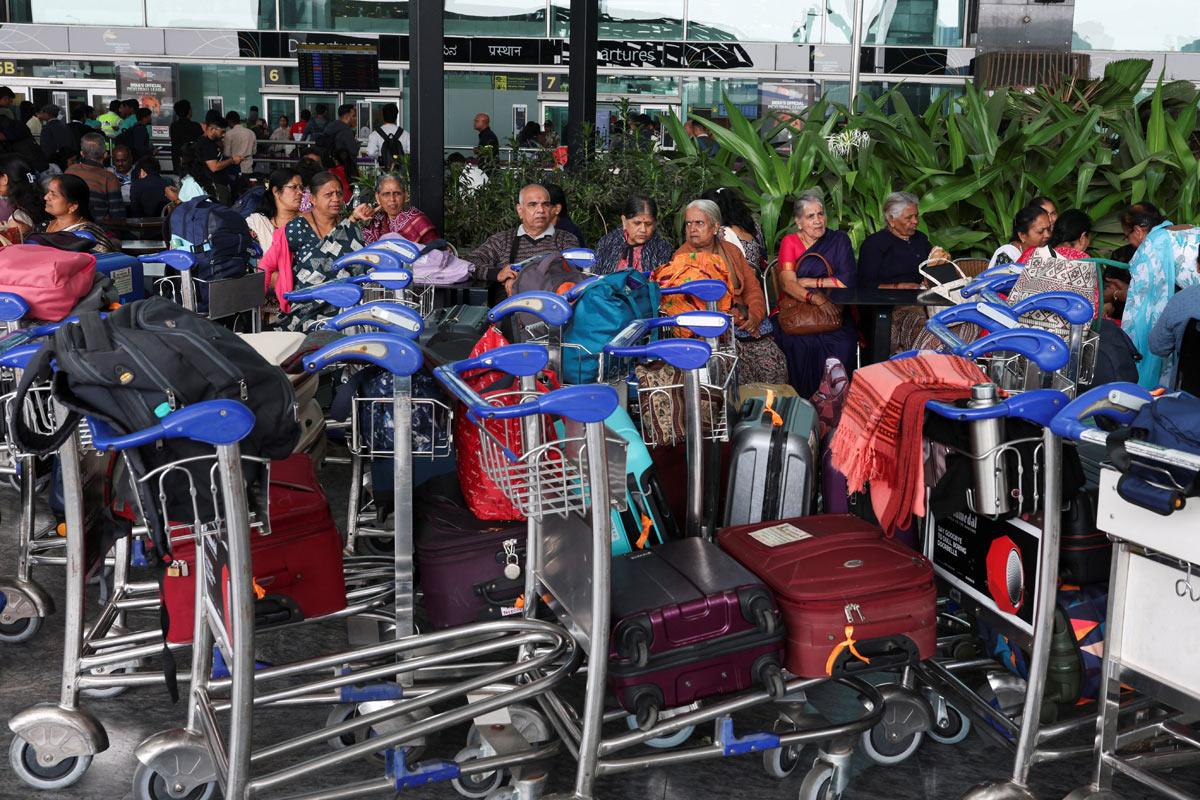
Precisely. When none of those flights were leaving, and then we lose 50% for refunds. That is price gouging and exploitation. That is ridiculous. The next flight is not departing. Why are you then making me book on that?
Of course, IndiGo will bounce back -- there is no question about it. But passenger trust has been shaken. Where IndiGo will feel the pinch is when it commences flying international routes extensively because these systems will not function in this manner, when you are executing multiple long-haul operations.
And that is perhaps the reason why IndiGo's international operations were not as severely affected...
No, it is also because the compensation there is substantially higher. You wish to ensure that nothing on those international routes is impacted. You do not wish to pay global compensation nor can you risk international reputation. That is the bottom line. Obviously, that is a method of firefighting.
I return to the point that nobody wishes ill upon any of these entities. We want all five or six big and small operators -- we want a healthy aviation ecosystem operating. We want to ensure that matters do not go wrong.
I have witnessed a couple getting married via video conference. I have witnessed somebody attempting to attend his father's funeral and stuck in another city. It is so tragic.
Let us hope the government initiates some substantial reforms where it places the passenger first.








 © 2025