
'They are saying that there is a pilot shortage which is not correct, but if it was true, did they suddenly come to know this on December 5?'
'If they didn't have crew, why did they seek approval for a winter schedule? To get the approval, the operator has to show crew strength and also a buffer of crew available.'
'If they had a crew crunch, why did they ask for extra flights? Or was it something else that made them so sure that they would get away with this exemption and bans?'

"This level of disruption has not been seen before. It was like a Banana Republic. Nobody was in control, nobody knew what was happening," says Captain Anil Rao, General Secretary, Air Line Pilots' Association of India and a pilot with 25 years of flying experience.
"This whole mess could have been prevented. IndiGo knew the problem and could have handled the situation much better, but caused mayhem at the airport," Captain Rao tells Rediff's Archana Masih.
As a pilot who understands flying schedules and the functioning of the aviation sector, how long would it take for IndiGo to normalise operations across the country?
I am not sure how IndiGo will stabilise operations because there were almost 1,000 flights which got affected.
A lot of flights are still cancelled today.
I don't think a large backlog like this can get normalised in two days. Flights that have been cancelled will have to be rescheduled. Passengers will have to be reissued tickets and seats. Stranded travellers have to be moved to their destinations.
Plus IndiGo claims there is a crew shortage which will have to be managed.
How long do you think it would practically take?
I don't have inside information as the technical details will be with the operator only.
IndiGo is also saying that possibly a technical or software glitch could have led to this situation.
This level of disruption has not been seen before. In incidents like a bomb scare or a security alert, the functioning at one particular airport gets delayed and it takes a couple of days to regain normalcy after the airspace opens up and the staff/ crew and infrastructure is available.
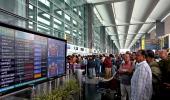
But a security alert or bomb scare is localised at one particular airport while in the IndiGo crisis, there was chaos at airports across the country.
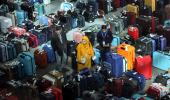
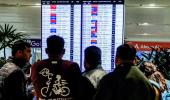
The whole country was affected. People were stranded everywhere.
IndiGo claims that the major issue was shortage of crew. How will crew shortage be addressed or resolved in two days? We will have to wait and see.
What about the passengers who have suffered so much without any recourse? What do you make of the government's response?
The IndiGo chaos did not happen overnight.
The government is helping passengers by providing alternate flights or other modes of transportation and the civil aviation minister has spoken on the floor of Parliament.
The airports seem calmer than two days back. The most important thing is to take care of the passengers and their emotions. Secondly, passengers should be transported in a timely manner.
Travellers didn't have anywhere to go. The prices of hotels were skyrocketing during that time. I hope stranded passengers will be taken care of.
The problem was that passengers were being informed about delays and cancellations after reaching the airport.
They should have told passengers beforehand, refunded the money or made alternate arrangements.
Let's hope that what is promised is resolved. Or IndiGo will have to curtail its flights.

Passengers never faced a situation like this. Shouldn't IndiGo face punitive legal action? In its response to the show cause notice sent by DGCA to the CEO, Indigo has asked for more time for root-cause analysis.
It's a big airline with a big management and huge network of operations. The CEO has been given a show course notice and has to give the reply. He cannot get away with it.
Maybe they are buying time or are busy looking at the passengers' welfare or resolving the other chaos, but the show cause notice once given has to be replied to. That is how the legal system works.
Let's see what reason they come up with for the whole chaos. They have to give the reason to the government why this happened -- and why the passengers were not informed earlier.
Why they were not prepared? Why they did not prepare the passengers?
They suddenly cancelled over 2,000 flights. That doesn't happen.
It is understandable if there is a technical problem with the aircraft or the systems. But they claim there was a crew crunch -- if that was the reason, then why didn't they inform beforehand?
They left the passengers and operations to fend for themselves. It was like a Banana Republic. Nobody was in control, nobody knew what was happening.
Passengers reached the airport and found there was no crew, no flights. They were simply stranded.
This whole mess could have been prevented. They knew the problem and could have handled the situation much better, but caused mayhem at the airport.
If other airlines like Air India and Akasa could prepare themselves for the revised Flight Time Duty Limitation rule, IndiGo had no reason not to, right?
Correct. That's what we are also asking.
Instead of being pulled up, the FDTL rule is being held in abeyance for IndiGo till February 10.
That is also not very clear because you cannot hold a rule under abeyance for one airline and ask the other operators to follow rules.
The rules are either followed by all or none. They cannot be selectively followed.
Either the rule exists or does not.
'Abeyance' means the whole rule is put in hold. Even we are confused. We don't know what rule we are flying under.
The new FDTL rule was basically so that pilots get enough rest before entering a cockpit. What message does that send if a rule aimed at pilot welfare and enhanced passenger/aircraft safety is held in abeyance?
It's a rhetorical question.
You want safety, but remove the rules.
You remove the rules, but say all safety measures will be followed.
If that is so, then why are you not following the rules?
The statements are not in concurrence.
You cannot say we will hold it in abeyance plus keep the safety in practice.
We have asked for clarification.
How has this affected the larger Indian aviation sector? Has this damaged India's reputation?
It will create a bad image of the airline because IndiGo is the biggest airline in India and flies to several nearby countries as well.
When the image of an operator gets affected, then the whole system is to be blamed.
Where the fault happened? Why it happened? All these have to be ascertained.
Like I said, it was understandable if these flights were affected because of external factors beyond our control -- security threat, weather or natural calamity.
In this case, the truth has not been told. They are saying that there is a pilot shortage which is not correct, but if it was true, did they suddenly come to know this on December 5?
If they didn't have crew, why did they seek approval for a winter schedule? To get the approval, the operator has to show crew strength and also a buffer of crew available.
Then, how can they suddenly say they don't have crew?
If they had a crew crunch, why did they ask for extra flights? Or was it something else that made them so sure that they would get away with this exemption and bans?
Since you are in the same field, does IndiGo have a pilot crunch?
No, they don't.
If there was a pilot shortage, they would not be operating so many flights.
The average flying hours of an Indian IndiGo pilot is about 55 to 60 hours a month. That is normal. In fact that is quite less.
That was the reason why pilot salaries were reduced from 70 hours to 50 hours.
This was done because they have excess crew.
Usually a pilot, whether he is flying or not, gets a minimum flying hours payment which was 70 hours.
Since the pilots were not flying as much, the company didn't want to pay for 70 hours. If a pilot flew only 50 hours and the operator had to pay for 70 hours, then the company is losing money.
The fact that their contract was reduced from 70 to 50 hours itself is an indication that they were overstaffed.
This was done about two months back. Then how are they saying that they don't have enough crew today?
They reduced the minimum guarantee hours because the pilots were not flying as much.
These are two contradicting facts.

Passengers are left with no choice because IndiGo has the lion's share of routes. Passengers are really at the mercy of IndiGo...
That's what monopoly does.
It's like the Indian Railways, you have to use it whether you like it or not.
Now, of course, the Railways have improved because of competition from the airlines. But when you don't have competition, the quality of service drops and passengers are taken for granted.
If you want to go to Dimapur or Agartala, a train journey will take days. By air you can get there in a few hours -- and probably only IndiGo operates to those destinations.
You will not have any choice -- good, bad, ugly -- you will have to fly.
Perhaps this would provide reason for the government to rethink and have more competition enter the market.
Yes.
In the 1990s, there were a lot of airlines which opened up. Of course, it closed down subsequently.
We have also requested the same thing to the minister, and he said we should have more airlines coming in. But for that, there are rules and regulations to encourage new operators and new competitors.






 © 2025