
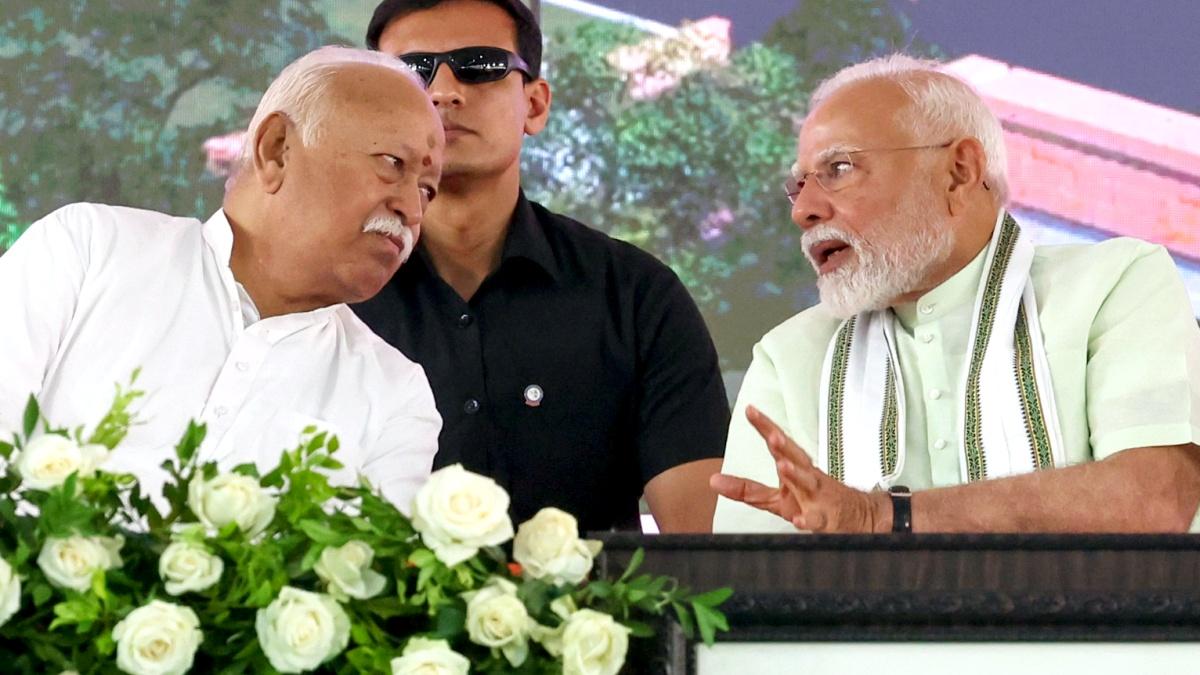
BJP and RSS leaders are once again pushing to remove the words 'secular' and 'socialist' from the Constitution's Preamble, showing a deeper effort to change India's identity from a diverse, multi-religious republic to a Hindu-first nation, even though they don't have the numbers in Parliament to officially change the Constitution, observes N Sathiya Moorthy.
Even as Supreme Court lawyer and media commentator M R Venktaesh's next title, Discovery And Bharat: Christian Constitution in a Hindu Nation is to hit the stands soon, a debate on the nation's Constitution is already on, with a specific reference to the changes made to the Preamble, otherwise a sacred cow.
India has always prided itself as having the longest Constitution at birth. For a modern nation since Independence in 1947 and Republic status three years later in 1950, India's is also the Constitution with so many amendments.
What was once criticised as being unwieldy and at times thoughtless came to be hailed as a 'dynamic' statute since the second generation.
Yet, there may not be any other Constitution whose Preamble itself may have been subjected to amendments as ours has been.
The 'golden jubilee' of the Emergency, proclaimed by Indira Gandhi on the night of June 25, 1975, provided the occasion for the Hindutva brigade, also known as the Sangh Parivar, to come down heavily on her government-initiated 42nd Amendment, which was one more product of that sordid era in the post-Independence history of the nation.
Naturally, the RSS parent of the ruling BJP at the Centre was one up on others in criticising the Emergency and condemning the 42nd Amendment.
And now, the youth wing of the ruling Congress party in southern Karnataka has filed a police complaint against RSS General Secretary Dattatreya Hosabale, for passing 'unconstitutional, inflammatory and divisive' comments by demanding the repeal of the terms 'secular' and 'socialist' that to many of his belief were unacceptable interpolations introduced in an era in which democracy had been put to sleep.
What the Karnataka Youth Congress leaders did not know or remember was that veteran BJP leader Subramanian Swamy's petition with the same demand is pending before the Supreme Court.
Whether the state police can initiate any criminal action against Hosabale, a Karnataka native otherwise, is the question.
In between, the never-say-die Vice President V P Dhankar, who is also the ex officio chairman of the Rajya Sabha, has declared in defence of Hosabale that the two terms along with a third one, 'integrity', a belated afterthought in 1976, were a 'sacrilege' not to the spirit of the Constitution but to Sanatana, or Hinduism.
Either the VP has already concluded that Hinduism and 'India that is Bharat' are one and the same and were possibly inter-changeable, or he was committing the same 'crime' as Hosabale in the eyes of the Karnataka Youth Congress, but with the 'protection' offered by the high Constitutional office that he now holds.
But then, the Congress, going by Emergency era history, cannot complain, at least about Dhankar seemingly equating India and Hinduism, or political Hindutva.
After all, the party had a national president in Dev Kanta Barooah who, during the Emergency, declared that 'Indira is India and Indira is India.'
So, which is better -- equating the nation with an individual or with a particular philosophy or 'way of life', as the Supreme Court defined Hinduism to be -- however complex, complicated and contra-indicative the new political interpretation of Hindutva, be.
Even without this one, Dhankar has been taking as many pot-shots outside Parliament as inside, not that he was afraid of controversy while being the governor of West Bengal with its own firebrand chief minister Mamata Banerjee in his earlier avatar.
Dhankar was last heard, commenting on, or criticising the Supreme Court's presumptive orders that cleared 10 Tamil Nadu laws after the equally controversial Governor R N Ravi had sat on them for an unjustifiable length of time -- either himself, or by forwarding them to President Droupadi Murmu, and hence the Centre.
The Opposition has been quick to react the way they have been doing all through when the ruling BJP's RSS parent especially is on the other side.
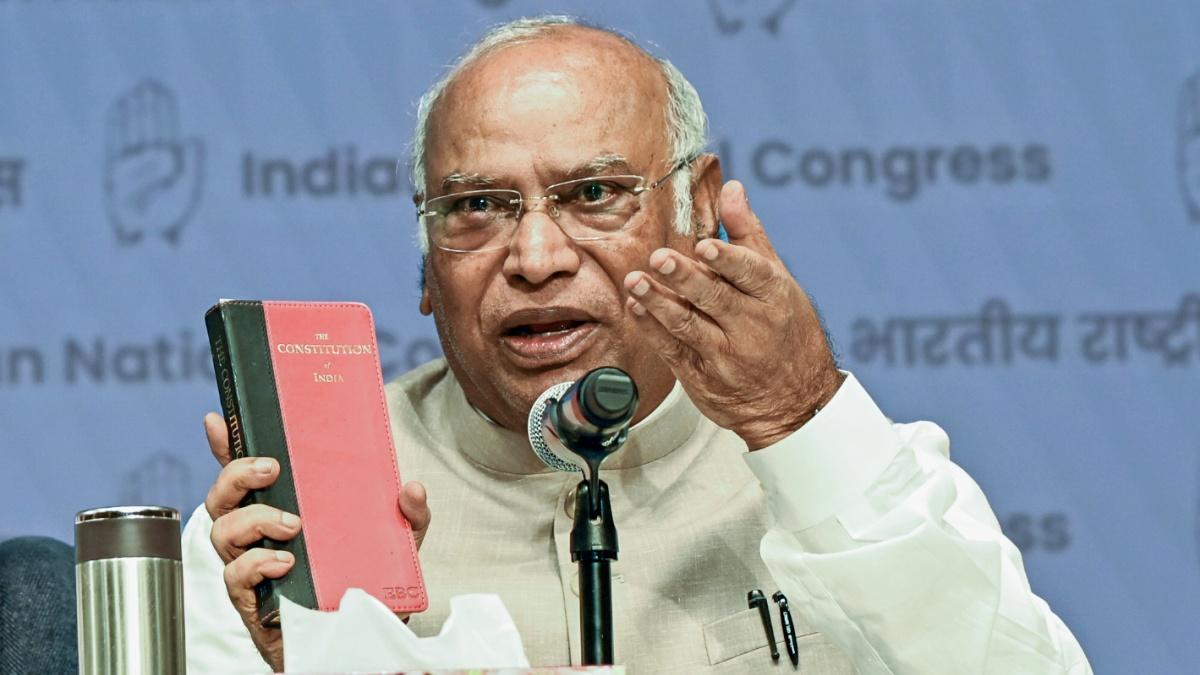
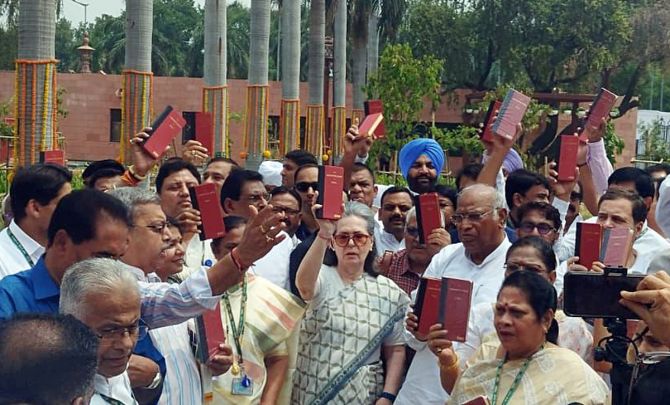
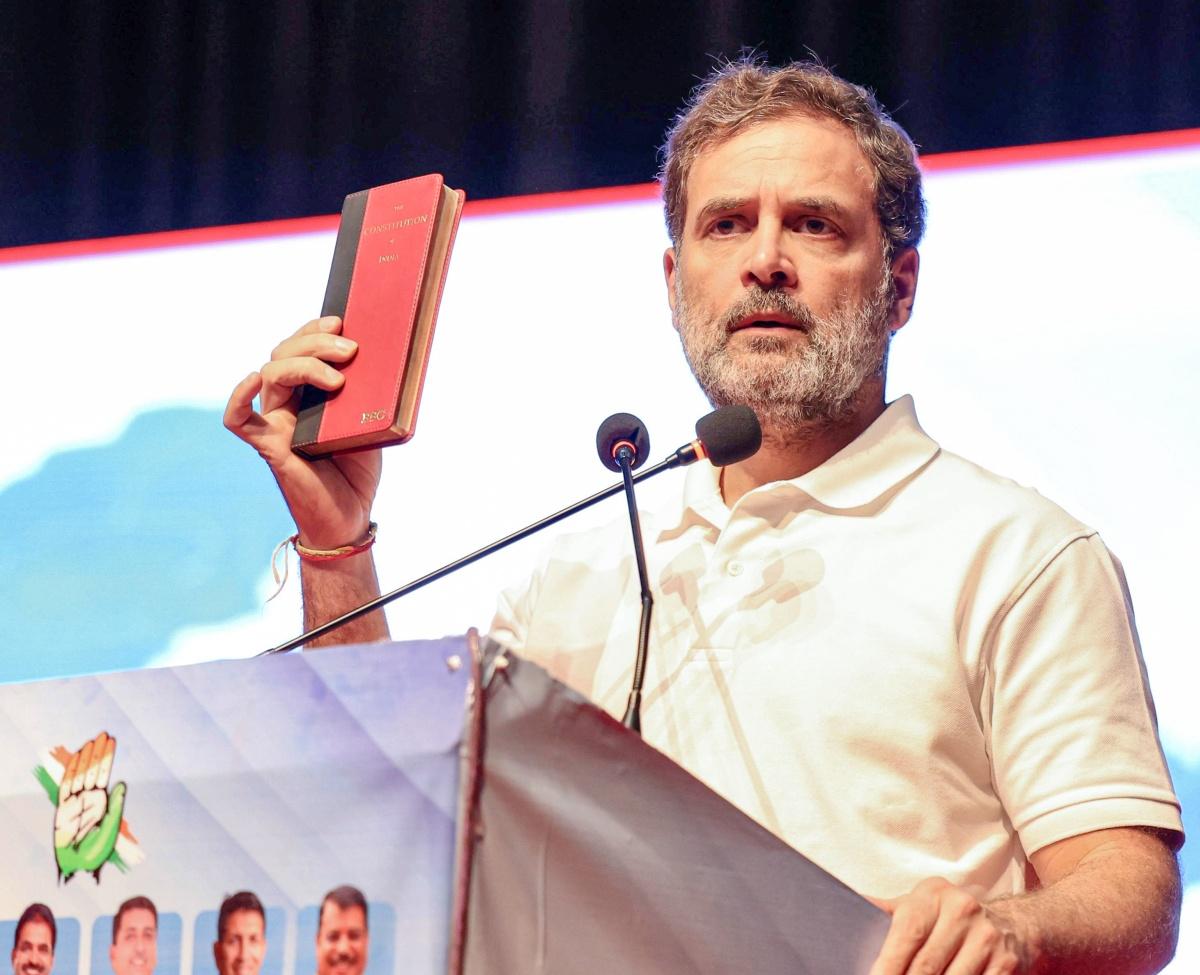
Congress leader Rahul Gandhi went as far as to claim that the RSS did not want the Constitution as it stands but they wanted Manusmriti, instead.
Hence, their constant complaint about the inclusion of 'secularism' and 'socialism' in the Preamble. Other Congress leaders have said as much.
The CPI added a point by referring to Hosabale's mentioning that the Preamble as it existed now was not the one that was written in by B R Ambedkar, the architect of the Constitution.
The party said that Ambedkar was (also) opposed to Hindu Rashtra in any form, implying that is what the RSS and the BJP wanted imposed on the Indian nation.
Incidentally, the CPI was supporting Indira Gandhi and the Emergency, and hence the 42nd Amendment, too -- while the party's breakaway CPI-M comrade from the previous decade was opposed to both, and stood with the rest of the Opposition.
And the BJP's ideological forebears, namely, the Jana Sangh, was part of that mumbo-jumbo combo that became the Janata Party, post-Emergency, only to wither away unceremoniously.
Just now, the question is if the ruling BJP wants the Preamble amended to its pristine past?
Or, will it, in the name of rectifying past mistakes -- which it can claim the 100-plus amendments are -- want a whole new Constitution, a Constitution that the likes of Dhankar, with his eyes possibly on the presidency, wants to reflect the spirit and act of Sanatan Dharma?
Or, will it have to be a 'Hindu' replacement of a 'Christian Constitution' that M R Venkatesh seems to be arguing in his upcoming book, as only the cover title that is already in circulation suggests?
Or, is it something mainly political as Subramanian Swamy has initiated?
Not many may remember or recall -- or want to do either -- that during the 1990s, there were whispers among the BJP elite about the need for a large-scale amendment of the Constitution, if not a whole new Constitution.
At the time, especially after the BJP became the single-largest party in the Lok Sabha from 1996 onwards, all talk of amending the Constitution was political and electoral in form and content.
From the post-Emergency Janata Party victory in 1977, the Jan Sangh first and the BJP as its post-Janata avatar was convinced that it could win a comfortable majority in the Lok Sabha with votes and seats from the 'Hindi belt', since translated as 'Hindu belt'.
That was saying a lot for their time, but then the present-day Modi leadership has taken the party to 'non-traditional' support bases in the South, East and the North-East, where especially the BJP is at present in power in many states and is a force to reckon with, elsewhere.
It is anybody's guess if in the present mood, the ruling dispensation and their ideological peers and parents would want a cow slaughter ban, for instance, 'upgraded' from Chapter IV to Chapter III, which 'mandates' the Indian State and all its organs to enforce the 'Fundamental Rights' guaranteed thereof, again under the same Constitution.
After all, the cow slaughter ban is the only agenda-point of political Hindutva that has not been fully enforced, nation-wide.
Others in the list included abolition of Article 370 and 'triple talaq', and a uniform civil code, apart from an afterthought of the 'Ayodhya issue', had mostly been achieved.
In Prime Minister Modi's first term, in many BJP-ruled states like UP, MP and Rajasthan in north India, they resorted to manslaughter in the name of cow protection.
The government at the Centre and its leadership looked elsewhere, possibly until someone whispered in their ears that beef already had a huge market, and not all those exporters belonged to a particular community, as was being made out by the choice of slaughter victims on the street.
Even in the pre-Emergency era, it used to be known also as the 'cow belt', especially after a protesting group of allegedly apolitical sadhus, set fire to the Delhi residence of K Kamaraj, the then president of the ruling Congress at the Centre.
The man was not in the house at the time, but the building was totally gutted.
The protestors were demanding a nation-wide cow slaughter ban, as proposed (and not mandated) under Chapter IV of the Constitution, on 'Directive Principles of State Policy', which did not have teeth then, nor does it have at present.
Talking of the Emergency, incidentally, people often tend to forget the 'Turkman Gate' demolition of Muslim houses in capital Delhi, as a part of a beautification campaign, at the instance of Sanjay Gandhi, the uncrowned czar of those times.
It is one thing that then DDA chairman Jagmohan, who was in the crossfire over the demolition, ended up being the BJP's even more controversial governor in Jammu and Kashmir.
It was like Nayyar, the Faridabad district magistrate who locked the Ayodhya site in 1949, reportedly defying Union Home Minister Sardar Vallabhbhai Patel's directive, becoming a Jan Sangh member of the first Rajya Sabha, 1952.
It was the same way former CAG T N Chaturvedi first became a BJP member of the Upper House after exposing the Congress government of the day in the Bofors deal, followed by a stint in the Karnataka Raj Bhavan.
Yes, the Congress too had indulged in it all when in power -- or, set the precedent, in whose footsteps alone the BJP walked.
Yes, talking of Turkman Gate, you did have UP's Yogi Adityanath in particular ordering the demolition, first of a particular community, and later that of anyone protesting against his government.
Yogi's BJP co-sevaks in other states followed suit until the Supreme Court intervened -- for current Chief Justice of India B R Gavai to cite as an instance of 'judicial activism' at an overseas conference.
Today, the ruling BJP has had its way on a variety of matters, where working with legacy institutions, symbols and legislation had become an anathema.
From Mahatma Gandhi, everything Congress and everything Nehru-Gandhi, and by extension all those with a history from before Independence, had to be abandoned.
Sardar Patel was/is the only exception, for reasons that show him up as 'more Hindu' than most other Congress leaders of the time -- barring possibly Pandit Madan Mohan Malaviya.
The latter's name, of course, most men in the Hindutva brigade either do not know or have not been told to revere as much as they hail Sardar Patel alongside RSS founder Dr Keshav Baliram Hedgewar or the RSS' second Sarsanghchalak Madhav Sadashiv Golwalkar.
Thus, you have a new War Memorial and Parliament House in the national capital, a new sceptre that symbolises royal lineage from a very distant past, new crime and penal laws in the place of those that had been inherited from the colonial masters from, say, the 1860s -- with a lot of tinkering, and titles that are now in Hindi, whose status as the 'national language' someone up there wanted to impose....
Then, why not a new Constitution, or a vastly amended Constitution? Maybe, it was down in the list of priorities, but then the results of last year's Lok Sabha elections have robbed the BJP of an absolute majority, not to imagine the required two-thirds majority in the Lok Sabha, to begin with.
Truth be acknowledged, even at present it is anybody's guess if all those allies, starting with the ruling TDP in Andhra Pradesh and Nitish Kumar's JD-U in Bihar, which have propped up Modi 3.0 which had won only 240 seats in a 543-member House, will be willing to back a new Constitution or a set of new Constitutional amendments -- not, at least without a price.
Yet, they all together cannot make the two-thirds mark, and that's it. It has meant that periodically, especially around the time of Republic Day in January and Independence Day in August, the RSS-BJP have to keep issues alive by giving vent to their thoughts and emotions, just as their comments from a relative past helped them to achieve their goals on Ayodhya, Article 370, et al.
Thereby hangs a tale!
ALSO READ:
- 'Nothing Wrong If We Rewrite The Constitution'
- 'No one in the RSS questions the Constitution anymore'
N Sathiya Moorthy, veteran journalist and author, is a Chennai-based policy analyst and political commentator.
Feature Presentation: Rajesh Alva/Rediff






 © 2025