
As we read and assess what is going on around us in the India of 2025, it is instructive to do this through the lens of 75 years ago and the events that led to the formation of the BJP as we know it, recalls Aakar Patel.
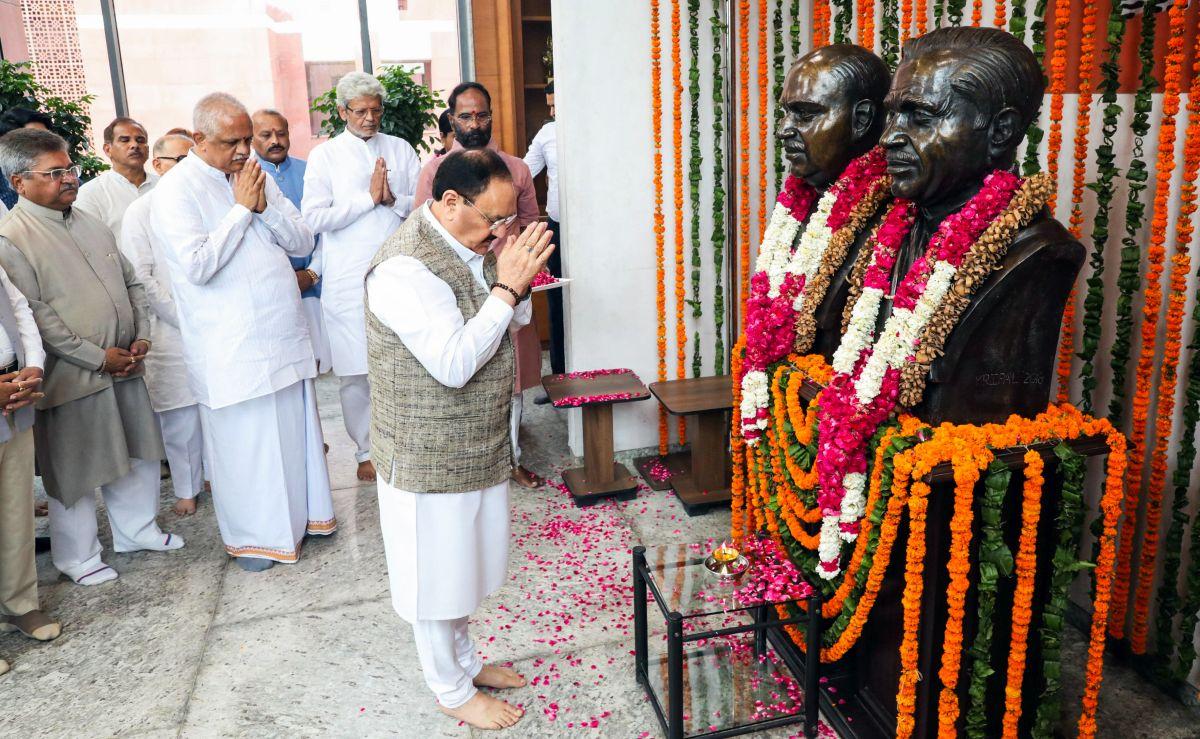
We marked the 50th anniversary of the Emergency a few days ago. Another anniversary, this time the 75th, went relatively unnoticed.
This was of the formation of the Bharatiya Jana Sangh, and the reasons for its coming into being.
On May 5, 1950, Syama Prasad Mookerjee announced the agenda of the party being formed which had an eight-point programme.
These were: 1. United Bharat; 2. Reciprocity instead of appeasement towards Pakistan; 3. An independent foreign policy; 4. Rehabilitation of refugees; 5. Increased production of goods and decentralisation of industry; 6. Development of a single Bharatiya culture; 7. Equal rights to all citizens and improvement of the backward classes; 8. Readjustment of the boundaries of West Bengal and Bihar.
Other than Mookerjee, who was from the Hindu Mahasabha, the structure of the Jana Sangh came from the Rashtriya Swayamsevak Sangh, and today the party remains, of course, a subsidiary of the mothership.
Why did the RSS get into politics? The story is interesting. This is how the Jana Sangh's official history, published by the BJP a few years ago, explains it.
An RSS rally in Delhi in December 1947 drew a large crowd and also attracted Hindu princes, businessmen and leaders of other Hindu organisations.
This popularity was something that alarmed the Congress, especially Nehru, according to the RSS. Gandhi's assassination on January 30, 1948 gave the Congress the opportunity to move.
It decided to ban the RSS on February 2, 1948, three days after Gandhi's murder. RSS chief Madhav Sadashiv Golwalkar had sensed that the RSS would get into trouble once the details of Gandhi's assassination were out.
He acted immediately. On the day of the killing, January 30, 1948, he sent telegrams to RSS branches suspending operations for 13 days.
The same day he also telegrammed Nehru, Patel and Devdas Gandhi with a message of condolence: 'Shocked at this cruel fatal attack and tragic loss of greatest personality.'
The next day he again wrote to Nehru expressing his shock and referring to Godse as 'some thoughtless perverted soul' who had 'committed the heinous act of putting a sudden and ghastly end to the life of poojya Mahatmaji by the bullet'.
He called the killing unpardonable and an act of treason.
That day he wrote also to Patel: 'My heart is wrung with extreme agony. It is difficult to find words to condemn the person who committed this crime...'
The government notification declaring the RSS unlawful said: 'The professed aims and objects of the RSS are to promote the physical, intellectual and moral well-being of the Hindus and also to foster feelings of brotherhood, love and service amongst them ... the Government have, however, noticed with regret that in practice members of the RSS have not adhered to their professed ideals.'
'Undesirable and even dangerous activities have been carried on by members of the Sangh (who) have indulged in acts of violence involving arson, robbery, dacoity, and murder and have collected illicit arms and ammunitions. They have been found circulating leaflets exhorting people to resort to terrorist methods to collect firearms ... rendering it incumbent on the government to deal with the Sangh in its corporate capacity.'
Golwalkar was arrested on February 3, 1948 along with 20,000 swayamsevass. The RSS says it was shocked that no political party and no political leader spoke up for it or stood in its defence. The ban remained for a little under a year-and-a-half.
It was lifted after the RSS was asked to produce a constitution. This was written up and submitted.
The ban was lifted on July 11, 1949. Immediately following this, the RSS began debating entering politics in the pages of its house organ, The Organiser.
It published articles from RSS workers including K R Malkani who wrote that the Sangh 'must take part in politics not only to protect itself' but also 'to stop un-Bharatiya and anti-Bharatiya politics' and to 'advance the cause of Bharatiyata through state machinery'.
For these reasons, the Sangh must 'continue as an ashram for the national cultural education of the entire citizenry, but it must develop a political wing for the more effective and early achievement of its ideals'.
Malkani said the new party 'will be revivalist of ancient values as it will be futuristic in its targets' and it would be told 'not to depend on foreign values, attitude and manners' and that 'the principle of this re-organisation in Hindustan can only be Hindutva'.
RSS worker from the Arya Samaj Balraj Madhok wrote that the Sangh 'must give the lead to the country in regard to the political and economic problems of the country' because this was 'vital to the very existence of the Sangh itself'.
Mookerjee in his statement to Parliament on April 19, 1950 said that he had 'played a very large part in creating public opinion in favour of a Partition of Bengal'.
As part of this he 'gave assurances to the Hindus of East Bengal (later, Bangladesh) stating that if they suffered at the hands of the future Pakistan Government ... free India would not remain an idle spectator'.
As we read and assess what is going on around us in the India of 2025, it is instructive to do this through the lens of 75 years ago and the events that led to the formation of the BJP as we know it.
Aakar Patel is a columnist and writer and you can read Aakar's earlier columns here.
Feature Presentation: Aslam Hunani/Rediff.com








 © 2025