
This is the longest winning streak for gold in the last three decades.

A continued rally in gold prices and a poor showing by stocks have pushed the ratio of the gold price to the Sensex to its highest level in over a decade if one omits the pandemic days of 2020, when there was a fall in equity prices for a brief period.
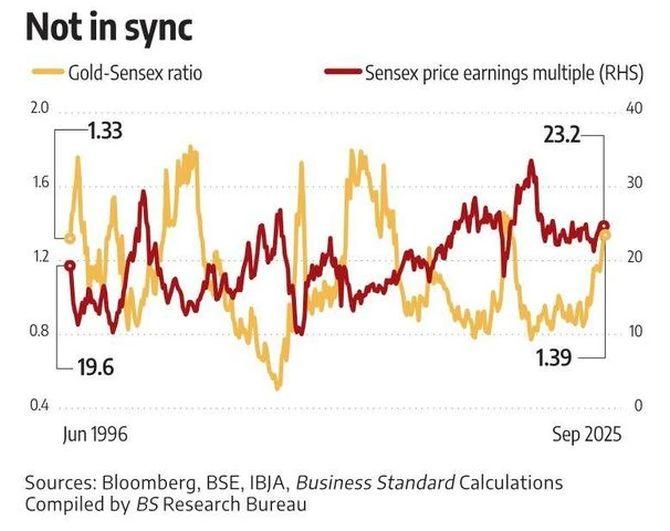
The ratio of gold to equity for the Indian markets on September 26, 2025 climbed to 1.4, the highest since January-March 2014, when it was close to 1.5.
For comparison, the ratio was 0.97 at the end of December last year and 0.89 at the end of September.
The current ratio is also out of line with the historical averages over the longer term.
In the past 30 years, the median value of the ratios of the spot gold price to the Sensex has been 1.04.
This means historically, equity and gold prices move in tandem over the long term and a period of good performance by one asset class is followed by its underperformance.
For example, the Sensex outperformed gold for nearly two years between late 1998 and June 2000. This was followed by a steady selloff in equities for the next few years and the yellow metal beat the Sensex between the middle of 2000 and the middle of 2003.
Equity then outperformed gold for four years between 2003 and 2007, followed by a sharp rise in gold prices in 2008 and 2009 while stock prices declined.
Recently, there was a steady rally in equities for nearly a decade between 2012 and 2021, barring a blip during March-June 2020, while gold prices languished.
The yellow metal has been outperforming Indian equities for four years now, starting September 2021.
This is the longest winning streak for gold in the last three decades, surpassing its outperformance between February 2000 and May 2003.
In the past four years, spot gold prices (for standard 24K gold) in the domestic market have been up 147 per cent from Rs 45,600 per 10 gm at the end of September 2021 to close at Rs 1,12,895 on September 24, 2025.
In comparison, the benchmark equity index during the period is up just around 37 per cent. The index closed at 81,159 on Thursday compared to 59,126 at the end of September 2021.
In the same period, the ratio of gold to the Sensex is up nearly 80 per cent in the last four years -- from 0.77 in September 2021 to 1.37 on September 24, 2025.
In the past a higher ratio had signalled equity undervaluation over low-risk assets such as precious metals and presented buying opportunities for equity investors.
Analysts, however, don't expect a mean reversal in the gold to equity price ratio anytime soon and they anticipate gold to continue to outperform.
"Currently gold prices are driven mainly by purchases of central banks looking for an alternative to the dollar for investing their foreign exchange. This hints at a gradual move to some form of the gold standard from a dollar-gold standard currently," said Dhananjay Sinha, co-head, research and equity strategy, Systematix Institutional Equity.
"This is a phenomenon that takes place once in a century and has no parallel in recent history," adds Sinha.
Gold's new role as a hedge against geopolitical uncertainties and a central-bank reserve asset has pushed the yellow metal into uncharted territory and it could rise even higher.
"Central banks are structurally raising the floor under gold prices by steadily reducing the amount of gold available for trading in the market," wrote Lina Thomas, research analyst, Goldman Sachs.
The brokerage house is advising investors to protect their portfolios of stocks and bonds against unexpected tail risks in financial markets by diversifying into gold and other commodities.
Any possibility of a mean reversal in the gold-Sensex ratio has been complicated by relatively high equity valuations. In the past when this ratio surged it was accompanied by an equally sharp decline in equity valuations.
When the ratio jumped to a decadal high of 1.73 in February 2009, the index-trailing price-to-earnings multiple and price-to-book value ratio slumped, respectively, to a two-decade low of 10 and 2.5.
Similarly, there was a sharp fall in Sensex valuation ratios in 2012 and 2020 along with a surge in the gold-Sensex ratio.
In contrast, the recent rally in gold prices has occurred without any decline in equity valuation.
The Sensex price-to-book value ratio is close to its high level in a decade while trailing price-equity multiple is hovering at its post-Covid highs.
Feature Presentation: Aslam Hunani/Rediff












 © 2025