
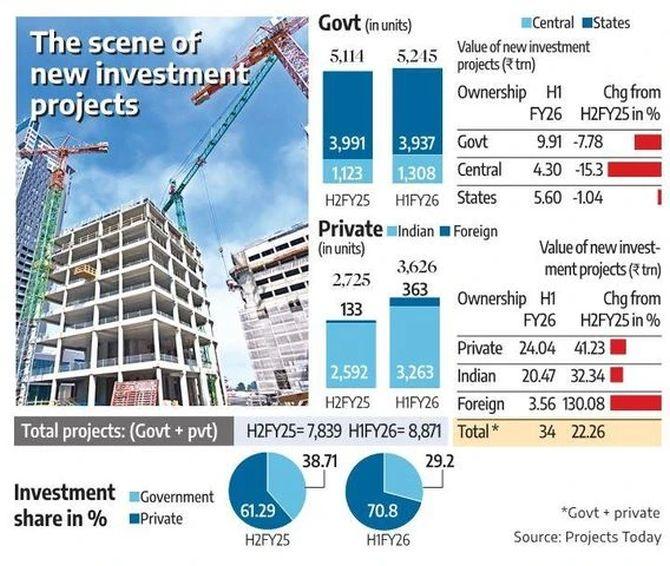
Private investment projects constitute well over 70 per cent of the nearly Rs 34 trillion of fresh investments announced in H1 this year.

Signalling a rebound in private investments, the second quarter of 2025-26 (FY26) witnessed a near doubling in the value of new investment plans from private promoters, with fresh outlays of Rs 10.55 trillion in about 1,800 projects, compared to Rs 5.69 trillion a year ago.
The total value of new investment projects surged 62 per cent in Q2 to cross Rs 15 trillion, taking overall investments in the first half (H1) of FY26 to Rs 34 trillion, 22.3 per cent higher than the previous six months, according to data from investment monitoring firm Projects Today.
Within this, new private sector capex plans rose a sharply 41 per cent in H1FY26 relative to H2FY25, at Rs 24 trillion, led by a spurt in manufacturing and electricity projects, even as infrastructure building plans moderated with new public capex projects slowing down.
Notably, foreign investors' capex plans soared 130 per cent to over Rs 3.56 trillion, while domestic private players recorded a 32 per cent uptick.
Private investment projects constitute well over 70 per cent of the nearly Rs 34 trillion of fresh investments announced in H1 this year.
This reflects a significant shift after years of heavy lifting on the investment front by government and public-sector capex to compensate for tepid private investment impulses.
For context, the private sector's share of new capex was just around 61 per cent in Q2 as well as H2 of FY25.
New central government investment plans grew 15 per cent year-on-year to Rs 2.07 trillion in Q2, with states accelerating new capex projects by 36 per cent to over Rs 2.38 trillion.
However, on a sequential six-month basis, central capex plans were down 15 per cent in H1 this year compared to H2FY25, while the value of states' investment projects declined 1 per cent.
"The April-September 2025 period has demonstrated resilience with a 22 per cent rise in fresh investment announcements, led by private-sector proposals in the manufacturing and renewable energy sectors.
"The second half is expected to reinforce this trend, supported by a rebound in public infrastructure spending and steady consumer demand," said Shashikant Hegde, director and CEO of Projects Today.
Private investments, he reckoned, are likely to retain their lead in FY26.
"While export-oriented sectors may feel the pinch of global trade frictions, sectors like construction, electronics, automobiles, data centres, transport and social infrastructure, are expected to keep the aggregate investment outlook buoyant... Having accounted for over 70 per cent of total new investment proposals in H1-FY26, private promoters showed strong intent in long-gestation and high-value projects across renewable energy, metals, petrochemicals, and digital infrastructure," Hegde pointed out.
Fresh infrastructure investments sequentially contracted 2.5 per cent to Rs 10.87 trillion in H1FY26, and the sector's share in total investment fell from 40.15 per cent to 32.02 per cent, largely due to a slowdown in government-led capex plans and fewer mega transport and social infrastructure projects.
On the slight moderation in government-led projects in H1FY26, the project monitoring firm's head said he expects the trend to reverse in the coming months, with central and state sectors together likely to close the year with healthy expansion.
Manufacturing projects worth Rs 8.81 trillion were announced between April and September, 34 per cent higher than H2FY25, lifting the sector's share in new outlays to nearly 26 per cent from 23.7 per cent.
"The rise was broad-based, supported by announcements in steel, cement, automobiles, and electronics, reflecting both private-sector optimism and PLI (production-linked incentive) schemes extended to key industries," Projects Today's 100th survey report of investment projects noted, adding that metals, petrochemicals, fertilisers, plastics, and automobiles projects, provided most of the momentum.
Electricity investments grew at an even faster rate of 38.54 per cent in H1 to hit Rs 12.93 trillion, commanding a share of 38.1 per cent in fresh outlays compared to 33.6 per cent in H2 last year.
This was driven by large-ticket solar and wind power projects, coupled with mega-sized thermal and hydel power projects.
Activity in the mining sector remained subdued, with a 15.5 per cent drop to Rs 29,275.5 crore in H1, following a sharper contraction in the previous half. ONGC was the largest investor, with twin oil and gas exploration projects costing Rs 10,267 crore.
However, irrigation investments rebounded sharply to Rs 1.05 trillion in H1, an almost 188 per cent spike from H2FY25, thanks to new State-sponsored irrigation schemes, particularly the Polavaram-Banakacherla linking project in Andhra Pradesh worth Rs 81,900 crore, and Maharashtra's Rs 6,394 crore Poshir Dam project.
Maharashtra re-emerged as the top destination for fresh outlays in Q2, after losing the spot to Rajasthan in Q1 this year, but its share in the country's new project investments dropped to 19.6 per cent from 25.1 per cent in Q2FY25.
Andhra Pradesh took the sharpest leap over this period, accelerating to the second spot with investments of Rs 2.89 trillion, equivalent to a 19.2 per cent share in total fresh outlays, up from a mere 3.4 per cent share worth Rs 31,620 crore in Q2 last year.
The latest quarter numbers have lifted the N Chandrababu Naidu-led state's performance to the second-best in the country after Maharashtra through the first half of FY26, with investments of Rs 4.77 trillion, nearly 2.8 times its tally in H2FY25, when it was ranked sixth.
This pushed Rajasthan, with investments of Rs 4.72 trillion, to the third spot in H1 from the second rank in H2 last year, despite a healthy sequential uptick in outlays.
Gujarat, which received the third-highest outlays in H2 FY25 worth Rs 3.32 trillion, slipped to the fourth position among states in H1 this year, though outlay numbers declined only marginally to about Rs 3.27 trillion.
Its overall share in new investments dropped to 9.6 per cent from 12 per cent in H2 FY25.
Feature Presentation: Aslam Hunani/Rediff










 © 2025