
The recent notification by the Insolvency and Bankruptcy Board of India (IBBI) allowing part-resolution of stressed assets of companies under the insolvency process has sent many resolution professionals (RPs) and committees of creditors (CoCs) back to the drawing board to reassess their strategies for resolving corporate insolvencies.
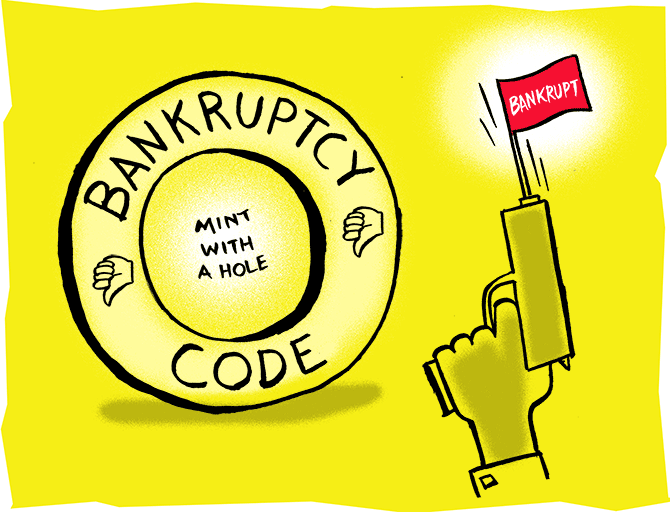
In a notification dated May 26 of this year, the IBBI allowed RPs to invite resolution plans for not just the company as a whole but also for the sale of one or more of its assets.
“By enabling concurrent invitations, the resolution process can reduce timelines, prevent value erosion in viable segments, and encourage broader investor participation,” IBBI said in its notification.
Insolvency and Bankruptcy Code (IBC) experts say the move was a much-demanded course correction by RPs, especially since IBBI had earlier allowed companies to go in for partial resolution only after first exhausting the option of resolving the company as a whole.
“We are witnessing increased interest from bidders in structuring resolution plans around standalone units or asset clusters, especially in sectors like infrastructure, EPC (Engineering, Procurement, and Construction), and manufacturing. Resolution professionals are now revisiting earlier liquidation bound cases to assess viability under this new lens,” said Sonam Chandwani, managing partner, KS Legal & Associates.
Several ongoing and upcoming large insolvency cases in sectors including infrastructure, real estate, steel, thermal power, and retail are expected to see a practical application of this part-wise resolution model.
“It is a good step though not many large companies are still remaining in the corporate insolvency resolution process, so the impact in short term may be muted.
"Nonetheless, it would still be put to use in CIRP cases where companies have varied businesses across sectors or geographies," said Ashish Chhawchharia, partner (debt & special situations), Grant Thornton Bharat.
IBBI’s latest quarterly report shows 1,926 bankruptcy cases are active within the Corporate Insolvency Resolution Process (CIRP) framework.
Out of the 1,194 corporate debtors (CDs) rescued under the IBC as on March this year, 172 had admitted claims of more than Rs 1,000 crore.
“This would enable the RPs to attract a wider pool of bidders, where some would be interested in the company, others in specific assets, thereby increasing participation, shortening timelines, and potentially maximising recovery.
"This can prevent viable assets from being dragged down by non-perfo rming ones and reduce the number of liquidation cases,” said Amit Kumar Nag, partner at AQUILAW.
In March 2024, the insolvency regulator had allowed the committee of creditors to invite resolution plans for individual projects in the real estate sector, providing the much needed flexibility for the sector related insolvencies. Insolvency law experts had said that project wise insolvency or “reverse insolvency” was a very practical solution given the unique nature of the real estate sector which had intervening financial interests of lenders and allottees alike.
However, outside real estate, too large companies undergoing insolvencies could have businesses which are very different or are spread across different locations.
Some bidders may be interested in particular businesses or acquiring assets in a particular location.
“The larger impact is likely to be seen in some time, but we have received queries from resolution professionals as well as resolution applicants on the feasibility of business transfer agreement oriented resolution plans for a certain division of the business of the corporate debtor,” said Sukrit Kapoor, partner at King Stubb & Kasiva, Advocates and Attorneys.
Experts say that in the present scenario, cases such as Gensol Infrastructure, which has recently been admitted to insolvency, would see the part resolution option being used given its business ranged from electric vehicles to infrastructure.
In case of Byju's, too, its online education business and physical coaching centres could find different takers.
Bidders are expecting a calculated recalibration in the resolution plans in the near future following the latest change in regulations.
“The amendment shall reduce timelines, prevent value erosion in viable segments, and provide the scope for broader investor participation, therefore, making the entire process swift with minimal depreciative loss,” said Asav Rajan, associate partner at IndiaLaw LLP.
For many IBC watchers, the amendment is seen as a response to the insolvency of Jaiprakash Associates Limited (JAL) which was told by the adjudicating authority to try “cluster resolution” only after the full resolution of the company does not elicit a good response.
Five companies have submitted resolution plans with earnest money for Jaiprakash Associates Ltd. (JAL), the flagship company of the beleaguered Jaypee Group, the company said in a stock exchange filing. Adani Group, Vedanta Ltd., Jindal Steel & Power, Dalmia Bharat, and PNP Infrastructure.
“If the committee of creditors of JAL is not satisfied with the plans being submitted, then this would be a perfect case to try part resolution,” a senior RP said.












 © 2025