
'We are expecting investment, public and private, of around Rs 40 trillion by 2029.'

N Chandrababu Naidu is known for promoting information technology in his previous stints as chief minister. After taking charge again last year, the 'CEO CM' is shifting gear to concentrate on artificial intelligence, quantum, and green energy. Naidu talks about his 'Swarna Andhra' dream in an exclusive interview with Shine Jacob/Business Standard in Visakhapatnam.
You used to be called chief executive officer of Andhra Pradesh for promoting IT.
In your return as chief minister, what are your focus areas that will drive the Swarna Andhra 2047 vision?
Technologies are changing and so is the way business is done. Earlier I promoted IT with Hi-Tech City. Now technology has moved toward AI and also data centres.
These data centres need green energy. I am ensuring that data centres and green energy find meeting ground. This will help the power requirements of the data-centre industry.
That is where ecosystem players are building up, and I am working as a catalyst. And now people are coming.
Corporate offices will become redundant with data centres, AI, and quantum. One should imagine what is happening.
Previously, I imagined IT and promoted it, and as a result, the highest earners in the sector are Indians and among them, 35 per cent are from the Telugu community.
Google's mega AI investment is on. What will be the role of industry in the Swarna Andhra dream?
We are expecting investment, public and private, of around Rs 40 trillion by 2029, which is the first phase. As of today, in the public sector itself, we may get Rs 20 trillion with an employment of two million.
The way things are happening, more and more investment will come as people are thinking that something is happening only in Andhra Pradesh.
The state is going to become the gateway of India for investment. Once you create wealth, revenue will be generated, and through that, we can give welfare and go for an equitable society.
I am targeting P4 (public, private, people, partnership) with people as capital.
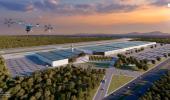
Google is investing $15 billion over five years to build its largest AI data centre outside the United States in Visakhapatnam.
ArcelorMittal is coming up with a Rs 1.4 trillion steel plant, Bharat Petroleum will have a Rs 1 trillion refinery, NTPC and the state government are investing Rs 1.5 trillion.
Everybody is talking about data centres.
The strong point with India is its demographic dividend. We want population management in place and to have more children.
That is why I have introduced schemes like the Talliki Vandanam (providing annual financial assistance of Rs 15,000 to mothers of school children).
Any number of children and I am giving them benefits.
Being someone who revolutionised IT in India, what is your perspective on quantum computing and AI?
Now I am taking the next step into quantum computing. When I started quantum-valley plans, people never understood that.
It took some time. We are creating an ecosystem for manufacturing quantum computers. Within two years, we will produce them here.
AI is the order of the day, and I want to see every home using AI. That will make our lives simple and more effective. That is why I brought the Ratan Tata Innovation Hub to Amaravati.
We are coming up with a hub-and-spoke model for technology and innovation, focusing on Visakhapatnam, Rajahmundry, Vijayawada, Amaravati, Tirupati, and Anantapur.
I am bringing everybody together -- industry, knowledge partners, venture capital, bankers, and mentors. Most importantly, to create last-mile infrastructure, we are laying emphasis on MSMEs (micro, small, and medium enterprises) as well.
Every constituency will have one MSME park, and in the park, we will create everything in a plug-and-play model with all infrastructure. This will help them operate immediately.
What is your vision for making Amaravati a global city?
Amaravati is an interesting project. Any city is built with private participation and the government will be a facilitator.
We have introduced land pooling for farmers, and 29,000 farmers have given 33,000 acres without taking a rupee.
This is land monetisation. I am constructing offices and developing them, and giving back their land.
Then private participation is there, with a lot of educational institutions and hospitals coming up in the area.
This will get me revenue. We are spending around Rs 50,000 crore to develop infrastructure.
Higher debt is a concern for the state. How are you looking to tide over this?
It will take some time. We have to balance things, keeping in mind people's aspirations. By fulfilling that, I have to step up economic activities. This way I can reduce debt.
What about rising investment in renewables?
Solar has become cost-effective. Now, hybrid models are coming with solar, wind, and pumped storage. In the course of time, green hydrogen and ammonia will become a reality.
We will export both these through our port-led economy. We have a coast of 1,000 km with around 20 ports. Our idea is to make full use of them.
One by one, the ecosystem is being created. I am creating a green hydrogen valley.
In the case of agriculture too, food habits of people are changing. That is why we are trying to produce demand-driven crops.
I am asking people to take steps to enrich the soil by correcting deficiencies. Rayalaseema will be a horticulture hub, and Andhra Pradesh will be an aquaculture hub.
How important are Centre-state relations in achieving the targets?
They (the Centre) are helping out in the case of the Visakhapatnam steel plant, the Amaravati project, and many more.
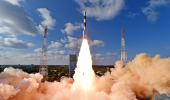
Our prime minister has introduced private-sector participation in satellites. Now, the state's dedicated space city will launch satellites.
We are encouraging drones too through a Drone City. We are making three regional development authorities -- Visakhapatnam, Amaravati, and Tirupati.
Feature Presentation: Aslam Hunani/Rediff






 © 2025