
Any industrial policy is only as good as how it is applied and the other reforms that support it.
This was as true 40 years ago as it is now, points out Debashis Basu.
First it was the shadow-banning of exports of rare earths that panicked Indian electric vehicle manufacturers. Now comes the Chinese halt on specialised fertilisers.
A German tunnel-boring machine bound for India is reportedly stuck in China, awaiting export clearance.
What next? India, the drug-manufacturing giant, imports 80 per cent of key starter materials from China. What if that is choked?
China needs nothing critical from India -- on the other hand, India needs $115 billion worth of goods every year from China to keep various parts of its economy going.
All those who were advocating that manufacturing is less relevant to nation-building in a globalised economy need to offer an explanation to the chokehold China has come to acquire.
The answer, of course, is more local manufacturing, especially of critical items, which should come as a surprise.
Forty years ago, the dominant economic prescription was a heady cocktail of free-market principles: Open competition, minimal government interference, low tariff barriers, and financial liberalisation.
This marked a decisive triumph of free-market ideology over State-led planning.
Well, this manner of thinking appears to have come full circle now: Tariff barriers are up and government intervention is strongly shaping economic forces.
United States President Donald John Trump wants to reshore manufacturing, from steel to electronics to drugs.
His predecessor Joe Biden had doubled down on vast subsidies for semiconductors and green technologies.
Britain is discussing subsidising energy bills of manufacturers, and India has been offering incentives to boost local manufacturing in 17 sectors.
Indonesia is mandating 'local content' in foreign investments in manufacturing -- with its vast nickel reserves, it aspires to be an EV powerhouse.
The idea of an 'industrial policy' once evoked memories of State inefficiency and rent-seeking.
Between the 1950s and 1970s, India's industrial policy was a mix of price controls, licensing, import restrictions, and public-sector dominance -- a model that stifled entrepreneurship, fostered inefficiencies, and propped up corrupt State enterprises that drained the public exchequer.
So how is it that industrial policy and its core component, manufacturing, are back as the preferred growth hormones? The answer is China.
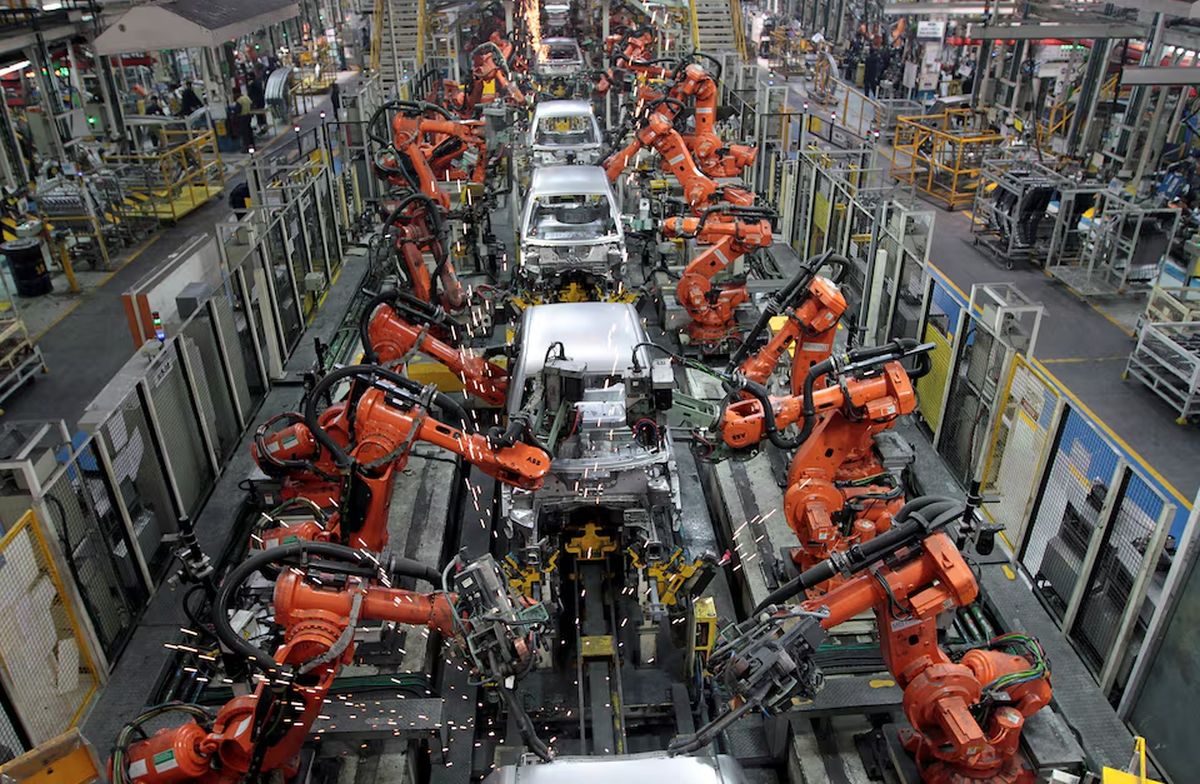
Missed the lessons of how sensible industrial policies can transform a nation -- Japan before the World Wars, and Taiwan and South Korea later? China today provides a dazzling masterclass on how to formulate and implement long-term industrial policy, under which it has come to control 32 per cent of global manufacturing, making even the mightiest of nations vulnerable in the face of its prowess.
Where does India fit into these trends? Prime Minister Narendra Modi's 'Make in India' campaign promised to raise the share of manufacturing in GDP from 15 per cent in 2014 to 25 per cent by 2025, with an eye on job creation and export growth.
But apart from promotional slogans and roadshows, little of substance happened.
A more structured attempt came six years later, in March 2020, when India launched the production-linked incentive (PLI) scheme for three sectors, which was later expanded to 17.
The idea was to scale up domestic manufacturing capability to up to ₹30 trillion, substitute imports, and create six million new jobs.
The PLI scheme has spurred some success in mobile-phone assembly and pharmaceutical ingredients.
Yet, domestic value addition remains low, with key components still being imported.
In January 2024, a government release claimed that 678,000 new jobs had been created under it -- a drop in a country where over 10 million young people enter the labour market annually.
The manufacturing share of GDP has in fact slipped further, from 15.4 per cent in 2020 to 14.3 per cent in 2025.
A Reuters investigation, citing internal government documents, noted that less than 8 per cent of the allocated PLI funds had been disbursed till October 2024.
Additionally, two-thirds of the scheme's targets had been missed. What happened?
The PLI scheme puts the cart before the horse. The horse in this case is the quality of education and research, and the enormous frictional cost of doing business that comprises logistics, energy, taxes and cess, bribes, state and central laws, and red tape.
This is why even labour-intensive sectors like leather, garments, handicrafts, and jewellery have failed to scale.
The scheme is a useful reminder that shortcuts won't build industrial capability.
A genuine manufacturing ecosystem takes years of foundational reform.
India's efforts to build this foundation have been sporadic at best.
In the mid-2000s, the Congress-led government tried to emulate the export-led success of countries like Thailand and Malaysia by promoting special economic zones.
But the initiative devolved into corruption, controversy, and scandal, ultimately fizzling out.
It had included gems such as a 1,000-acre land allotment near Nagpur to fugitive businessman Mehul Choksi.
India never tried to reduce logistics costs systematically until October 2021, when Gati Shakti was launched.
Apart from reducing logistics costs (currently 13 to 14 per cent of GDP compared to 8 to 10 per cent in China), it also aims at enhancing connectivity with economic zones.
Had manufacturing taken off, it could have addressed India's twin challenges of joblessness and poverty.
Unlike services, it can absorb large pools of unskilled and semiskilled labour.
But instead of building this base, the government has focused on numerous cash transfers and welfare schemes.
While these may prevent unrest and yield political dividends, they also dull the incentive to work, especially in rural India.
Employers in the manufacturing sector routinely report a shortage of willing labour, despite high unemployment.
India's demographic dividend is fast turning into a demographic liability.
The small-scale sector, which employs the overwhelming majority of workers, is struggling in a stifling and creaking ecosystem.
Any industrial policy is only as good as how it is applied and the other reforms that support it.
This was as true 40 years ago as it is now.
Debashis Basu is editor of moneylife.in and a trustee of the Moneylife Foundation.
Feature Presentation: Aslam Hunani/Rediff











 © 2025