
New investors should not allow themselves to fall prey to FOMO and rush headlong into gold.

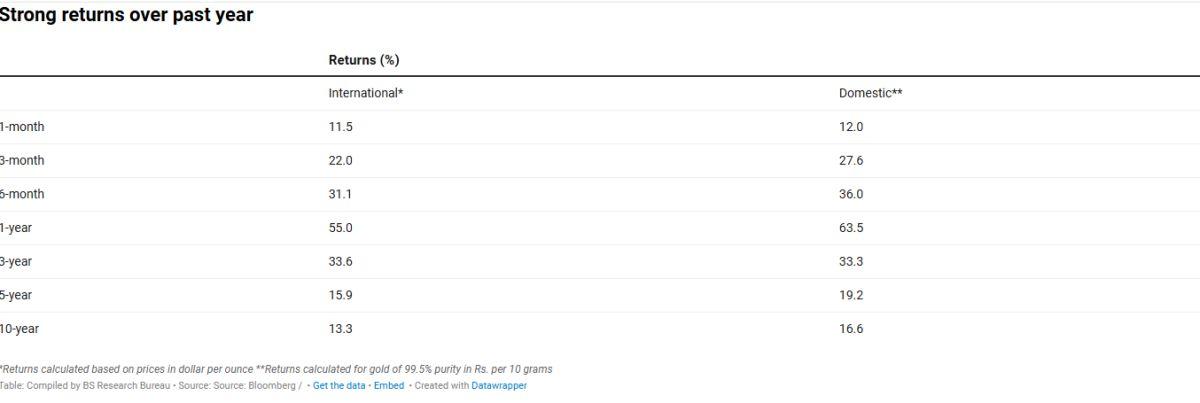
Gold touched a record high of Rs 1.24 lakh per 10 grams on October 7, according to media reports. It is up 62.4 per cent over the past year.
The yellow metal also crossed $4,000 per troy ounce for the first time in the international market.
Central bank purchases a key driver
Central banks are diversifying their reserves away from US dollar holdings.
"About 25 to 30 years ago, central banks typically held 75 to 80 per cent of their reserves in US treasuries. That figure has fallen below 60 per cent and could drop further in the future," says Vikram Dhawan, head commodities and fund manager, Nippon India Mutual Fund.
A global reset in asset allocation is taking place by institutional and retail investors (besides central banks), which has accelerated after Covid.
Those who were previously underweight in gold or not invested at all, except during crises, are now increasing their allocations.
Geopolitical tensions since 2022, trade wars, and macroeconomic uncertainties about inflation, currencies, and interest rates have made gold attractive.
Global debt levels are at historic highs. "Since gold carries no credit risk, it has become a preferred asset," says Dhawan.
Western central banks' low interest-rate policies and increased chances of rate cut by the US Federal Reserve are also supporting gold.
The attractiveness of this non-yielding asset increases when real interest rates decline.
"The US government shutdown has also increased market anxiety, prompting investors to seek refuge in precious metals," says Saumil Gandhi, senior analyst - commodities, HDFC Securities.
Depreciation of the Indian rupee against the US dollar has led to a higher price rise in rupee terms.
"In India, rupee depreciation and higher exchange-traded fund (ETF) flows have further boosted gold prices," says Tapan Patel, fund manager - commodities, Tata Asset Management.
Asset allocation reset to support rally
The ongoing global reset of asset allocation may continue to fuel the rally.
"Until this reset is complete, gold prices are likely to remain supported," says Dhawan. Once the rebalancing reaches a plateau, prices may become range-bound.
Continued tariff and trade uncertainty in the Trump era could drive safe-haven flows into gold.
"US Fed rate cut cycle, central bank buying, weaker dollar due to de-dollarisation, speculation over US government shutdown, uncertainty over US mid-term election, and geopolitical risks can lead to further uptrend," says Patel.
Global investment banks have been raising their price targets for gold, which could encourage more retail participation. India's underperforming equity market is also propelling investors towards gold.
Higher-than-expected inflation in key markets like the US could push gold prices further up.
"Persistent currency depreciation would lead to higher domestic gold prices," says Vishal Dhawan, founder & CEO, Plan Ahead Wealth Advisors.
Ongoing currency depreciation would also boost the value of gold in rupee terms, he adds.
Physical demand could take a hit
De-escalation of geopolitical tensions or trade wars could act as a headwind for gold.
"Short-term corrections may occur if there are successful tariff negotiations or peace deals," says Patel.
At the current high prices, jewellery demand could be affected. This could weigh on prices unless offset by investment flows and central bank purchases.
Demand during the festive season will be an important indicator.
"Weak physical demand could lead to volatility, as India accounts for a large share, around 20-odd per cent, of global demand," says Vikram Dhawan.
The rally has become overstretched after a sharp run-up. "Some investors may book profits at current levels, leading to short-term volatility," says Gandhi.
Outlook remains positive
Experts are of the view that the bullish trend in gold is likely to continue in the near future, though minor price or time corrections may occur.
"Comex gold could reach between $4,100 and $4,300 in the next six months. Domestic market prices could rise to around Rs 1,25,000 to Rs 1,27,000 per 10 grams in six months," says Gandhi.
Vishal Dhawan is of the view that after three years of unusually high returns, gold prices are likely to consolidate.
Build exposure gradually
New investors should not allow themselves to fall prey to FOMO (fear of missing out) and rush headlong into gold.
Vikram Dhawan suggests that they should take exposure to it for diversification and asset allocation, rather than chase short-term gains.
The ideal allocation to gold depends on a person's risk appetite and investment objectives.
"Aggressive investors can allocate up to 5 per cent of their portfolio to gold. Conservative or moderate-risk investors can raise their gold allocation to around 10 per cent," says Vishal Dhawan.
Investors with zero or low exposure should invest in a staggered manner using a systematic investment plan or a systematic transfer plan, or they should buy during price dips.
New investors must enter with at least a 7 to 10-year horizon.
Existing investors should book profits if their allocation to gold has exceeded the upper limit, say, of 10 per cent, that they had set. Consider capital gains tax before selling.
"Avoid selling gold before it has become eligible for long-term capital gains tax," says Vishal Dhawan.
Disclaimer: This article is meant for information purposes only. This article and information do not constitute a distribution, an endorsement, an investment advice, an offer to buy or sell or the solicitation of an offer to buy or sell any securities/schemes or any other financial products/investment products mentioned in this article to influence the opinion or behaviour of the investors/recipients.
Any use of the information/any investment and investment related decisions of the investors/recipients are at their sole discretion and risk. Any advice herein is made on a general basis and does not take into account the specific investment objectives of the specific person or group of persons. Opinions expressed herein are subject to change without notice.
Feature Presentation: Aslam Hunani/Rediff










 © 2025