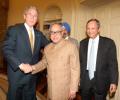
External Affairs Minister Pranab Mukherjee met United States President George W Bush at the White House in Washington on Monday and discussed the entire gamut of bilateral ties, including the civil nuclear deal.Bush and Mukherjee are said to have exchanged not only pleasantries but also discussed the width and depth of the United States-India relations that included the civilian nuclear initiative.Specific details of the meeting have not been made available to the media.

Petraeus said he will recommend reducing the number of American troops in Iraq by next summer.
The Act will allow the two countries to share civilian nuclear technology and bring India's civilian nuclear program under the safeguards of the International Atomic Energy Agency.
The Australian government has already made it clear that it will reverse a decision by the previous John Howard administration to sell uranium to India as New Delhi is not a signatory to the Non-Proliferation Treaty. 'But the Bush administration is expected to seek a promise from Australia that it will not vote against the Indian agreement in the NSG, in which it is one of 45 member States.

External Affairs Minister Pranab Mukherjee has arrived in Washington as part of his maiden bilateral visit to the United States, during which the civil nuclear deal is expected to dominate the parleys.Mukherjee is scheduled to meet Secretary of State Condoleezza Rice tomorrow at 8:45 am (6:15 pm IST). The minister will go to the White House in the afternoon to meet President George W Bush as well as National Security Advisor Stephen Hadley.

The two came together when Bush ran for Governor of Texas in 1992
The trip will be decorative. No offical treaty to mark the conclusion of the 123 Agreement will be signed by Bush and Dr Singh
The prime minister is also expected to hold high level meetings with several world leaders on issues of mutual importance.
Bush said the US is in constant communications with the Pakistan government over the issue.
Maintaining that he is not aware as to when exactly the US-India civilian nuclear agreement is going to be formally inked, the State Department's deputy spokesman Robert Wood said the important thing is that the deal has been finalised and what remains now are just administrative matters.
President George W Bush admitted on Friday that the United States is going through "tough times" amid fears that the economy has slid into recession, but assured Americans that the underlying strength of the economy would lead to a rebound. The country is "obviously going through tough times," he said but expressed confidence that the action taken by the government would put the economy back on track.
United States President George W Bush will sign the law on the India-US nuclear agreement very soon, US Secretary of State Condoleezza Rice said in New Delhi on Saturday.Addressing a joint press conference with External Affairs Minister Pranab Mukherjee, Rice assured that the US will keep its commitments both to the 123 agreement and the Hyde Act while implementing the nuclear deal with India.Rice added that the Hyde Act was consistent with the 123 agreement.

Scenes from Inauguration Day in Washington, DC as Joe Biden is sworn in as the 46th president of the United States.

The prime minister is scheduled to meet President Bush at 17.10 hours local time (0230 hours IST Friday). Indications that the agreement may not be inked on Thursday were given by David Mulford, US Ambassador to India, who received Dr Singh at the Andrews Air Force base near Washington.
Bloggers, who have picked up on this order and have begun pointing out its inequities, point out that the wording of this EO is deliberately vague.
Foreign hand fuelling insurgency: Pakistan
Prime Minister Manmohan Singh left Frankfurt for New York on a five-day visit to the US, during which he will address the UN General Assembly and hold bilateral talks with world leaders.

National Security Advisor M K Narayanan, who was part of the Indian delegation that held talks with the US side, on Thursday confirmed that the deal was clinched.
Pakistan plans to ask Bush to allow American investors, in line with IAEA safeguards.
China has said that it enjoys good relations with both India and Pakistan.
In view of the persisting differences, negotiators of the two sides have said a political push would be required to break the logjam.
President George W Bush ordered the Pentagon to shoot down the satellite through a Navy missile just before it reenters earth's atmosphere.
The erstwhile envoy to New Delhi made these remarks after accepting the 2007 Bridge-Builder Award for his role in transforming US-India relations.
President Bush has signed the economic stimulus package, to give a booster shot to US economy.
The protestors also demanded PM Singh's resignation.
A news report had claimed that Bush had threatened Dr Singh with regard to voting for Venezuela in the elections for non-permanent members of UN Security Council.
The text of US President George W Bush's final State of the Union address delivered to Congress on Monday.
The Associated Press, in a story widely reproduced in the US media, cites top US military commanders as saying that Pakistan's tribal areas are the new Ground Zero in the battle against global terrorism -- even more so than Iraq.

First Look on J&K protest over Iraq mosque blast.
"All we are interested in is that the substance of the 123 agreement should confirm with what I told the people of India, what I told Parliament."
President George W Bush said he is "pleased" with outgoing Under Secretary of State Nicholas Burns for agreeing to continue to handle the "historic" Indo-US civil nuclear deal in which Washington has been making "progress" under him.
'The reprocessing issue requires a political decision, and not a technical one,' says an Indian diplomat.
India and the US reviewed on Tuesday the Agriculture Knowledge Initiative, a joint effort of Prime Minster Manmohan Singh and US President George W Bush, with emphasis on the food processing sector.
The United States has a moral and national interest in helping poor and struggling countries transform themselves into free and hopeful societies, Bush said.
 © 2026 Rediff.com - Advertise with us - Disclaimer - Privacy Policy - Sitemap - Feedback - About us - Terms of use - Grievances