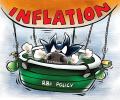
The Indian government has extended the Reserve Bank of India's (RBI) mandate to maintain retail inflation at 4 per cent, with a tolerance band of 2 per cent on either side, for another five years until March 2031.

Kerala Police arrested 165 people and registered 455 cases in a statewide operation targeting cyber financial fraud, confiscating devices and disrupting criminal networks.

Rashid Naseem, wanted in India for an alleged investment fraud, has been arrested in Dubai following an Interpol Red Notice and extradition request.

A Lenovo study reveals that Indian enterprises are planning to increase their investments in Artificial Intelligence (AI) at a higher rate than other countries in the Asia-Pacific region.

The Indian rupee weakened against the US dollar due to rising crude oil prices, geopolitical tensions in the Middle East, and foreign fund outflows.


Uttam Ghosh offers his take on the Delhi police's brutal crackdown on Jamia Millia Islamia students on Sunday during a protest against the Citizenship (Amendment) Act.

Retail inflation stood at 2.75 per cent in January under the new series of All India Consumer Price Index (CPI), with 2024 as the base year, released on Thursday.

The easing of external commercial borrowing (ECB) norms by the Reserve Bank of India (RBI) is expected to significantly boost overseas fundraising by Indian companies, market participants said.

'Multi-asset funds have cornered 30 per cent of hybrid fund inflows in 2025, reflecting a growing preference for diversified portfolios that combine equity, debt and commodities.'

Net foreign direct investment (FDI) remained negative in November 2025 for the third consecutive month, mainly due to high repatriation, the Reserve Bank of India (RBI) said in its January bulletin.

The Reserve Bank of India (RBI) on Tuesday came out with a draft framework on declaration of dividend by banks, as it proposed capping dividend payout to shareholders at 75 per cent of their net profit-- also called profit after tax (PAT).

The Supreme Court has agreed to hear a Public Interest Litigation (PIL) in March seeking action against political parties that promise or distribute 'irrational freebies' before elections. The PIL argues that such practices unduly influence voters and undermine the fairness of the electoral process.

India is the second-most-preferred destination among chief executive officers planning international investments - up from the fifth spot last year, according to PwC's 29th Annual Global CEO Survey released on Tuesday. The United States is their first choice.

India's main inflation measure, the Consumer Price Index (CPI), is set for another major update, even though it has been in its current form for only about 15 years.

Business confidence in India Inc rose to a five-quarter high in December quarter of FY26, amid further reform expectations and steady domestic demand, a survey by industry body Confederation of Indian Industry (CII) showed. The CII Business Confidence Index (BCI) rose for the third consecutive quarter to 66.5 in the December quarter from 66 in the preceding September quarter.

India's state-level fiscal rules have improved headline deficits, but the gains are fragile and uneven with major states still grappling with high debt levels, a World Bank report submitted to the 16th Finance Commission (FC) said. According to the report, despite nearly two decades of adoption of fiscal responsibility laws (FRLs), debt levels have not converged.

The new labour Codes, notified by the central government in November 2025, have pushed up employee costs for private-sector banks and insurance companies, with these firms reporting higher operating expenses in the October-December quarter (Q3FY26) due to the statutory impact of the new labour Codes.

'The problem is not just slower growth, but also the quality of growth.'

The life insurance industry recorded nearly 40 per cent year-on-year (Y-o-Y) growth in new business premiums (NBP), aided by the rationalisation of goods and services tax (GST) on individual life insurance premiums, which has made policies more affordable for consumers.
Six banks that reported their quarterly business updates for the October-December (Q3FY26) quarter on Friday recorded double-digit growth in their loan books compared with a year ago. Deposits also posted healthy growth during the period.

Trading pattern in the stock market this week will largely depend on the ongoing Q3 earnings announcement from corporates, global trends, and foreign fund movement, analysts said. Moreover, geopolitical developments and any update on trade negotiations would also be keenly tracked by investors, experts noted.

The European Union's (EU's) offer to slash tariffs on 97.5 per cent of Indian chemical exports to zero is set to give India's pharmaceutical and medical device firms preferential access to the European markets.

India's high cost of capital due to relatively shallow corporate bond markets, limited institutional investor depth, sovereign risk premia, and regulatory restrictions on capital flows, is a constraint on private investment and long-run growth, the Economic Survey, authored by Chief Economic Advisor (CEA) V Anantha Nageswaran, said.

Uttam Ghosh offers his take on the smile fest at the SCO summit in Tianjin.

The Supreme Court allowed a pregnant woman and her child into India on humanitarian grounds after they were pushed into Bangladesh.

India has resumed issuing tourist visas to Chinese nationals through its missions and consulates worldwide, marking a step towards rebuilding ties after the resolution of the eastern Ladakh military stand-off.

The Centre is considering amendments to the Recovery of Debt and Bankruptcy Act in the Budget to allow some Debt Recovery Tribunals to focus only on high-value cases.

Macroeconomic data announcements, global trends and trading activity of foreign investors would be major driving factors for market movement this week, analysts said. Unabated capital infusion by domestic institutional investors have supported the positive trend in the stock market last week, traders said.

Banks are depending more heavily on the market for certificates of deposit (CDs), whose worth climbed to a record Rs 5.75 trillion in the fortnight to January 15, owing to deposit tightness in the system.

The number of rights issues more than doubled and hit a 28-year high in 2025, even as qualified institutional placements (QIPs) shrank amid a broader market correction and the Securities and Exchange Board of India's (Sebi's) revised framework for rights issues.

Following the notification allowing 100 per cent foreign direct investment (FDI) in the insurance sector, the Finance Ministry has revised norms to remove the requirement that a majority of directors and key management personnel in an insurance company with foreign investment be Indian residents.
A neutral monetary policy stance, heavy government borrowing, and issuers adjusting to a higher-for-longer yield environment have set the stage for a largely stable corporate bond market in 2026.
The committee formed under the Life Insurance Council to review the commission structure in the life insurance sector has recommended capping distributor commissions or deferring them to ease acquisition costs. The recommendations will be sent to the insurance regulator -- Insurance Regulatory and Development Authority of India (Irdai).
Retail inflation rose to a three-month high of 1.33 per cent in December 2025 mainly due to higher prices of kitchen essentials, including vegetables and protein-rich items.
The loss of input tax credit (ITC) following the rationalisation of the goods and services tax (GST) on individual life and health insurance from 18 per cent to nil is may weigh on the profits of life insurers in the third quarter (Q3) of 2025-26 (FY26).

The government should refrain from raising income tax surcharge on the super-rich and reintroducing wealth tax in the upcoming 2026-27 Budget, as the move could prompt persons in high-income brackets to leave the country for low-tax jurisdictions, according to tax experts.

The rupee slumped 5 per cent in 2025 as persistent capital outflows from foreign investors, alongside heightened dollar demand from importers, making it one of the worst-performing Asian currencies.

Banking sector has witnessed healthy growth in advances in the third quarter of financial year 2026 (Q3FY26) against the same period last year, as the full impact of goods and service tax (GST) rate cuts drove growth. Most of the lenders saw their credit growth outpace the deposit growth in the quarter.

Cleaner balance sheets, regulatory support and strong growth prospects helped Indian private banks attract over $6 billion in foreign capital, with more deals expected in 2026.
