India and the US have decided to hold sector-specific talks in the coming weeks to finalise the structure of the proposed bilateral trade agreement (BTA), the government said on Saturday. The engagement between the two countries came in the backdrop of the USA's threat to impose reciprocal tariffs on its key trading partners, including India, on April 2.

US President George W Bush has announced that he intends to nominate an Indian American, Karan K Bhatia, of Maryland, as Deputy US Trade Representative, with the rank of Ambassador.

A fresh US executive order (EO) which seeks to bring down prices of prescription drugs in the country by up to 90 per cent -- on par with other developed nations -- will affect innovator companies, while sparing the Indian generic drug makers in the short term. US President Donald Trump signed the EO on Monday, directing the US Trade Representative and the Secretary of Commerce to act against foreign countries that "purposefully and unfairly undercut market prices", driving price hikes in the US.
The White House has said India imposes a 100% tariff on American agricultural products and the high levies charged by other countries make it "virtually impossible" for US products to be exported to those nations. President Donald Trump has repeatedly criticised the high tariffs charged by India and other countries on American goods. He plans to roll out a set of reciprocal tariffs on April 2, which he says will be "Liberation Day" for the US.
An Indian official team is likely to visit Washington next week to iron out differences on certain issues before formally launching negotiations for the proposed India-US bilateral trade agreement (BTA), an official said. The visit, which comes within weeks of a high-level US team visiting India, indicates that the talks for the BTA are gaining momentum.

The US wants India to recognise internationally accredited labs, harmonise labelling requirements and the validity period of test reports and certification with global practices, and eliminate retesting requirements.

The Indian industry is paranoid about the USA's plan to impose reciprocal tariffs and wants early conclusion of a bilateral trade agreement, sources said on Wednesday. They said that the talks for the proposed bilateral trade agreement are going well.
India maintains "high" import duties on a wide range of American goods such as agricultural items, drug formulations, and alcoholic beverages, besides imposing non-tariif barriers, a US report has said. A day before announcing reciprocal tariffs, the US Trade Representative (USTR) released the 2025 National Trade Estimate (NTE) Report on March 31.
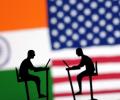
India and the visiting US officials have decided to hold a wrap-up session on Saturday morning to conclude the three-day talks on the proposed bilateral trade agreement, government sources said. They said the discussions are at a "very" early stage.

The USTR report, released just ahead of the US' April 2 deadline for implementing reciprocal tariffs, has also cited high tariffs and price caps, which have not increased in line with inflation, as key obstacles for US businesses.

The "construct of the DPDP Act" cannot be changed at this stage, though there may be some minor tweaks in the language of the Rules and formats in certain legitimate cases.
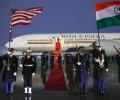
Ahead of the visit, officials from key government departments held intense discussions to identify key trade-related proposals.

The commerce ministry is working on different scenarios to assess the possible fallout of reciprocal tariffs to be imposed by the US administration on April 2 on its key trading partners including India, sources said. US President Donald Trump has said that April 2 will be 'Liberation Day' as he plans to announce tariffs or import duties to bring down America's trade deficit, and promote the country's manufacturing.
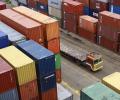
The US Trade Representative noted that India's average applied tariff rate stood at 17% per cent, the highest of any major world economy.
'As negotiations continue, the path forward demands not only diplomatic skill, but also vigilance against legal asymmetries embedded in America's trade playbook.'
Industry associations and companies in the United States, including the US Chamber of Commerce, Coalition of Services Industries and the iconic bike company Harley Davidson have called on the Donald Trump dispensation to push India to reduce tariffs, non-tariffs, and regulatory barriers to boost American exports.
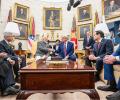
'The US has agreed to negotiate with us a mutually beneficial bilateral trade agreement, which will go for reduction of tariffs on both sides so that our trade can grow.'
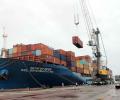
Trump's sweeping tariffs and penalties on China-built ships have turned global shipping into the front line of economic war, observes Shyam G Menon.

As the Union government explores ways to restrict import of laptops and other electronic devices starting with a 5 per cent reduction from the current level, it is working to ensure that there's no supply disruption in India even if an import cap is introduced, it is learnt. The caveat assumes significance in the context of the government's announcement of its plan in August 2023 to issue licences for import of select IT hardware products to reduce the country's dependence on China.

Global brokerage firm CLSA has reversed its early tactical shift from Indian equities to Chinese stocks, and has decided to raise India allocation while cutting exposure to China. In its report titled 'Pouncing Tiger, Prevaricating Dragon', CLSA cited challenges facing Chinese markets in the aftermath of Donald Trump's victory in the US elections as the reason for the move. "Misfortune can happen in threes. So it has played out for Chinese equities over the past week.

There was no smooth surge in middle class prosperity for foreign businesses to tap into because of the Indian economy was mismanaged, argues Debashis Basu.

After the government's online monitoring system for the import of electronic hardware items went live on November 1, inbound shipments of laptops and tablets slipped in November to a nine-month low at $225 million, contracting 17.15 per cent year-on-year. This decline was primarily driven by reduced imports from Singapore (down 43.7 per cent), Hong Kong (down 27.4 per cent), and China (down 14 per cent), according to the data released by the commerce department. China accounts for approximately 83 per cent of such imports.

India and the US have settled the last trade dispute at the World Trade Organization (WTO) over poultry products, according to a joint statement released on Friday. With this, the two countries have mutually resolved all the seven pending trade disputes at the WTO. "The leaders lauded the settlement of the seventh and last outstanding WTO dispute between India and the United States.

External Affairs Minister S Jaishankar has met United States Defence Secretary Lloyd Austin and held a productive conversation with him on deepening bilateral defence cooperation, including in the co-production of defence articles, and exchanged perspectives on a variety of security issues.
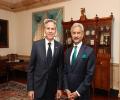
India and the US agreed to continue their cooperation in the areas of defence, space and clean energy as External Affairs Minister S Jaishankar met Secretary of State Antony Blinken here, amid a simmering diplomatic row between India and Canada over the killing of a Khalistani separatist.

The lawmakers from the US State of Washington have urged the Biden administration to help remove or reduce the tariffs on American apples imported to India as the country's fruit industry has incurred significant losses due to New Delhi's retaliatory measures. In a letter to US Trade Representative Katherine Tai and Commerce Secretary Gina Raimondo, all members of the House of Representatives from Washington State and other two senators said the tree fruit industry suffered losses due to India's retaliation to US tariffs. On average, 30 per cent of the apples, cherries, and pears produced in the Pacific Northwest are exported and India was once a strong market.

'As one might expect, he believed the Indians were preparing their nuclear weapons for deployment. It took us a few hours - and remarkably good work by our teams on the ground in New Delhi and Islamabad - to convince each side that the other was not preparing for nuclear war'
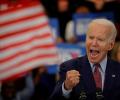
India will have to show more willingness to import, and since Biden will not encourage sale of oil and gas to bridge the gap, it means there has to be more meaningful duty reduction in other areas even if Delhi baulks at a Free Trade Agreement so soon after walking out of RCEP.

India has agreed to allow import of pork and pork products from the US as a part of a bilateral trade deal which will facilitate export of Indian mangoes and pomegranate to the US. The development comes months after the two governments renewed the India US Trade Policy Forum (TPF), after which both nations agreed to iron out thorny issues that included market access issues pertaining to the agriculture sector.

The US on Thursday raised concerns over India's Personal Data Protection (PDP) Bill and draft non-personal data governance framework, claiming these could potentially threaten innovation and economic growth. In its latest 'Special 301' Report, the US Trade Representative (USTR) kept India on the priority watch list, maintaining the country remains one of the world's most challenging major economies with respect to protection and enforcement of intellectual property (IP). In December 2021, a joint parliamentary committee released a report recommending changes to the PDP Bill, 2019, that could undermine important IP protections in India.
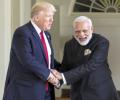
Indications are that a 'preliminary agreement' may be unveiled during Prime Minister Narendra Modi's visit to the US this week, with President Trump signing the final deal in India in November.
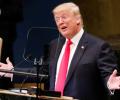
Trump said the relationship with both India as well as the country's Prime Minister Modi "is great".

The US Trade Representative's (USTR) office will also conduct the Section 301 probe against nine others, including Austria, Brazil, Indonesia, Italy, Spain, Turkey, the Czech Republic, the UK, and the EU, for levying or considering digital services taxes "discriminating against US companies".

The US president alleged that China had been indulging in tremendous intellectual property theft worth hundreds of billions of dollars on a yearly basis.
US officials said the win will help lower trade barriers and open new markets.
In January last year, the US signed the first phase of the trade deal with China, which former President Donald Trump described as historic, concluding more than a year of tough negotiations including several months of suspension of talks between the two largest economies of the world.

The high point of the trip will be Goyal's meeting with US Trade Representative Robert Lighthizer on November 13, which is expected to see the USTR push India towards lower import duties in a broad range of areas.

The group has called for a retaliatory tariff action against India, if New Delhi does not roll back the 'unilateral and discriminatory' equalisation levy or Google Tax.
He had the responsibility to oversee the US trade relations with Asia and Africa.

Calling COVID-19 pandemic and vaccines as one of the most important aspects of his discussions with top officials of the Biden administration, External Affairs Minister S Jaishankar has said the endeavour is to expand production of vaccines in India with assistance from the US.
 © 2026 Rediff.com - Investor Information - Advertise with us - Disclaimer - Privacy Policy - Sitemap - Feedback - About us - Terms of use - Grievances