
The CBI had received Rs 802.19 crore initially in the last budget and it was increased to Rs 835.75 crore in the revised estimates for 2020-21.

State-owned oil firms such as ONGC and IOC will invest over Rs 1.11 lakh crore in the next fiscal year starting April as they supplement the government's massive spending programme to spur economic growth. Oil and Natural Gas Corporation (ONGC), Indian Oil Corporation (IOC), GAIL (India) Ltd, Bharat Petroleum Corporation Ltd (BPCL), Hindustan Petroleum Corporation Ltd (HPCL) and Oil India Ltd (OIL) will together make a 7.4 per cent higher capital expenditure in the 2022-23 fiscal (FY23). The capex spending of Rs 1.11 lakh crore in 2022-23 compares with a revised estimate of Rs 1.04 lakh crore for the current fiscal year that ends in March, according to Union budget documents.

'The number of leave accumulated sometimes goes up to 300.' 'The encashed amount is equivalent to almost 10 months' salary.'

The Union Budget on Monday evoked contrasting responses in the political arena with the ruling Bharatiya Janata Party hailing it as a vision for an 'Aatmanirbhar Bharat' and the Opposition describing it as a 'let down like never before' that was meant to 'deceive' people.

PEs and VCs are taking a closer look at their bouquet of investments. Leading voices in the sector are categorical that cash-burn rates -- that's blowing up equity to acquire market share -- as a business model can't continue to be the polestar.
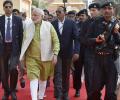
In the Union Budget for 2021-22 presented by Finance Minister Nirmala Sitharaman on Monday, the force received Rs 429.05 crore, an increase of Rs 2.78 crore (or 0.65 per cent hike) from the last budget.

The definition will be revised by raising capital base to Rs 2 crore from the current limit of Rs 50 lakh.

The agency was allocated Rs 835.39 crore to manage its affairs in 2021-22 which was later increased to Rs 870.50 crore in the Revised Estimates given in the Budget document released Tuesday by Finance Minister Nirmala Sitharaman.

'Modi has sowed the seeds of a transformational change.' 'For the sake of the nation and our children I hope he succeeds.'

In addition to the negative sentiment as a consequence of changes announced in the Union Budget 2023-24 concerning tax treatment for debt repayment distribution, concerns about hiring slowdown and its leasing impact, as well as higher interest rates, could blight the sector in the near term.

The government on Tuesday announced Rs 900-crore allocation in the Budget for the newly set up Ministry of Cooperation for the 2022-23 fiscal, besides slashing Alternate Minimum Tax (AMT) on cooperative societies to 15 per cent and surcharge to 7 per cent, which nodal minister Amit Shah hailed saying it will boost the sector. Of the total allocation for the next fiscal, a significant amount of Rs 350 crore has been provided for digitisation of Primary Agriculture Cooperative Societies (PACs), while Rs 274 crore for an umbrella scheme 'Prosperity through Cooperatives' which would have a number of sub-components with the aim of all-round development of cooperatives in the country. For the first time, a separate budget of Rs 11 crore has been provided to Vaikunth Mehta National Institute of Cooperative Management (VAMNICON).

The pre-budget Economic Survey, which is tabled in Parliament ahead of the Union Budget to present the state of the economy and suggest policy prescriptions, quite often misses on the GDP forecast, sometimes by a significant margin. This time, Finance Minister Nirmala Sitharaman will table the Economic Survey for 2021-22 in the Lok Sabha on Monday soon after the President's address to both Houses of Parliament. She will present the Union Budget for the next financial year beginning April 1, 2022, on Tuesday.

Senior tax officials were told to focus on cash collection from the arrears so that the target for FY23 was achieved and the overall revenue position improved.

Per capita income has more than doubled to Rs 1.97 lakh in around nine years. Indian economy has increased in size from being 10th to 5th largest in the world in the past nine years. Seven priorities of the Budget, 'Saptarishi', are inclusive development, reaching the last mile, infrastructure and investment, unleashing the potential, green growth, youth power and financial sector.
