
As per the Trai recommendations, the STD service providers would be connected to ISPs through public internet for the purpose and the two service providers would have mutual agreement for the same. The move will permit calls from personal computers to fixed line and mobile phones. Currently, a voice call can travel between two computers but not from a mobile or a fixed phone.

The continued growth in the communications sector, especially mobile subscriber base, is expected to push further the level of energy consumption by networks, Trai said while releasing a consultation paper 'Green Telecommunications'.
Telecom Regulatory Authority of India is working on a consultation paper on digitalisation of television broadcasting in the country, which is expected tobe submitted to the government next month.

TRAI said it will hold an open house discussion regarding the paper on October 1.
The telecom regulator had suggested imposition of a price on operators for holding spectrum beyond the contracted limit of 6.2MHz.

All the accused, including the three telecom firms and their promoters, proprietors and top executives, moved the court of Special CBI Judge O P Saini seeking direction to the investigating agency to file the TRAI report, which has said there was no loss to the exchequer in allocation of 2G spectrum.
Concerned over poor track record of Internet service providers, Telecom Regulatory Authority of India recommended on Thursday lowering of foreign direct investment on par with telecom sector at 74 per cent from the existing 100 per cent.
The Telecom Regulatory Authority of India is recommending the cancellation of sports broadcaster ESPN STAR Sports' downlinking licence for non-compliance with the DTH platform's pricing formula.TRAI's proposed action follows its direction and a show cause notice to ESPN Software India in the last two months asking it to fall in line with its DTH pricing formula.

At Rs 2,685 crore for 1MHz pan-Indian spectrum, reserve price would be 52% higher than that of 1,800MHz band
TDSAT Chairperson Justice Arun Kumar directed the Trai and MSOs -- Hathway Cable and Indusind Media, who were later impleaded as parties, to file their replies by December 3 and counter affidavit by the leading broadcasters - Zee Turner, Set Discovery and Star India by December 10.

In a development that may help jailed former Telecom Minister's A Raja's defence in court, the telecom regulator has informed the CBI that Trai did not recommend the auction of 2G spectrum in 2007, implying that there was no loss to the exchequer in the award of licences.

While the market for satellite broadband currently is small, the potential is large as an estimated 30 per cent of the country does not have reliable terrestrial broadband services.
Broadcast regulator TRAI on Monday asked the government to defer the controversial conditional access system for at least another three months, maintaining that this suggestion does not in any way contravene the high court order on the issue.

In separate petitions filed at the Telecom Disputes Settlement and Appellate Tribunal, ESPN Software India, MSM Discovery, Zee Turner and Star Den Media Services said the tariff suggested by the sectoral regulator was not commercially viable.
The Telecom Regulatory Authority of India on Wednesday said it would come out with the final consultation paper on full unification of telecom services in a "couple of weeks."
Telecom Regulatory Authority of India on Friday hit out at cellular operators' reported move to sue it over unified licencing regime saying countries worldwide were moving towards the same.
TRAI on Tuesday met key telecom operators including the Tatas, Reliance, and Shyam Telecom, besides BSNL and MTNL, to work out an interim arrangement regarding the interconnection usage charge till its review process was over.

...benefiting 350,000 persons. Also, Trai detected and blocked seven million mobile phone connections involved in cyber fraud and suspicious activities.

Trai chairman Rajiv Khullar says, India has to pull up its stocks in order to achieve financial inclusion.
Amidst complaints of misleading advertising campaigns, some of the leading telecom service providers have been sent notices by Trai to explain within three days as to why they were not complying with the guidelines on tariff publications.
Its says reconsider lower reserve price, uniform usage charges; GSM players to bear the brunt.
After lifetime validity plans, differential tariffs have come under the scrutiny of Telecom Regulatory Authority of India, which is planning to formulate policies to check discrimination in such tariffs

India may be 15th among the top 25 Artificial Intelligence nations, but it has the 'the greatest upward potential' according to research by Tufts University's business school, the Fletcher School. At the top is the US, followed by China, fighting for global leadership in AI followed by the UK, Japan, and Germany. In the 15th spot, India is ahead of Brazil, Argentina, Indonesia, Mexico, Turkey, Indonesia and Thailand.
Trai also recommended allocation of 3G spectrum in the 2.1 GHz band through auction in tranches of 2x5 MHz. And if this spectrum band was not adopted, it would be possible to provide spectrum only to two to three operators, apart from state-owned companies (Bharat Sanchar Nigam Limited and Mahanagr Telephone Nigam Limited).

Telecom companies as well as the regulator have been of the view that the auction should take place only when adequate spectrum is made available, and the bidding should be held simultaneously for both the services -- 2G and 3G.

62% of residents in north India look at the change favourably after the implementation of a new tariff order by Trai, finds research report on the migration on consumer TV viewing behaviour.

GSM operators on Monday stepped up pressure against the regulator's 2G recommendations, with Idea Cellular writing to the DoT and officials of Vodafone Essar calling on TRAI chief J S Sarma to convey their objections to the spectrum proposals.

On the heels of a highly successful 3G spectrum auction, the telecom regulator Trai on Thursday said it plans to bring out the recommendations on the fourth generation (4G) technology or ultra-broadband by the end of the year.

Amid hue and cry by mobile operators about paying heavily for excess spectrum that would impact their profitability, telecom regulator TRAI on Friday said that outgo would be small and would not impact their operating profits.
Telecom regulator Trai has initiated action against cellular operators including Bharti, Idea and Hutchison for defying its order on selective blocking of calls originating and terminating in some basic service operators' networks.
Says recommendations not in line with court order; move follows Telenor threat to quit India.
Telecom Regulatory Authority of India is understood to have taken a decision to recommend auction of spectrum for the launch of next generation (3G) mobile services.
The telcos have been offering 3G services through roaming agreements among themselves.
At present, there is no such system to know if the customer's complaint has been addressed or not, if not why, once a user lodges complaint with a service provider on any issues ranging from billing to quality of service. It is left to the telcos to look at complaints and act on it and sometimes there are long-pending complaints which go unadressed for a long time or not looked into at all and the customers become helpless and stop pursuing the solution.
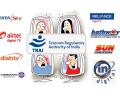
The Trai order is expected to change how consumers pay for cable or DTH services. This will result in disruption within the TV viewing market.
Throwing the ball back in the government's court, TRAI on Friday favoured status quo on the existing cable set-up across the country, including tariffs.

Bharti Airtel on slammed telecom regulator TRAI's recommendations on spectrum fee, saying they are retrograde and arbitrary.
