
The commission sent back the proposal of unrestricted internet telephony, seeking more clarity on how it would function, highly placed source said.
The government has ruled out banning Blackberry services in India. This was stated by the telecom secretary in New Delhi on Friday.Security agencies had said that they should have access to data that are being encrypted by services like BlackBerry on mobile phones and then decrypted when the phone reaches its destination. The government had cited security concerns as it could not monitor the content on RIM's servers, which were located in Canada and other foreign locations.
Communication Minister A Raja on Thursday asked the Telecom Commission, which is responsible for policy formulation, licensing and wireless spectrum management among other things, to review the annual spectrum charges that service providers pay as licence fee.
The proposal is aimed at arresting the decline in wireline services growth and spur availability of broadband internet access across the country. The move has been high on the agenda of Communications Minister A Raja for some time now.
The waiver, decided recently by the Telecom Commission, a wing of the DoT, is worth around Rs 200 crore (Rs 2 billion) per year. The commission also decided to reduce the levy towards the Universal Service Obligation Fund from the present 5 per cent to 3 per cent of the adjusted gross revenue.
The government is planning to divest its residual 26.12 per cent equity in the Tata-owned Videsh Sanchar Nigam Ltd, now called Tata Communications. It is unlikely, however, that the government will decide to sell its entire residual stake in the stock market before it resolves the issue of the surplus land of around 773 acres that was kept outside the disinvestment process.
The Telecom Engineering Centre, the technical wing of the DoT, has submitted its much-awaited report on spectrum allocation to the Member (Technology) of the Telecom Commission. The report, which is the last hope for GSM-based players for additional spectrum allocation, is believed to have gone along with the TRAI's recommendation of increasing subscriber base for awarding additional radio waves.
The government is likely to refer the controversial issue of Blackberry mobile phones to the Telecom Commission to decide whether operators can continue offering this service. The issue of Blackberry was raised after Tata Teleservices recently said they have been denied the permission to offer this value added service by the Ministry of Home Affairs due to security concerns. Telecom operators like Bharti Airtel, Vodafone & Reliance are offering Blackberry services to users.
Addressing a pre-bid conference for auctioning 3G and BWA spectrum, telecom commission member (finance) R Ashok said, "Successful 3G bidders will be eligible for getting 2G spectrum." The auction for the allocation of third-generation radio waves is due next month. But there was confusion whether 3G players would be eligible to get 2G spectrum.
The government expects to garner about Rs 5,000 crore (Rs 50 billion) from the existing mobile operators such as Airtel, Vodafone and Idea by imposing a one-time fee on those who are holding spectrum beyond the threshold limit of 6.2 Mhz, a move which will raise the cost of radio frequency.
From a policy point of view, India's telecom industry is getting exciting once again. After a lull of a few years, we're back to the same half-truths from regulators/policy makers, and the all too familiar attempts to help favoured firms.
It means a CDMA players like Reliance can also operate GSM services and get the required spectrum from the government within the same licence. Earlier, they were allowed spectrum either for CDMA or for GSM within the licence. However, now they have to pay an amount equal to the entry fee of a UASL licence (over Rs 1,680 crore for a pan-India licence) to get the spectrum as recommended by the Telecom Regulatory Authority of India.
The Department of Telecommunications (DoT) has mooted a proposal under which operators will pay a one-time fee for all spectrum allotments beyond 6.2 MHz.
Concerned over mobile signals crossing the international border, the department of telecom is planning to take action against telecom operators

Telecom Regulatory Authority of India has recommended up 62 per cent reduction in base price of premium 2G spectrum and up to 37 per cent in case of radiowaves freed from the cancellation of 122 licences, compared to the amount fixed for previous auction.
Pitroda is also considered the pioneer of the Indian telecom revolution, more than his reputation as a venture capitalist, inventor, technocrat and social thinker.
The government announced a Rs 1000-crore (Rs 10-billion) project to convert wireless operations of defence services on Optical Fibre Cable, a move that is estimated to release 45 MHz of spectrum.
The ministry of finance has shot off a missive to the Department of Telecommunications stating there could be a revenue loss in 2006-07 to the national exchequer, owing to reduced license fee from international and national long distance services.

Income will be higher as spectrum in 2,100-MHz band will also be auctioned
The Telecom Commission is considering imposing fines of Rs 400 crore (Rs 4 billion) on seven telecom service providers for delay in commissioning of services. A note for this purpose was put up for consideration last month.
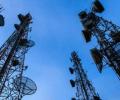
It aims to attract $100 billion investment and create 4 million jobs in the sector by 2022.
The proposed reduction in license fee for long distance services (STD and ISD) providers would impact the current levels of government revenues directly by about Rs 500 crore (Rs 5 billion) in a full fiscal.
Hit hard by the rising number of illegal telecom exchanges and unauthenticated mobile customer base, Department of Telecom is considering amending the Indian Telegraph Act, 1885 to include stringent penalties of up to Rs 5 crore.
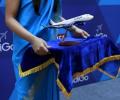
Bharti Airtel, the country's largest mobile operator, has already joined the global Seamless Alliance to provide in-flight connectivity.

This decision was taken at Executive Council meeting of National Association of Software and Service Companies held in Pune.
In a bid to resolve the row between cellular and basic players, Communication and IT Minister Arun Shourie constituted on Friday a 7-member committee including Reliance's Mukesh Ambani and Bharti's Sunil Mittal

Delay due to rise in operating cost of telcos, late adoption of 4G network
At present 100% FDI is allowed, of which up to 49% investment in a company can be done through the automatic route
Its says reconsider lower reserve price, uniform usage charges; GSM players to bear the brunt.
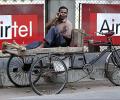
Inter-ministerial body Telecom Commission on Tuesday approved hiking foreign direct investment limit in the sector from 74 per cent to 100 per cent.

The Department of Telecom has postponed the next spectrum auction to February 3 from January 23 amid pending issues, including spectrum usage charges, and a demand from operators seeking more time.

DoT will have wider consultations with all stakeholders.
.jpg)
The inter-ministerial body will take the final decision on October 29 taking into account Trai's reply.
The move will help telcos, including Reliance Jio, Vodafone, and Idea Cellular

A panel headed by Economic Affairs secretary Arvind Mayaram had suggested FDI limit be raised to 49 per cent in almost all sectors through the automatic route.

Telecom Commission approves high base price of Rs 11,485 cr per Mhz for 700-Mhz frequency; no decision taken on proposed standard spectrum usage charges of 4.5%

The auction will help operators augment expansion of high-speed 4G voice and data services in the world's second largest mobile phone market.

A Parliamentary Committee will discuss the controversial issue of net neutrality on Thursday at a meeting where officials of telecom companies like Airtel, Vodafone and Idea are expected to present their views.
 © 2026 Rediff.com - Advertise with us - Disclaimer - Privacy Policy - Sitemap - Feedback - About us - Terms of use - Grievances