
State-owned Indian Renewable Energy Development Agency's (Ireda's) chairman and managing director Pradip Kumar Das has announced that the company has requested the government to allow it to carry out a follow-on public offer (FPO) as it will need further equity infusion to maintain the pace of growth. The FPO would aim to raise between Rs 4,000 crore and Rs 5,000 crore. Ireda, which provides funding assistance and other services to renewable energy and energy efficiency/conservation projects and is 75 per cent owned by the government of India, has requested the Union Finance Ministry to be included under Section 54EC of the Income Tax Act, which will help reduce borrowing costs.

More services such as ATM operations are proposed to be brought within the service tax net.

Seeking investments to boost growth, Finance Minister Arun Jaitley on Thursday vowed a corruption-free governance.

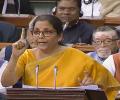
Highlights of the Union Budget 2024-25 presented by Finance Minister Nirmala Sitharaman in Lok Sabha on Tuesday.

Adding petrol and diesel to GST was a challenging task due to their significant role as revenue generators for both the central and state governments.
A month ahead of the Budget, Minister of State for Law Ravi Shankar Prasad on Wednesday favoured "moderate" tax rates and further simplification of procedures while speeding up reforms to push up growth.

'Investors should consider small and midcaps only if they can handle volatility and have a longer investment horizon.'
Finance Minister P Chidambaram on Tuesday said the country must have a basic tax structure that is broad-based and oriented to low tax rates.
Ahead of the Budget exercise, which is set to begin on Wednesday, Finance Minister P Chidambaram on Tuesday hinted at further moderation in tax rates, deepening of reforms and cut in wasteful expenditure.

Average monthly GST collection rose from Rs 90,000 crore during the first year of its implementation -- 2017-2018 -- to Rs 1.68 trillion during 2023-2024, representing an 87 per cent rise.
Chidambaram stresses importance of addressing the issue of escalating costs and prices.
At present, the service tax rate stands at 12 per cent. Added to this is a 2 per cent education cess, bringing the incidence to 12.24 per cent.

Direct tax collection, net of refunds, moderately exceeded the revised estimates (RE) for the financial year 2023-24 (FY24) on the back of personal income tax revenues, but corporation tax receipts fell short of the RE. Net direct tax collection stood at Rs 19.58 trillion in FY24, surpassing the RE of Rs 19.45 trillion by Rs 13,000 crore, or 0.7 per cent. The government had revised up FY24 projections for personal income tax by 13.5 per cent over the Budget estimates (BE) of Rs 9 trillion, at Rs 10.22 trillion.

So tell us, does Sitharaman's budget deserve cheers or boos?

Finance Minister Nirmala Sitharaman on Thursday said there are no changes in tax rates for direct and indirect taxes, including import duties. She also said the number of tax filers has swollen 2.4 times and the direct tax collection has trebled since 2014.

Investors with a long-term horizon and high-risk appetite seeking capital appreciation can consider investing in ELSS.

Despite the rally in equities over the last few years, India, according to Christopher Wood, global head of equity strategy at Jefferies, is still in early stages of an equity cult. Any changes to the capital gains tax for equities - both long-term and short-term - in Budget 2024 scheduled to be announced on July 23, he believes, can trigger a bigger correction that what the markets witnessed post the Lok Sabha election outcome on June 4 that saw the Bharatiya Janata Party (BJP) lose majority, though it was able to form the government with the help of coalition partners.
'The economy needed 3 or 4 major fixes. The major one was, of course, the direct tax structure, but we ended up complicating the existing convoluted tax structure,' says M R Venkatesh, chartered accountant and lawyer.

Overall market reaction to the Budget was neutral. Investors absorbed the changes to the tax rates (positive for salaried class) and capital gains taxes (CGTs, negative due to the removal of indexation and increases. Other proposals largely pertain to supporting rural development, buybacks taxed as dividends, Custom duty changes that impact multiple sectors, higher outlays for clean energy, etc. There's some moderation in the growth of capex outlay across defence, fer

In a pre-Budget wishlist, Vinod Juneja, managing director, Braj Binani Group, said, "I expect the finance minister to target the GDP growth of at least 8% or higher for the next 3 financial years."

Invest in MFs for liquidity and choice of funds. Invest in NPS for the tax benefits, tax-free rebalancing, and for earmarked savings for retirement.

Room for rise of up to 2 percentage points, move to help meet higher expenditure need in FY17

'If an individual makes significant financial investments, she should stick to the old regime.' 'If the individual prefers straightforward computation without any tax benefits, the new regime would be suitable.'

While the minimum holding period for LTCG taxation has now been lowered, the tax outgo could be a bit higher under the new structure.

Union Finance Minister Nirmala Sitharaman, along with her team of bureaucrats, delved into the fine print of the 2024-25 Budget documents in a press conference, detailing the government's road map on bringing down the debt-to-GDP ratio and bold tax measures.
Forty years ago, an individual in the highest tax bracket (above Rs 70,000 per annum) had to pay 70 per cent income tax.

India Inc on Thursday pitched for lowering income tax burden on common man, increase in capital expenditure, and firm steps to contain food inflation in their nearly two-hour long interaction with finance minister Nirmala Shitharaman ahead of the Union Budget. During pre-Budget consultation with Sitharaman, the industry leaders and associations also urged the government to focus more on infrastructure development with a view to maintaining the economic growth momentum. The industry leaders also laid stress on boosting the MSME (micro, small, and medium enterprises) sector, considered a backbone of the Indian economy and main employment generator.

'The Budget needs to focus more on social welfare schemes.'

Besides low interest rates, a reduction in active Covid cases and strong high-frequency macro data have lifted the sentiment of both corporate India and the stock markets.

'Those trying to use these funds for quick gains should avoid them due to risk of being late to the party.'

In the case of double-income couples, not more than 40 per cent of the net income of one partner should be the EMI for the property.

The challenges before the government, he said, is to put public sector banks back on track and continue to operationalise stalled infrastructure projects

Led by a new generation of entrepreneurs, India's family offices are shifting from traditional investments in physical and tangible assets like real estate to investing in technology, healthcare, and retail stocks. This new wave of family offices is engaging in stock market investments, including pre-IPO placements and secondary market operations. "Born into a world of technology, the next generation, especially those born after 2000, view technology as equally crucial as finance for running a business.

Higher levy on dividends earned by individuals also on radar.
In comments that may be seen as pointers to the forthcoming Budget, a senior government official said that raising tax rates was no more an option.
The government on Monday indicated that it may tinker with the excise duties and service tax rates in the interim budget in an apparent bid to boost economy but may not pursue key reforms legislations due to lack of political consensus.
Says there is a case 'if voluntary compliance increases'.
 © 2026 Rediff.com - Investor Information - Advertise with us - Disclaimer - Privacy Policy - Sitemap - Feedback - About us - Terms of use - Grievances