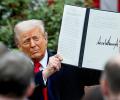
India needs another shot of difficult reform, of the kind only possible at gunpoint. Mr Trump holds that gun to our heads now. A drastic reduction in tariff protection, other elements of sarkari wet-nursing will force entrepreneurial India to become competitive again, argues Shekhar Gupta.

Former US deputy secretary of state Strobe Talbott has said that on the nuclear question and issues relating to India's security, Congress president Sonia Gandhi was "almost Indira-like."
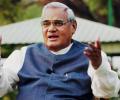
It was good fortune for India to have Atal Bihari Vajpayee lead the government at a crucial moment in our history. He avoided India meeting the fate of Iraq or Ukraine, asserts military historian Colonel Anil A Athale (retd).
The former US deputy secretary of state said India turned down the proposal saying Washington should not play into the hands of the Pakistanis by seeing Kashmir as a flashpoint.
It was the NDA government that had first mooted the idea of additional nuclear installations being subjected to International Atomic Energy Agency inspection in return for civilian nuclear co-operation. On the basis of this, it was logical for Talbott to assume that the NDA government would have accepted the present deal or even something less. He had read the minds of his interlocutors correctly
The former deputy secretary of state said the US president should make it clear to his Pakistani counterpart that support to terrorism and incursions across LoC is 'absolutely unacceptable'.

Strobe Talbott's tweet that hijackers may have wanted to use the missing Malaysian flight to attack Indian cities should be seen in the context of Lashkar-e-Tayiba's long standing plans to attack Indian cities like Delhi, Bangalore and Chennai from the skies. Vicky Nanjappa reports.

In more than a decade since 2002, 60 fugitives were extradited or deported by foreign governments to India, which received a major victory in its fight to bring the perpetrators of the 26/11 Mumbai attacks to justice when a US federal court agreed to the extradition of Pakistani-origin Canadian businessman Tahawwur Rana to the country.

The Indian position on the Russia-Ukraine war and the unconditional treaty between China and Russia appear to have caused some ripples in India-US relations and led to a reappraisal of India's usefulness to the US in the eventuality of a conflict with China, notes Ambassador T P Sreenivasan.

Brookings Institution tries 'Re-imagining India.' Aziz Haniffa listens in

'The Modi visit will prove to be the watershed where India and the United States commenced technology trade and transfer.'
As Prime Minister Manmohan Singh meets President Obama at the White House on Friday, September 27, former US Deputy Secretary of State Strobe Talbott, the man who set the ball rolling in transforming the United States-India relationship, tells Rediff.com's Aziz Haniffa why he believes US-India ties are 'alive and healthy.'
In an exclusive interview, Strobe Talbott, a key protagonist in resurrecting the United States-India relationship after India's nuclear tests in May 1998, talks about the US-India relations, Iran and the Pakistan situation to Rediff.com's Aziz Haniffa.

Vajpayee had always felt that India must act with conviction and panache. He decided that, irrespective of the attendant risks, he would undertake what many felt was a precarious course. A fascinating excerpt from N K Singh's Portraits Of Power: Half A Century Of Being At Ringside on Atalji's 96th birthday, December 25.
Ironically, Talbott, currently the president of the leading US think-tank Brookings Institution, has been critical of the nuclear deal, as India is yet to sign the Comprehensive Test Ban Treaty.
Singh did not speak on recent developments in the Indo-US civil nuclear cooperation but confined himself to self-explanation during the short duration discussion.
The US had virtually compelled the P V Narasimha Rao government in 1995 not to conduct nuclear tests after it got to know about preparations for it, a former US official indicated on Monday.
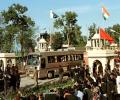
'Despite the subsequent events at Kargil and the October 12, 1999 military coup in Pakistan, the Lahore initiative firmly established Vajpayee's credentials as a crusader of peace,' says Colonel Anil A Athale (retd).
Strobe Talbott, former United States deputy secretary of state who laid the foundation for better US-India ties, on how they can be taken higher.

During Vajpayee's tenure, he was there as an indispensable insider, witness to every action that had an impact on history: Pokhran-II (nuclear tests in 1998), the 1999 Kargil conflict between India and Pakistan, the Indo-Pak Agra Summit in 2001, intense engagement with the United States on nuclear issues besides the Kandahar hijack.

China is going to be an indispensable partner in Russia's ongoing crisis with the US, while on its part, China cannot remain indifferent if Russia gets crushed by the US, lest it loses 'strategic depth', observes Ambassador M K Bhadrakumar.
"Therefore, we have given our full support to the consolidation of a multi-party democracy in Afghanistan. We feel that it can and should be a multi-ethnic society, a plural society backed by the United States and India," Saran said.
The Indo-US civil nuclear deal may face questions from China in the Nuclear Suppliers Group, former American deputy secretary of state Strobe Talbott said in New Delhi.
"I had the opportunity to telephone my old friend George Fernandes and told him I had heard about the problem he had," he said.
'George Fernandes is a decent and sober leader. He also proved to be a good defence minister. But what he hid and what\n\nmade headlines through Talbott's book has hurt our national self-respect,' said the outfit's mouthpiece Panchjanya.
The United States cherished its relationship with India and both countries should use globalisation as a tool to bring lasting peace and stability in the Indian subcontinent and across the world, former US deputy secretary of state for South Asia, St
'We don't want confrontation; we are trying to build a cooperative relationship in which both sides have stakes in producing an improving climate of relations and responsible behaviour.' What does Shiv Shankar Menon, one of India's most brilliant diplomats and the former National Security Advisor, think of the Modi visit to the US, the Chinese stand-off in Ladakh and the situation on the LoC?

What the Indian economy looks like next January will influence her view on India, not her genetics, notes Shekhar Gupta.
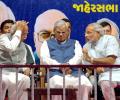
'If Vajpayee's BJP saw a chance to redefine India's nuclear theology, Modi's BJP has scarcely paid any attention to it.'
 © 2026 Rediff.com - Investor Information - Advertise with us - Disclaimer - Privacy Policy - Sitemap - Feedback - About us - Terms of use - Grievances