
Standard & Poor's, which has threatened to downgrade the country's sovereign rating to junk, sees economic growth improving.
Standard & Poor's, which has threatened to downgrade the country's sovereign rating to junk, sees economic growth improving.
The outlook cut is based on a weak premise since the economy is expected to rebound this fiscal but a wake-up call was needed.
The recent rally has seen investors' preference shift to high-beta and policy reform-driven sectors like capital goods, banking, power, infrastructure and oil and gas.
East European countries have better rating than India though their economies are not as stable as the latter.
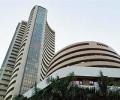
The 30-share BSE Sensex closed at 20,822 down 72 points after touching a high of 21142.85 while the broader 50-share Nifty index closed at 6,187 levels down 27 points; the index touched a high of 6,289 today.
Key indices ended weak for a third consecutive session after a stellar rally.
T C A Anant, the Union government's chief statistician, thinks global rating agency Standard & Poor's (S&P) does not fully understand our economy's structure, comprising a large unorganised sector as well.
Keen to prevent a downgrade of India's sovereign rating by Standard & Poor's (S&P), which could trigger an exodus of foreign investors, Prime Minister Manmohan Singh has told the Congress party there is no option but to raise diesel prices by at least Rs 5 a litre after the Presidential election. The current diesel subsidy is Rs 9.13 per litre sold.
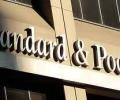
Citing economic slowdown and political roadblocks to policy-making, rating agency S&P on Monday warned India could become the first BRIC nation to lose investment-grade rating.
The announcement by Standard & Poor's (S&P) on Wednesday to cut its outlook for India from stable to negative should cause no surprise, even though it comes barely five days after a similar exercise by Moody's, which had retained its outlook on India as stable.

A day after Standard & Poor's (S&P) came out with its report on how India could be the first among Brazil, Russia, India and China (BRIC nations) to lose its investment-grade rating, markets shrugged off the concern, ending in the green.
The political fall-out of the US downgrade is not over. Republicans and Democrats are both trying to pin the blame on the other party, displaying their great skill in spinning news to score partisan political points.

In a report on the rupee's depreciation, S&P said, "Revenue for companies that export and operate overseas would rise, because they would get more rupees for the goods and services they sell."
Confidence in the company as government is the biggest shareholder.

NPA percentage in loans may touch 10% by March 2013, up from 5% in March 2011.
Global rating agency Standard & Poors (S&P) has said that despite the outlook for Indian corporates being stable, a negative bias persists with corporate entities pursuing rapid inorganic growth with leveraged buyouts and debt-supported expansion.

The growth prospects are particularly high for Indian companies in the speciality and complex generic drugs segment in the US, the report said.

The official said the finance ministry will impress upon rating agencies the resolve of the government to contain fiscal deficit at 4.1 per cent this year and lower it to 3 per cent by 2016-17.

Global rating agency Standard & Poor's said the government's decision to increase domestic gas prices is likely to benefit two major gas producers Oil and Natural Gas Corp (ONGC) and Reliance Industries Ltd (RIL).

The 30-share Sensex ended 50 points lower at 28,112 and the 50-share Nifty declined 12 points to close at 8,531.
S&P in November ruled out an upgrade in the country's rating for some considerable period, citing India's low per capita GDP and relatively high fiscal deficit.

Major global indices like CAC 40, DAX Shanghai Composite, Hang Seng, Nikkei, Straits Times, Sensex, Nifty have lost 1% - 10% in a week
 © 2026 Rediff.com - Investor Information - Advertise with us - Disclaimer - Privacy Policy - Sitemap - Feedback - About us - Terms of use - Grievances