
The government is finalising the national action plan on climate change and would release this in June, said Shyam Saran, Prime Minister's special envoy for climate change. The action plan would focus on key issues like improving energy efficiency, harnessing solar energy, studying the melting and cracking of icebergs on the Himalayas and understanding the dynamics of coastal and island territories.The plan would contain mechanisms for implementation of various policies.
Special Envoy Shyam Saran on Tuesday said "political uncertainty" over the N-deal agreement could increase if the government in Washington changes. "This government has a commitment to the agreement and every effort possible will be made to see the deal through," he added.
As Australia is one of the world's biggest uranium-producing countries, its attitude will be critical to India's efforts to open up trade in nuclear materials.

"All the G77 and China members have made it very clear that they are not envisaging that there could be any kind of uncooked paper which would go up to the heads of state and the government," said Shyam Saran.
With his administration focusing on alternative sources of energy so as to reduce dependence on fossil fuel, US President Barack Obama wants to build Indo-US renewable energy partnership which would end up in benefiting not only the two countries, but also the entire world.
With the Nuclear Suppliers Group draft set to be amended because of demands from some member countries, the government in Delhi on Sunday held a high-level meeting to analyse the new development and discuss options available to it. External Affairs Minister Pranab Mukherjee held hour-long discussions with Prime Minister's Special Envoy on Nuclear Deal Shyam Saran and senior officials of the Ministry of External Affairs and Department of Atomic Energy on the issue.
Part of the focus of the current discussions is also on the "next steps" that are involved in the civilian nuclear initiative such as status of India's negotiations with the International Atomic Energy Agency on India-specific safeguards and the NSG
Conveying that there will be no let up in India's drive to modernise its energy and defence sectors, prime minister's special envoy Shyam Saran said on Tuesday this should encourage Washington to look at New Delhi as a source of demand for its goods and services.
Nepal is taking its first steps towards a republican democracy. In doing so, it is breaking with the past and seeking a new policy architecture for reforming its economy, internal governance, relations with neighbours and restructuring its armed forces.
US Undersecretary of State for Political Affairs Nicholas Burns will resign, a senior US official said on Friday.
Australia's new government on Tuesday said that it will not sell uranium to India until the country signs the nuclear Non-Proliferation Treaty. Last year, the previous federal government struck an in-principle agreement with India to sell uranium to the country. The deal was to be subject to strict conditions, including guarantees that the uranium would be used for power generation only, despite India not being a signatory to the NPT.
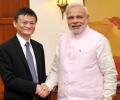
Alibaba's pervasive economic and social influence in China is seen as a threat to the authority of the Chinese Communist party, notes Shyam Saran.
The two countries held annual foreign office consultations.

The Indian official is arriving in Kathmandu on a two-day visit on Wednesday afternoon to take stock of the political situation that has developed after a lack of consensus over Maoist demands for declaring the country a republic led to the postponement of November election.
The two deliberated on how to go about in implementing the agreement, with the US Ambassador emphasising the need for taking the next steps as early as possible as delay could endanger the agreement
Foreign Secretary Shyam Saran said the old mindset of balance of power or conflict of interests between India and China was outdated.
The government on Monday expressed willingness to set up a mechanism to resolve the stand-off with Left parties over the Indo-US civil nuclear deal, Communist Party of India leader A B Bardhan said.
India on Thursday said it will scale up nuclear energy production to 60,000 megawatts by 2030 after signing the pending N-deals with more countries.
The United States Senators and Congressmen, Saran interacted with, assured him that the US Congress is committed to the India-US civilian nuclear agreement and the enabling legislation to facilitate the deal would be taken up by the Senate early next
The two leaders are understood to have reviewed bilateral ties.
The PM is supposed to meet the Pak President at the NAM summit.
The decision is significant as it comes in the midst of India's efforts to lobby support in the international community for its civil nuclear energy ambitions.
Talking about opposition by the Left parties to the growing ties with Washington, the Prime Minister's envoy said, "Whatever be the reservations that have been expressed about our relations with the US, no other friendly country, member of the NSG has the necessary standing to lead the process of opening up the existing multilateral regime to accommodate India".
Pakistan Foreign Secretary Riaz Mohammad Khan said
US President George W Bush and West German Chancellor Angela Merkel on Monday agreed to "consider" supporting Shashi Tharoor, India's candidate for the post of the UN secretary general to succeed Kofi Annan.
Saran is on a visit to Australia and New Zealand to try and assuage their concerns with regard to backing India's nuclear aspirations.
Ahead of talks between the Sri Lankan government and the Liberation Tigers of Tamil Eelam, India Friday pitched for consensus among the island nation's main political parties to salvage the fragile truce.
Seeking to dispel their apprehensions, Saran is expected to highlight New Delhi's impeccable record on non-proliferation front.
Pakistan had earlier moved the World Bank for appointment of neutral experts but India has insisted on solving the issue bilaterally.
India and the US Wednesday held intensive discussions on energy, particularly focussing on civil nuclear cooperation and signing of three memorandum of understanding on cooperation in oil and natural gas sector.
The Indian side is likely to stress that Pakistan is not doing enough to end terrorism being perpetrated by groups based in that country and needed to do much more if the peace process was to continue.
Foreign Secretary Shyam Saran will head the Indian delegation at the two-day talks with his Pakistani counterpart Riaz Mohammad Khan.
 © 2026 Rediff.com - Advertise with us - Disclaimer - Privacy Policy - Sitemap - Feedback - About us - Terms of use - Grievances