
The Election Commission has directed enforcement agencies and security forces to take proactive measures during the Bihar elections to prevent the use of drugs, liquor, and cash to influence voters.

Retail inflation slipped to 1.54 per cent in September from 2.07 per cent in the preceding month mainly due to subdued prices of food items, including vegetables and pulses, according to government data released on Monday. The consumer price index (CPI) based inflation was 5.49 per cent in September 2024.

The country's largest lender State Bank of India on Wednesday announced the completion of the divestment of about 13.18 per cent stake in Yes Bank to Sumitomo Mitsui Banking Corporation of Japan for Rs 8,888.97 crore. State Bank of India (SBI) has received Rs 8,888.97 crore from the acquirer Sumitomo Mitsui Banking Corporation (SMBC), a Japanese multinational financial services company belonging to the Sumitomo Mitsui Financial Group (SMFG), the bank said in a regulatory filing.

Titan, Nestle, Hindustan Unilever, State Bank of India, Larsen & Toubro, ITC, Zomato and Bajaj Finserv were also among the laggards. Adani Ports, IndusInd Bank, Tata Motors and HDFC Bank were among the major gainers.

IPOs have been the flavour of the season for some time. But the coming together of three mega IPOs, from diverse businesses and historic relevance, could tell a story that's still in the making, points out Nivedita Mookerji.

Reserve Bank Governor Sanjay Malhotra on Saturday said that the market forces decide the value of rupee with respect to the US dollar and the central bank is not worried about day-to-day movement of the currency value.

'Other sectors that manage the savings pools of Indians are giving tough competition to life insurance companies.'

The RBI under former governor Shaktikanta Das resisted pressures to cut interest rates through 2024 as it kept its 'Arjuna's eye' trained on inflation, but the central bank under a new detail-oriented head will soon have to take a call if it can continue sacrificing growth. Das, a career bureaucrat who in 2016 oversaw Prime Minister Narendra Modi's highly disruptive demonetisation move, left a lasting legacy as he demitted office towards the end of 2024 after expertly navigating monetary policy for six years, the highlight of which was steering India's recovery through the pandemic.

A retired banker in Delhi lost his entire life savings, amounting to Rs 23 crore, to cyber fraudsters who posed as ED and CBI officers. The victim was kept under 'digital arrest' for over a month and forced to transfer funds under duress.

India's forex reserves rose by $2.7 billion to $698.19 billion during the week ended July 25, the RBI said on Friday. In the previous reporting week, the overall reserves had dropped $1.183 billion to $695.489 billion.

The RBI under new Governor Sanjay Malhotra on Friday cut interest rate for the first time in nearly five years as the central bank pivoted the policy stance to support a shuttering economy. The 25 basis points rate cut to 6.25 per cent comes after last rate reduction in May 2020. The last revision of rates happened in February 2023 when the policy rate was hiked by 25 basis points to 6.5 per cent.

The Indian economy is recovering from the slowdown in momentum witnessed in the September quarter, driven by strong festival activity and a sustained upswing in rural demand, according to a Reserve Bank of India (RBI) bulletin released on Tuesday. An article on the 'State of the Economy' in the December bulletin noted that the global economy continues to exhibit resilience with steady growth and moderating inflation.

While liquidity in the banking system has turned surplus in the last few weeks, it could go back to deficit again, mainly due to corporate advance tax outflows. The net liquidity surplus of the banking system rose to touch Rs 1 trillion on Tuesday on the back of government spending, according to the data released by the Reserve Bank of India.

India's forex reserves jumped $4.7 billion to $702.97 billion for the week ended September 12, the Reserve Bank of India said on Friday. In the previous reporting week, the overall reserves had increased $4.04 billion to $698.27 billion.

Reserve Bank Governor Sanjay Malhotra on Friday said the exchange rate policy has remained consistent over the years and the central bank does not target any 'specific level or band' of the rupee, which slipped to an all-time low of 87.59 to a US dollar. On Thursday, the rupee plunged 16 paise to close at a record low of 87.59 against the American currency. "I would like to mention here that the Reserve Bank's exchange rate policy has remained consistent over the years.

Ask rediffGURU Naveenn Kummar your insurance mutual fund and personal finance-related questions.

Earlier, such entities were only permitted to invest their rupee surplus balance in accounts in central government securities, including treasury bills. "It has now been decided to also permit investment of these balances in non-convertible debentures/bonds and commercial papers issued by an Indian company," the RBI said.

The ratio of MF assets under management to total bank deposits has more than doubled in 10 years.
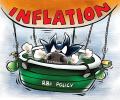
The Reserve Bank of India (RBI) has projected retail inflation at 4.2 percent for the next financial year beginning April while retaining the forecast for 2024-25 at 4.8 percent. The central bank attributed the expected easing of inflation to good kharif production, winter-easing in vegetable prices and favorable rabi crop prospects. However, the RBI also noted that continued uncertainty in global financial markets coupled with volatility in energy prices and adverse weather events presents upside risks to the inflation trajectory.

The Reserve Bank of India's (RBI's) caution on inflation, highlighted during the recent monetary policy meeting, may put investors' faith in fast moving consumer goods (FMCG) stocks to test, analysts said. They, however, believe FMCG stocks may ride through this near-term investor anxiety as related companies are, typically, well-equipped to handle inflation due to their pricing power and steady demand for essential goods.

The initial public offering of non-banking financial company Tata Capital Ltd got fully subscribed on the final day of bidding on Wednesday. The company's Rs 15,512 crore share sale received bids for 45,84,78,044 shares against 33,34,36,996 shares on offer, translating into 1.38 times subscription, according to NSE data till 13:36 hours.
The Reserve Bank of India on Monday issued an operational framework for reclassification of investment made by a foreign portfolio investor to foreign direct investment (FDI) if the entity breaches the prescribed limit. Markets regulator Sebi too has issued a circular on procedure for reclassification of FPI investment to FDI.
As RBI governor, Sanjay Malhotra will have to give the highest priority to the interest of the economy while deciding on the growth-inflation trade off at Mint Street.

'Inflation is not good for industry. Nor for the economy as a whole.'

Indian corporate are increasingly shifting away from bank funding towards alternative sources, such as equity and bond markets, as their deleveraged balance sheets have improved their ability to raise equity at better valuations. Moreover, the 100 basis points (bps) rate cut by the Reserve Bank of India (RBI) has enabled them to access long-term funds from the debt capital market at cheaper rates.

The Central Bureau of Investigation has filed a case against Reliance Communications and its promoter-director Anil Ambani, for an alleged bank fraud that caused a loss of over Rs 2,000 crore to State Bank of India, officials said on Saturday. The agency is carrying out searches at the residence of Anil Ambani and premises linked to RCOM in connection with the case, they said.
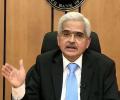
Reserve Bank Governor Shaktikanta Das on Tuesday said the fiscal-monetary coordination was at its best during the last six years even as he thanked Prime Minister Narendra Modi for giving the opportunity to head the monetary authority of the country. Das, in a series of posts on X, on his last day of his six-year term as RBI Governor, also thanked the Finance Minister, various stakeholders and his colleagues at the central bank.

India's forex reserves jumped $4.04 billion to $698.27 billion during the week ended September 5 on the back of a sizeable increase in value of gold reserves, the RBI data said on Friday.

Among Sensex firms, Maruti, Axis Bank, Larsen & Toubro, ICICI Bank, Bharti Airtel, Infosys, Adani Ports and Hindustan Unilever were the laggards. However, Titan, State Bank of India, Eternal and Trent were among the major gainers.

Ahead of the key meeting called by the steel ministry with the industry captains on Monday to discuss the impact of rising steel imports, companies have raised the issue of cheaper 'substandard' inflows from China, Vietnam, and South Korea, saying they are setting the benchmark for domestic prices and squeezing the profitability of Indian producers.

India's forex reserves dropped by $9.32 billion to $688.87 billion for the week ended August 1 in one of the highest declines in the recent past, the RBI data showed on Friday. The overall reserves rose by $2.7 billion to $698.19 billion in the previous reporting week.

Private sector banks slipped in market capitalisation (mcap) during the July-September quarter, underperforming their government-owned peers as trade uncertainties dragged market sentiment, said S&P Global Market Intelligence. According to its analysis, HDFC Bank shed 4.8 per cent in mcap during the third quarter, while ICICI Bank's dropped 6.7 per cent.
Reserve Bank of India (RBI) Governor Shaktikanta Das has said the decision on interest rate moderation will be based on long-term inflation trajectory and not monthly data. The Monetary Policy Committee (MPC) headed by the RBI Governor is scheduled to meet between October 7 and 9 and take call on interest rate. The RBI kept the repo rate unchanged at 6.5 per cent for the ninth time in a row amid risks from higher food inflation.

The transmission of the February and April rate cuts is now complete, validating the central bank's monetary stance and contributing to a revival in credit growth, said Reserve Bank of India (RBI) Governor Sanjay Malhotra on Friday. "We now have preliminary figures for June credit rates, and we find that for new loans, the rates are lower by at least 50 basis points (bps)... within two months of our 50-bp cut, we are in June, and the whole of the monetary policy transmission has happened.

Indian corporates collectively raised over Rs 17,500 crore from the domestic debt capital market through bond issuances on Tuesday. The issuances were led by Bharti Telecom's Rs 10,500 crore fundraise in two tranches, the largest by an Indian company in the domestic market so far in FY26.

Trading sentiment in the equity market will be guided by macroeconomic data announcements, global trends and quarterly earnings from IT major TCS this week, analysts said. Stock markets would also be tracking trading activity of foreign investors who remained net sellers of Indian equities in September.

Wholesale price inflation (WPI) softened to 0.13 per cent in September on easing in prices of food articles and manufactured items, government data showed on Tuesday. WPI-based inflation was 0.52 per cent in August and 1.91 per cent in September last year.

Among the Sensex firms, Sun Pharmaceuticals, Tech Mahindra, HCL Technologies, Infosys, Bajaj Finance, Eternal, Tata Consultancy Services, UltraTech Cement, Bajaj Finserv, Tata Steel, ITC and L&T were the major laggards. Asian Paints, Mahindra & Mahindra, BEL, Adani Ports, State Bank of India, Trent, HDFC Bank were among the gainers.

Despite gross domestic product (GDP) growth being lower-than-expected for the July-September quarter, the six-member Monetary Policy Committee (MPC) may not cut the policy repo rate in the review meeting scheduled for next week due to high inflation in October, according to experts. "Consumer Price Index (CPI) inflation breaching the upper limit of the RBI's tolerance band in October (6.2 per cent year-on-year) is not a favourable backdrop for the MPC to commence the easing cycle, even as the growth outcome disappointed the MPC's expectations," said Shreya Sodhani, regional economist at Barclays, who expects the policy repo rate to be kept unchanged in the December meeting.

Rashtrapati Bhavan has introduced a new initiative, the E-Upahaar auction, to monetise valuable assets for a social cause, in alignment with a broader governmental policy, championed by Prime Minister Narendra Modi, of auctioning gifts received by dignitaries to fund welfare programmes.
