
They said that massive public investment in infrastructure, social sectors and agriculture would generate employment and the Union Budget should give it a priority and allocate necessary funds for this.

Competition watchdog CCI needs to scrutinise the practices of the state-owned companies as they are not above the law of competition, the Chairman of the 13th Finance Commission, Vijay Kelkar said on Friday.

Against FY17 target of Rs 56,500 cr, Centre plans to fetch around Rs 6,400 cr in the first half.
With tax collections slowing down because of the global economic crisis, the government is looking at non-tax receipts like disinvestment to plug the widening fiscal deficit gap, which last fiscal crossed 6 per cent of the GDP. It can raise significant resources by selling a minority stake of 10 per cent in state-run firms. The Centre can earn at least Rs 37,000 crore by selling up to a 10 per cent stake in the top 10 PSUs in which it owns over 90 per cent.

These could include strengthening the public-private partnership (PPP) dispute resolution mechanism, uniform PPP institutional framework, easier terms for infrastructure companies accessing bond markets, and tax sops, Business Standard has learnt. Investment in infrastructure projects with high multiplier effect has been the Centre's main plank to revive the economy, create employment and boost consumption.

'Given the possibility that our unstable northern and western borders may become 'live' at short notice, any major systemic change which impacts combat effectiveness should be brought about in a cautious and progressive manner.'
The new Congress-led government on Tuesday promised to 'revitalise' sick public sector units and strictly adhere to the roadmap laid out for divestment of public sector units in the Common Minimum Programme to be unveiled this week.

At the same time, the Cabinet approved reducing government's stake in select PSUs such as IOC to below 51 per cent while continuing to retain management control.
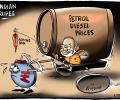
In five hikes, petrol price has gone up by Rs 2.74 per litre and diesel by Rs 2.83.

RBML - the joint venture of Reliance Industries Ltd and supermajor BP - has told the government that fuel retailing for the private sector in India has become unsustainable after market-controlling public sector firms frequently froze petrol and diesel prices at rates way below the cost, sources said. Despite a surge in oil prices, state-owned Indian Oil Corporation (IOC), Hindustan Petroleum Corporation Ltd (HPCL) and Bharat Petroleum Corporation Ltd (BPCL) first froze petrol and diesel rates for a record 137 days beginning early November 2021 when five states including Uttar Pradesh went to the polls, and last month again went into a hiatus that is now 47 days old. "They (Reliance BP Mobility Ltd) has written to the petroleum ministry over the fuel pricing issue," a highly placed source in the government, who didn't want to be quoted, told reporters.
Delays in crucial PSU appointments a reflection of poor governance and political vested interests
An increase in project cost will lead to corresponding increase in borrowing needs of these companies, particularly the oil marketing firms that have already borrowed nearly 50 per cent more this year compared to last year because of rising crude oil prices. Companies now fear this would make borrowing tougher in terms of higher interest rate and per client exposure norms of commercial banks.
NTPC and NHPC, which together own a third of India's electricity generation, have roped in state-owned power sector financing firm, Power Finance Corporation for the joint venture along with TCS. "We (referring to NTPC and NHPC together) are the largest power generators and we hope to create a market for this," said NTPC Chairman and Managing Director R S Sharma.
Even as state-owned refineries recorded all-time high margins during the first quarter, gaining from inventories they hold, Reliance Industries, which operates the world's third largest refinery, posted a modest gain in margins, resulting in the company recording lower-than-expected profits during the quarter.
Opposition in the Lok Sabha on Thursday took the government to task for its moves to divest its stake in oil majors -- Hindustan Petroleum Corporation and Bharat Petroleum Corporation

In a bid to curb the spread of COVID-19, the local trains are currently being run only for essential services staff, state and central government staff, employees of nationalised and private banks, PSUs and pharma companies, and QR code-based identity cards are mandatory for them.
PSU stocks continued with their reign of gains as the market expects that most of these companies have done well in the just concluded quarter.
There are many issues that will have to be resolved before the committee's recommendations can be translated into practice. First, the backlash from clubby bureaucrats from the elite all-India services will have to be dealt with. Then, the experiment with a more flexible system and variable pay based on performance should not be introduced across the board, but tried out in a dozen or two enterprises, to see how it works in practice.

Finance Minister Pranab Mukherjee gave the Business Today Best CFO in the Public Sector Award to Sarraf, ONGC said.
'We are worried for the workers because in the private sector, jobs are not secure, there is no decent work condition and there is no social security.' 'That's why we are opposing the economic policies of this government.'

A look into the challenges of selling loss-making public units.

Bharti Airtel and Vodafone Idea have communicated to the telecom department that they will not pay AGR dues of Rs 88,624 crore, the deadline for which ended on Thursday, and will wait for the outcome of modification petition listed for hearing before the Supreme Court next week, according to official sources. Reliance Jio on Thursday paid Rs 195 crore to the telecom department to clear all adjusted gross revenue dues accounted till January 31, 2020, according to an official source.
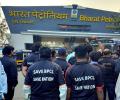
In December 2019, the India arm of Deloitte Touche Tohmatsu surprised many with its ultra-competitive bid to become the transaction advisor for the country's largest strategic divestment in Bharat Petroleum Corporation (BPCL). The multinational major quoted just Rs 1; the second-highest bidder, SBI Caps, reportedly quoted Rs 15-17 crore. For Deloitte, the motivation was to bag a prestigious deal adding a national energy company to its portfolio. No doubt, it expected BPCL to go to a marquee buyer in quick time.

K Mohandas, secretary, ministry of shipping, speaking on the sidelines of a conference in Mumbai said, "The proposal is that Indian public sector should acquire ships from Indian shipyards.
The chairman of the Securities and Exchange Board of India, M Damodaran, said on Wednesday public sector companies will have to comply with Clause 49 of the listing agreement for stock exchanges. However, few government-owned companies have met the Clause 49 stipulation (the table shows the state of play in some large government-owned companies).
Indian Oil, Bharat Petroleum, Hindustan Petroleum to open over 3,000 outlets this year. Even losses of over Rs 300 crore (Rs 3 billion) per day from selling automobile fuels have not stopped government-owned oil marketing companies from expanding their retail network across the country.
The sharp rise in oil prices is threatening to derail not only the long-term expansion plans of government oil marketing companies, which control over 95 per cent of the market, but also their day-to-day operations.

A day after the Union Cabinet paved the way for the government reducing its stakes in Oil and Natural Gas Corporation (ONGC), Coal India Ltd (CIL) and NHPC, the shares of these companies fell 3.4-5.2 per cent on bourses.
India's public sector steel companies will spend a whopping Rs 230 crore (Rs 2.30 billion) on corporate social responsibility to build 'Model Steel Villages' across the country during the current financial year.
Concerned over time spent by heads of public sector firms in 'boundary management', Prime Minister Manmohan Singh asked government on Wednesday to become more transparent in regulating and granting full operational autonomy to state companies.
The Cabinet Committee on Economic Affairs will discuss the proposal to lift the ban on state-owned companies from investing in mutual funds in its weekly meeting on Thursday.
It is important to generate an attitude that is receptive to technology-based delivery of services.
Prime Minister Manmohan Singh on Thursday favoured listing of more public sector companies on the stock exchanges as a means to professionalise their boards and said the government was working towards limiting its role in their everyday functioning.

The price of diesel sold to bulk users has been hiked by about Rs 25 per litre in line with a near 40 per cent rise in international oil prices, but retail rates at petrol pumps remain unchanged, sources said. Petrol pump sales have jumped by a fifth this month after bulk users like bus fleet operators and malls queued up at petrol bunks to buy fuel rather than the usual practice of ordering directly from oil companies, widening the losses of retailers. Worst hit are private retailers like Nayara Energy, Jio-bp and Shell, who have so far refused to curtail any volume despite a surge in sales.

India, besides China, the UAE and Qatar, are some of the major countries where CCI indulged in unfair practices to bag contracts.

To further ensure employability of students, IITs are encouraging students to positively accept more number of pre-placement offers and not wait till final placement season

Govt bosses in no hurry to exit from PSUs; many agencies, long process likely hurdles.

Initially, private buyers will be able to make bulk purchases on Government e-marketplace, it will subsequently be broadened to small-ticket buying as well.
 © 2026 Rediff.com - Advertise with us - Disclaimer - Privacy Policy - Sitemap - Feedback - About us - Terms of use - Grievances