
If Xi Jinping can establish control over the PLA Ground Force, relations between India and China will settle down to an even keel. The next few weeks will show whether Xi has finally succeeded in gaining control over the PLA Ground Force. That could bring about the substantive shift in India-China relations that both our leaders have been working for, observes Ambassador Prabhat Shukla.

A leading Chinese scientist specializing in semiconductor chips for weapon systems has been detained by anti-corruption authorities, according to his company, Zhejiang Great Microwave Technology.

'If Washington has to balance Chinese power, she will have to turn to the third biggest power in the world which is India.' 'The United States and India will have to work together in order to keep Chinese ambitions in check.'

Vice Admiral Li Hanjun, chief of staff of the People's Liberation Army Navy (PLAN), and Liu Shipeng, deputy chief engineer of China National Nuclear Corporation, have been expelled from the National People's Congress (NPC), the Hong Kong-based South China Morning Post reported.

Over a million officials are said to have been punished in Xi's anti-corruption campaign according to the official media accounts. The intensity of the campaign also attracted criticism that Xi made effective use of it to silence his critics and rivals within the party.

Important for India was Xi's meeting with representatives of PLA officers and soldiers stationed in Tibet. The video of the encounter was interesting to watch, especially the large number of lieutenant generals and major generals, observes Claude Arpi.

Pakistan plans to procure 40 jets of advanced Chinese stealth fighter J-35, which, if materialised, will mark the first export of China's latest jet. The sale would mark Beijing's first export of fifth-generation jets to a foreign ally and is expected to recalibrate regional dynamics, particularly in relation to Pakistan's rival India. The acquisition of new aircraft was pursued despite the serious economic crisis faced by Pakistan. China has helped Pakistan to jointly develop and operate the J-17 Thunder fighter jet, the mainstay of the PAF. China has delivered four advanced naval frigates to the Pakistan Navy in the last few years to enable it to play a bigger role along with its navy in the Indian Ocean and Arabian Sea.

The Central Military Commission, which is the overall high command of the Chinese military, is headed by Chinese President Xi Jinping.

Dismissing provocative comments made by a 'Major General' of the Chinese Peoples Liberation Army who sparked a controversy ahead of Defence Minister A K Antony's visit, officials in Beijing on Saturday said that the officer was superannuated and retired from political and military posts a while ago.

Key to China's decision regarding Taiwan will be its leadership's assessment whether the US will come to Taiwan's defence, explains Jayadeva Ranade, the former senior RA&W officer and China expert.

The elephant in the room will permeate the conversations, predicts Rup Narayan Das.

China plans to divert about 200 billion cubic metres of water annually from the Brahmaputra at its highest point, namely the Great Bend, where it turns into India. China's Brahmaputra dam will severely impact India, warns former senior RA&W officer and China expert Jayadeva Ranade.
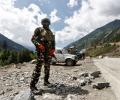
'How Xi Jinping will withdraw the aggression and justify it to his Communist party in case of a negotiated settlement might be his biggest headache.' 'Unless he is ready to gamble on an armed conflict, whose outcome given India's battle-readiness and determination is always uncertain,' observes Virendra Kapoor.

Prime Minister Modi made a strategic blunder of Nehruvian proportions -- presuming no war can happen now, and the Chinese won't be a military threat and risk their economic interests, observes Shekhar Gupta.

'The supreme art of war is to subdue the enemy without fighting.' Former RA&W official Jayadeva Ranade explains what China's military reforms mean for the world.

Chinese military has identified a host of problems after conducting massive military exercises for the first time to sharpen the troops' fighting capability which if not rectified will hinder its ability to win wars.

Chinese President Xi Jinping has asked the People's Liberation Army to be combat ready to win a "regional war" and make sure that all decisions from the central leadership are strictly followed.

Why did the Chinese military take over the lab in Wuhan in end January? Did something go wrong? Claude Arpi glances at the mystery surrounding the origin of the coronavirus.

General Zhao Zongqi is well known in India for having commanded the Chinese troops during the Dokalam episode. Zhao knows every inch and corner of the Indian border, at least the Eastern and Central sectors, including the Naku La area which witnessed fist-fights between Indian and Chinese troops in April/May. Claude Arpi introduces us to the PLA generals masterminding the Chinese aggression in Ladakh.
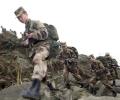
China is distributing millions of controversial updated maps to its military in the first upgrade in 30 years, reportedly reinforcing its claims over Arunachal Pradesh.

'Intrusions by PLA troops in the Ladakh sector are more in number than elsewhere and this region is now likely to remain an area of enhanced Chinese interest,' warns China expert Jayadeva Ranade.

If the aim is to become a player with some strategic space of its own, not just in the Indian Ocean region but also in the adjoining region, then greater interaction with China is desirable, even necessary.

Will China's new military reforms endanger Xi Jinping's rule?
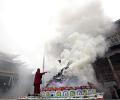
China has been keeping tabs on the restive Tibet province through a 'grid' system and some 600 'convenience police posts' armed with high-tech equipment that monitor the daily life of the citizens of Lhasa and other Tibetan towns. Worse, 'volunteer security groups' known as 'Red Armband Patrols' are roaming around in order to get more information and 'classify' each and every citizen, says Claude Arpi
 © 2026 Rediff.com - Investor Information - Advertise with us - Disclaimer - Privacy Policy - Sitemap - Feedback - About us - Terms of use - Grievances