
Industrial production expanded a provisional 3.4 per cent year-on-year in June.

India's industrial production growth rose marginally to 5.6 per cent in February from 5.5 per cent in January 2023, mainly due to good performance of the power, mining and manufacturing sectors, according to official data released on Wednesday. There was an improvement on an annual as well as sequential basis. The factory output growth measured in terms of the Index of Industrial Production (IIP) stood at 1.2 per cent in February 2022.

The services sector growth in India rose to a 13-year high in September on sharp increase in new business amid strong demand conditions, and job numbers continued to increase as overall business mood improved, a monthly survey said on Thursday. The seasonally adjusted S&P Global India Services PMI Business Activity Index rose from 60.1 in August to 61 in September, signalling a sharp upturn in output. In Purchasing Managers' Index (PMI) parlance, a print above 50 means expansion while a score below 50 denotes contraction.

Indian industrial output jumped 5.0 per cent in December as robust domestic demand bolstered the manufacturing sector, official data released on Tuesday showed.

Analysts polled by Reuters had forecast a contraction of 1.5 per cent in output.

'The lack of a majority isn't the issue. He has enough in 240, especially as none of his allies can pull down his coalition.' 'That's why he's started as if this were just another, normal term. That pretence is vital for him.' 'The change for Modi 3.0 comes not from numbers, but from the new environment of contestation,' points out Shekhar Gupta.

Auto manufacturers have focused on launching CNG variants of their popular models to meet consumer demand for vehicles with lower running costs.

Growth in overall factory output, as measured by the Index of Industrial Production.

It was 2.6% in January.

Last month, the agriculture ministry had projected 10 per cent fall in kharif foodgrains production at 117.18 million tonnes in view of poor rains and drought in more than 360 taluks in Karnataka, Maharashtra, Rajasthan and Gujarat.
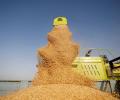
Temperatures in March will be critical to determining the impact of any unusual heatwave conditions on this year's wheat crop in North India. It is that time of the year when the crop enters its vital grain-filling stage, say meteorologists and crop experts. So far, the high day temperatures in the North are not believed to have any significant impact on the final yields since the crop hasn't entered a stage where heat affects yields.

Dixon Technologies' January-March quarter (Q4) results came in well below expectations, but the potential for signing up a new mobile client, and plans for backward integration into display manufacturing kept investors happy. Dixon's Q4FY24 revenue grew 52 per cent year-on-year (Y-o-Y) to Rs 4,660 crore, below Street consensus, due to weakness in consumer electronics (Rs 890 crore) and home appliances (Rs 294 crore) segments.

India has managed to move a smaller share of its working-age population away from farm-related work than many of its neighbours. Bangladesh, Bhutan, Sri Lanka and Nepal managed to shift a bigger share of jobs to non-agricultural work than India, shows data from the year 2000 to 2023 the compiled from the World Bank's April South Asia Development Update report. Only Pakistan and the Maldives show a lower shift among South Asian peers.

The seasonally adjusted S&P Global India Manufacturing Purchasing Managers' Index (PMI) slipped from 57.5 in September to 55.5 in October, the slowest rate of expansion since February. The October PMI data pointed to an improvement in overall operating conditions for the 28th straight month.

'While every year presents new challenges, it also provides opportunities for better growth and performance.'
India's factory output maintained its robust pace in March, growing by 13.5 per cent despite monetary tightening and a partial roll back of stimulus measures. Driven largely by manufacturing, this was the sixth straight month of double-digit expansion.

'By integrating data, research, and new insights, we are designing work environments that foster innovation, collaboration, and wellbeing.'
The UAE will comply with the Organisation of Petroleum Exporting Countries' directive to reduce its output by 1 million barrels a day, from the official quota of 28 million barrels, Minister of Energy Mohammed bin Dhaen Al Hameli said.

India's economic growth accelerated to 8.4 per cent in the third quarter of 2023-24, mainly due to good performance by the manufacturing, mining & quarrying and construction sectors. The Indian economy recorded a growth of 8.4 per cent in the third quarter of this fiscal (October-December 2023), according to data released by the National Statistical Office (NSO) on Thursday.
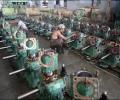
The headline HSBC India Purchasing Managers' Index -- a composite gauge designed to give a single-figure snapshot of manufacturing business conditions -- stood at 53.3 in November significantly higher from 51.6 in October.

Retail inflation eased to an 11-month low of 4.83 per cent in April as prices of some kitchen items declined though overall food basket firmed up marginally, according to a government data released on Monday. The Consumer Price Index (CPI)-based retail inflation was 4.85 per cent in March. It was 4.7 per cent in April 2023.

Foodgrain output stood at 129.94 million tonnes (mt) in last year's Kharif season.

During April-February, industrial output grew at 2.6 per cent compared with a growth of 2.8 per cent in the year-ago period.

Reliance Industries would repair a third of the wells shut at its main gas field in the eastern offshore KG-D6 block to boost output in the first quarter of 2014.
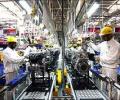
Industrial production was upwardly revised to 0.5 per cent year-on-year in August from 0.4 per cent earlier.

RIL and its partners BP Plc of UK and Canada's Niko Resources had last month spud the seventh well on the MA oil and gas field in the KG-DWN-98/3 or KG-D6 block in the Krishna Godavari basin.

India's industrial production growth perked up slightly to 5.2 per cent in January from 4.7 per cent in December 2022, mainly due to good performance of the power, mining and manufacturing sectors, according to official data released on Friday. There was an improvement on an annual as well as sequential basis. The factory output growth measured in terms of the Index of Industrial Production (IIP) stood at two per cent in January 2022.
As per data released by the government on Monday, industrial output grew by 3.5 per cent in the April-October period this fiscal, as against 8.7 per cent in the same period last year.
India's services sector growth eased to a three-month low in June but service providers continued to signal positive demand trends, which resulted in a stronger increase in new business volumes and further job creation, a monthly survey said on Wednesday. The seasonally adjusted S&P Global India Services PMI Business Activity Index fell from 61.2 in May to 58.5 in June. Despite falling from May, the latest figure was consistent with a sharp pace of growth.
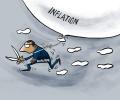
Most members of the Reserve Bank of India's monetary policy committee (MPC) decided to stick to the course on bringing retail inflation to the target of 4 per cent while voting for maintaining status quo in the April review, except external member Jayanth Varma who voted for a 25 bps cut in the repo rate. "I believe that the extant monetary policy setting is well positioned," RBI governor Shaktikanta Das said in the minutes of the policy review, which came out on Friday. "Monetary policy transmission is continuing and inflation expectations of households are also getting further anchored.

Manufacturing activities in India gained momentum in August as new orders and output increased at the quickest rates in nearly three years, according to a survey released on Friday. The seasonally adjusted S&P Global India Manufacturing Purchasing Managers' Index (PMI) rose to 58.6 in August from 57.7 in July. Pollyanna De Lima, Economics Associate Director at S&P Global Market Intelligence, said the PMI results for India painted a vibrant picture of the nation's manufacturing landscape in August.

The ministry of finance is likely to assume crude oil price to remain within $85 per barrel while estimating subsidies for the Interim Budget 2024-25 (FY25), to be presented on February 1. Brent crude prices moved up on Thursday, ending at $78.9 per barrel. Crude oil and cooking gas prices, which move in tandem, impact fertiliser and cooking gas subsidies, constituting 53 per cent of the government's total subsidies.

The US has downsized world's rice production by 15 million tonnes following an estimated decline in output of an equal quantity of the grain in India possibly due to drought.

Factory output growth, as measured by the index of industrial production, was at 8.1 per cent in December 2010.
The organisation of oil producing and exporting countries on Monday ruled out any increase in oil output to cool the high international oil prices.

The BSA Gold Star is launched....Ola Enters e-motorbikes Biz... Bajaj, TVS To Enter e2Ws Market...

The Centre recently released the first advance estimates of kharif crops that, barring tur dal, showed a dip in production due to uneven monsoon and other natural calamities including pest attacks in cotton. The first Advance Estimates, released a few weeks back, are usually initial projections on the crop size and, more often than not, are revised as more inputs come from the fields. But, the findings have rung alarm bells in several quarters. The Centre, along with many others, is confident that as more details come, the estimates will be revised upwards.
Farm production may go down a bit due to late and "below-normal" monsoon but the fall is unlikely to be substantial as the sowing season is far from over, said state-owned Indian Agricultural Research Institute.

Manufacturing sector activities in India moderated in June from a 31-month high in May, but output remained in the growth territory, as new work orders expanded sharply amid favourable demand conditions, a monthly survey said on Monday. The seasonally adjusted S&P Global India Manufacturing Purchasing Managers' Index (PMI) fell from 58.7 in May to 57.8 in June. Despite the fall, the headline figure pointed to a considerable improvement in operating conditions, the survey said, adding that the demand strength positively impacted several other measures such as sales, production, stock building and employment.
