
From the 30-share blue-chip pack, Mahindra & Mahindra, Zomato, Tata Motors, IndusInd Bank, Reliance Industries, Larsen & Toubro, UltraTech Cement, HDFC Bank, Adani Ports and Bajaj Finserv were among the major laggards. On the other hand, Hindustan Unilever, Tech Mahindra, Nestle, Bharti Airtel and ICICI Bank were among the gainers.

India-focused offshore funds and exchange-traded funds (ETFs) witnessed a net outflow of $376 million in three months ended March 2021, making it the twelfth consecutive quarter of withdrawal, according to a Morningstar report released on Wednesday. This was markedly lower than the net outflows of $986 million registered during the quarter ended December 2020. India-focused offshore funds and ETFs are some of the prominent investment vehicles through which foreign investors invest in Indian equity markets.

From the Sensex pack, Reliance Industries, Bajaj Finserv, HDFC Bank, Adani Ports, Maruti Suzuki India, Axis Bank, Hindustan Unilever, Sun Pharmaceuticals and Asian Paints were among the laggards. Reliance Industries fell the most by 2.38 per cent to close at Rs 1,171.10 apiece.

Foreign investors have continued selling in the Indian market, pulling out a massive Rs 85,790 crore (around $10.2 billion) from equities this month due to Chinese stimulus measures, attractive stock valuations, and the elevated pricing of domestic equities. October is turning into the worst-ever month in terms of foreign fund outflows. In March 2020, FPIs withdrew Rs 61,973 crore from equities.

The liquidity deficit in the banking system crossed Rs 2 trillion again on Monday, despite the second instalment of cash reserve ratio (CRR) reduction coming into effect from December 28.

Among the Sensex firms, HCL Technologies fell the most by 2.4 per cent. IndusInd Bank (2.35 per cent), Infosys (2.28 per cent), Wipro (1.8 per cent), NTPC (1.71 per cent), Asian Paints (1.7 per cent), Tata Consultancy Services (1.36 per cent),Tech Mahindra (1.03 per cent) and SBI (1 per cent) were among the major laggards.

India's stock markets corrected recently but foreign money is likely to chase China rather than India in the short-to-medium term, said Chris Wood, global head of equity strategy at Jefferies, on Thursday. Wood told the Business Standard Manthan Summit in New Delhi he is bullish about Indian equities from a long-term perspective, but for the short term he is cautious given the quantum of foreign investor (FII) outflows and valuation woes.

From the 30-share blue-chip pack, Bharti Airtel, Power Grid, Bajaj Finance, Nestle, Mahindra & Mahindra, Reliance Industries, Asian Paints, IndusInd Bank, Hindustan Unilever and HDFC Bank were the biggest gainers. Bajaj Finance climbed nearly 2 per cent after the company reported an 18 per cent increase in its consolidated net profit to Rs 4,308 crore for the December quarter.

The exodus of foreign investments from Indian equity markets continued unabated, with FPIs pulling out nearly Rs 20,000 crore in the last five trading sessions on higher valuations of domestic stocks and shifting their allocation to China. As a result, foreign portfolio investors (FPIs) have turned net sellers in the equity market, with total outflows reaching Rs 13,401 crore for 2024 so far. Going ahead, the FPI selling trend is likely to continue in the near term till data indicate the piossibility of a trend reversal.

Stock market investors became richer by a whopping Rs 77.66 lakh crore in 2024, helped by an overall optimistic trend in equities, where the BSE Sensex surged over 8 per cent. Analysts said the year witnessed a tug of war between the bulls and bears marked by volatility but, despite the uncertainties around the world, the Indian markets sustained the pressure and delivered impressive returns.

Equity mutual funds witnessed an outflow of Rs 9,253 crore in January, making it the seventh consecutive monthly withdrawal, primarily due to profit booking and portfolio rebalancing amid markets touching new highs. The pace of outflows from equities has however slowed for the third month and Gautam Kalia, head - Investment Solutions, Sharekhan by BNP Paribas said that it will likely turn positive soon as investors get used to the new normal. In addition, investors pulled out Rs 33,409 crore from debt mutual funds last month after investing Rs 13,863 crore in December, data from the Association of Mutual Funds in India showed on Tuesday.

The exodus of FPIs from the Indian equity markets continues unabated, as they withdrew Rs 64,156 crore ($7.44 billion) this month so far on depreciation of the rupee, rise in the US bond yields and expectation of a tepid earning season. This came after an investment of Rs 15,446 crore in the entire December, data with the depositories showed.

Foreign investors have pulled out Rs 44,396 crore from Indian equities this month, driven by strength of the dollar, rising bond yields in the US, and expectations of a weak earnings season. This came following an investment of Rs 15,446 crore in the month of December, data with the depositories showed.

In January, SIP account closures surpassed new registrations for the first time.

The last time this happened was in 1996.
The Indian rupee may experience some volatility in the early days of Donald Trump's presidency, but it is likely to stabilise soon after, a report by the State Bank of India (SBI) said on Tuesday, terming this short term phenomenon as "Trump Tantrum".

From the 30-share blue-chip pack, Adani Ports, UltraTech Cement, Larsen & Toubro, Sun Pharma, HDFC Bank, ICICI Bank, NTPC and State Bank of India were the major laggards. Tata Consultancy Services, Reliance Industries, ITC, Asian Paints, HCL Tech and Maruti were among the gainers.
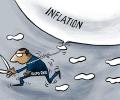
'As the Budget has taken some measures to spur growth, similar action from the MPC may be expected.'

From the 30 Sensex pack, Hindustan Unilever fell by nearly 6 per cent after the FMCG major reported a 2.33 per cent decline in consolidated net profit at Rs 2,595 crore for the second quarter ended in September 2024 impacted by moderation in demand from the urban market.

Overall, the MF industry saw nearly Rs 5 trillion, or 18 per cent, of asset erosion in March, with the asset base shrinking to Rs 22.26 trillion from Rs 27.22 trillion at February-end.
Equity benchmark Sensex on Thursday plunged about 965 points to crash below the 80,000 level due to heavy selling in global equities after the US Federal Reserve signalled fewer rate cuts next year. Besides, deep losses in consumer durables, banking and IT stocks amid foreign fund outflows added to the gloom, analysts said.

'Expect India to keep doing well irrespective of geopolitics.'

As India faces slowing economic growth, HSBC Global Research has downgraded the Indian stock market outlook from "overweight" to "neutral". In a report, the global financial services firm said profits at India Inc appeared to have softened while valuations are elevated. After annualized growth of 25 per cent in recent years, profits appear to have softened while valuations are elevated at 23x forward earnings.

'This is also a time when you realise that short-term trading and dabbling in derivatives may result in financial losses.'

Equity benchmark indices Sensex and Nifty settled lower for the sixth straight session on Monday due to heavy selling in bellwether stocks including HDFC Bank and Reliance Industries amid mixed trends in the global markets and outflow of foreign funds. Falling for the sixth consecutive session, the BSE Sensex tumbled 638.45 points or 0.78 per cent to settle at 81,050. During the day, it plummeted 962.39 points or 1.17 per cent to 80,726.06. The NSE Nifty slumped 218.85 points or 0.87 per cent to end at 24,795.75.

Investors will take cues from the December quarter corporate earnings, with blue-chips like Infosys, Reliance Industries scheduled to report their results this week, in addition, inflation data and trading activity of foreign investors will also be crucial in dictating market trends, analysts said.

Benchmark Sensex dropped 334 points on Monday due to intense selling pressure in metal and power stocks as FII outflows dampened investor sentiment. Besides, a sharp decline in the rupee against the US dollar also put pressure on domestic equities, traders said. After losing nearly 500 points, the 30-share BSE index recovered some lost ground to settle at 334.98 points or 0.55 per cent lower at 60,506.90. During the session, the index touched its intra-day low of 60,345.61.

The liquidity will move into deficit after advance tax payments and GST outflows. It will rebound in October because of government spending.

Foreign portfolio investors (FPIs) withdrew Rs 14,790 crore ($1.8 billion) from financial stocks in the first half of August, driven by global risk aversion sparked by US recession fears. Additional factors contributing to the decline in banking stocks included subdued earnings growth in the June quarter, concerns about slowing deposit growth, and stricter liquidity norms imposed by the Reserve Bank of India.

Foreign investors turned net sellers in October, withdrawing shares worth Rs 58,711 crore in the month so far owing to escalating conflict between Israel and Iran, a sharp rise in crude oil prices, and the strong performance of the Chinese market. The outflow came following a nine-month high investment of Rs 57,724 crore in September. Since June, Foreign Portfolio Investors (FPIs) have consistently bought equities, after withdrawing Rs 34,252 crore in April-May.

State Bank of India, Adani Ports, Tata Consultancy Services, ICICI Bank, Reliance Industries and PowerGrid were also among the laggards.

Stock markets closed lower for the second straight day on Friday amid relentless foreign fund outflows and losses in blue-chip stocks Reliance Industries, ICICI Bank and State Bank of India. Benchmark BSE Sensex declined by 55.47 points or 0.07 per cent to settle at 79,486.32. During the day, it tanked 424.42 points or 0.53 per cent to 79,117.37.

Inflows into mutual funds' equity schemes increased by over 14 per cent on-month to Rs 41,156 crore in December, even as market volatilities continued. The small and midcap schemes of mutual funds continued to attract investor interest with inflows touching record highs during the month, despite the concerns being expressed about the two segments for the risk they portend, industry body Amfi said.

Surplus liquidity in the banking system as measured by absorption of excess funds by the Reserve Bank of India (RBI) fell sharply at the end of the last week due to outflows on account of advance tax payments. According to the RBI data, the net liquidity absorbed by the central bank on September 16 was at Rs 3,243.57 crore, much lower than the average of Rs 56,809.92 crore in the preceding four days of the week. The average absorption of funds by the RBI so far in September is at Rs 1.13 trillion, against the average of Rs 1.2 trillion in the previous month, the data showed.

The systematic withdrawal plan stands out as a superior option, providing steady income despite market fluctuations and inflation, says Ramalingam Kalirajan.

From the 30 blue-chip pack, Mahindra & Mahindra, IndusInd Bank, Bajaj Finance, Tata Motors, Bajaj Finserv, Nestle and ICICI Bank were the biggest gainers. State Bank of India, Tata Steel, Adani Ports, Zomato, UltraTech Cement and HCL Tech were among the laggards.

State Bank of India, NTPC, ITC, Asian Paints, Bajaj Finance and Bajaj Finserv were also among the major laggards. In contrast, Power Grid, UltraTech Cement, HCL Technologies and Axis Bank were among the gainers.

'We plan to launch new initiatives, including cash flow-based lending, to ensure borrowers are not burdened and can access funds more quickly.'

'It is imprudent on the part of Indian insurance companies to invest out of the shareholders' fund in a private limited company.'

DIIs owned equities worth Rs 73.5 trillion, just 1.9 per cent less than FPIs. This marks a significant change from a decade ago.
