
The Moon Mineralogy Mapper or M3 has confirmed existence of water on moon by analysing the data collected from Chandrayaan-I.

The National Aeronautics and Space Agency on Thursday revealed that India's maiden lunar mission Chandrayaan-I spacecraft had traced water molecules on the lunar surface of the moon.

National Aeronautics and Space Administration's moon mineralogy mapper, an instrument on board India's lunar mission Chandrayaan-1, has clicked this magnificent image of the moon.The photograph shows a tricolour composite of reflected infrared radiation from the sun and illustrates the extent to which different materials are mapped across the side of the moon that faces the earth.Small amounts of water were detected on the surface of the moon at various locations.
Moon Mineralogy Mapper (M3) instrument of National Aeronautics and Space Administration (NASA) has beamed back images of the Orientale Basin on the western limb of the moon. An analysis of the images indicates abundance of iron-bearing minerals such as pyroxene, said Carle Pieters, a senior scientist of US-based Brown University and principal investigator for the M3 experiment.

Though the Indian Space Research Organization had to prematurely terminate the country's first moon exploration mission after it lost radio contact with Chandrayaan-1 over the weekend, the probe is already said to have yielded a treasure trove of useful data. This suggestion comes from Carle Pieters, a planetary geologist at Brown University in Rhode Island, the principal investigator of the Moon Mineralogy Mapper (M3), a NASA instrument on Chandrayaan-1.
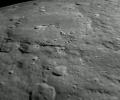
The team led by researchers from the University of Hawai'i (UH) at Manoa in the US discovered that these electrons in Earth's plasma sheet are contributing to weathering processes -- breaking down or dissolving of rocks and minerals -- on the Moon's surface.
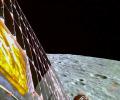
Chandrayaan-1, India's first mission to the Moon, was launched on October 22, 2008 from Sriharikota spaceport in Andhra Pradesh.

The ISRO is looking at Mangalyaan-2, a follow-on mission to Mars, and launching two satellites that would look at Venus and explore asteroids.

Scientists used a new calibration of data taken from NASA's Moon Mineralogy Mapper which flew aboard Chandrayaan-1 spacecraft in 2008.

Using data collected by India's Chandrayan mission, NASA has detected magmatic water locked under the surface of the Moon.
 © 2026 Rediff.com - Advertise with us - Disclaimer - Privacy Policy - Sitemap - Feedback - About us - Terms of use - Grievances