
It is disheartening to see the Bush Administration's efforts to hide more and more information from the public eye in the name of security, presumably to 'protect our freedoms'.

The seventh Tibet Work Forum was held in Beijing on August 28 and 29. Delhi should be deeply concerned, at a time India faces a precarious situation in Ladakh, because the TWF also defines China's western border policies, observes Claude Arpi.

India is committed to further developing friendly and cooperative relations with China, says Parrikar in Beijing.
Chinese President Hu Jintao is all set to succeed Jiang Zemin as the Chairman of the State Central Military Commission (CMC), further consolidating his grip on power in world's most populous nation.

The 2.3 million strong People's Liberation Army, the world's largest, adopts a more aggressive posture with massive structural revamp.
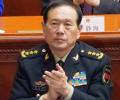
Lieutenant General Wei Fenghe's, China's new defence minister's, first guest of honour could be his Indian counterpart Nirmala Sitharaman.
The largely ceremonial position of the chairman of the Central Military Commission was the last top post Jiang held in the government for the last 15 years.

'It doesn't look as if any sensible, worldly wise, person is in charge in China.' 'If at all anybody is in charge, it can only be a bunch of bumpkins of whom Xi has become a puppet,' observes B S Raghavan, the veteran civil servant.

'Tibetans will participate in future conflicts with India (in all probability, some were already present in Galwan).' 'As nobody in India would like to have a deadly fight with Tibetan soldiers and officers, the issue needs to be closely followed,' observes Claude Arpi.
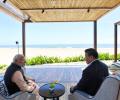
'India's relationship with China has been and will continue to be complex, delicate and sensitive,' says Rup Narayan Das.
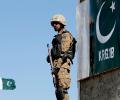
The country opened its airspace for all flights except for New Delhi, Bangkok and Kuala Lumpur on March 27.
China assured the Pakistani president of maintaining their 'all weather' relationship.

'The supreme art of war is to subdue the enemy without fighting.' Former RA&W official Jayadeva Ranade explains what China's military reforms mean for the world.

It is the country's second aircraft carrier, after the Liaoning, and the first to be made domestically.

Chinese President Xi Jinping has underlined the need for building a combat-ready army and accelerate the building of the theatre joint combat command system, amidst the People's Liberation Army flexing its muscles in the disputed South China Sea.

The official cited it as an example of 'how the Chinese military is trying to resolve issues through dialogue mechanisms'.
His weeklong visit is expected to enhance India-China military-to-military ties and boost mutual understanding and trust.
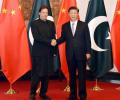
'The scheduling of Imran Khan's visit to Beijing and its focus on the J&K situation underscores that Beijing shares the Pakistani concern that tensions with India are only going to escalate further in the period ahead,' says Ambassador M K Bhadrakumar.

This is perhaps the most authoritative portrayal so far of Indian air power as a threat to China.

'There are reports of political dissent mounting on Xi Jinping's handling of the Wuhan fallout.'

In a few years from now, India will be looking at an entirely different type of military adversary across the borders, in our waters, in the air, in space and in our communication networks, says Nitin Pai.
At a time when Donald Trump is making belligerent noises, Chinese President Xi Jinping responds by overhauling the People's Liberation Army and restructuring the command of the PLA Navy to emphasise Beijing's resolve to dominate the South China Sea.

China has for the first time landed a military plane on one of its artificial islands in the disputed South China Sea.

China's highest ranking defence officer will visit India next month, the first such visit in a decade as the Chinese military seeks to expand relations with its Indian counterpart.

The removal of the term limit will give Xi a limitless tenure.

Kicking off his four-day visit, General Suhag met General Li Zuocheng, the head of China's ground forces which have undergone major restructuring in the last three years.
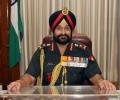
Operationalisation of a new border defence agreement to deal with recurring troop incursions along the LAC besides improving defence ties, is expected to top the agenda of General Bikram Singh as he starts a rare visit by an Indian army chief to China from Wednesday.

Pakistan's powerful Army Chief Gen Raheel Sharif's visit to Beijing comes in the backdrop of assertions by Pakistan that it will raise its concerns at the international level over India's successful test of supersonic interceptor missile.

A visit by Indian journalists, sponsored by the Chinese government, on Monday turned into a propaganda exercise by the Chinese Army for delivering its message on the prolonged standoff between troops of the two countries in Doklam near Sikkim.
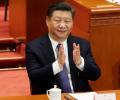
Xi has already been elected as general secretary of the ruling Communist Party of China at its once-in-five-year congress in October last year.

'He still has to deal with party norms and traditions and has been careful to follow the order of seniority,' points out Claude Arpi.
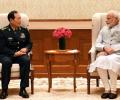
'China's military is expected to deploy full throttle its new equipment including J-20 stealth fighters, drones, medium range missile systems, surveillance and others to continue to put psychological pressure on India,' warns Srikanth Kondapalli, Professor in Chinese Studies, JNU.

'The military officers at China's National People's Congress reflect Xi Jinping's preference for elevating politically reliable, younger, officers with good professional qualifications,' says former RAW officer and China expert Jayadeva Ranade.

'China refuses to talk to India on nuclear or ballistic missile issues and conclude any de-targeting agreement as Beijing did with Russia or a non-targeting agreement with the US.'
 © 2026 Rediff.com - Investor Information - Advertise with us - Disclaimer - Privacy Policy - Sitemap - Feedback - About us - Terms of use - Grievances