
On June 18, Justice John Major released a scathing report on the 1985 Air India Kanishka bombing investigation, terming it an Air India, Canadian atrocity. The report criticised Candian authorities for ignoring warnings about a likely terror strike on the aircraft and lapses in subsequent investigations.
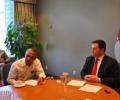
Canadian Citizenship and Immigration Minister Jason Kenney convened a roundtable discussion in Toronto with members of Air India victims' families on June 18, a day after Justice John Major released his 4,000-page report.
The final report into the 1985 Air India Kanishka bombing has recommended ex-gratia payment to the families of 329 victims, mostly of Indian origin as it blamed the Canadian government for its failure to prevent the country's worst terrorist attack.
Rediff.com's Ajit Jain brings forth the anguished stories of some of the inconsolable victims of the Kanishka bombing, as they try to come into terms with the new developments.
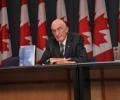
Indian carrier Air India has been vindicated by Justice John Major's report on the bombing of Air India flight-182, in which all 329 people aboard were killed after Boeing 747 Kanishka disintegrated off the coast of Ireland.
Justice John Major released a scathing report on the 1985 Air India Kanishka bombing investigation at the Media Center in Ottawa on Thursday, in which he stressed, "This is an Air India, Canadian atrocity."
A quarter-century after Canada's worst terrorist attack killed 329 people, an inquiry commission will make its report into the 1985 Kanishka bombing public this week, outlining recommendations about how to prevent such tragedies in future.
After the hearings, the Air India public inquiry commission headed by Justice John major will start working on the final report that is likely to be submitted this spring.
Major acknowledged there may be legal problems but maintained they're not insurmountable. For example, the law could provide that evidence can only be shared with the approval of a Federal Court judge.
The families who have lost loved ones in the 1985 Kanishka bombing on Friday sought a public apology from the Canadian government for the way it dealt with the tragedy.
The Canadian government has objected to a report that suggests systemic racism may have played a role in public and government attitudes towards the Air India bombing that killed 329 people in 1985.
The cameras installed by the Royal Canadian Mounted Police at the Surrey (British Columbia) house of Indo-Canadian journalist Tara Singh Hayer were reportedly not working the night he was assassinated on November 18, 1998, the Air India inquiry, now in progress in Ottawa, was told on Thursday.
The Air India Commission, inquiring the 1985 Kanishka bombing that claimed 329 lives, has pulled up the federal government for its inability to provide basic information about how terrorist financing legislation is working in the country. Justice John Major, who heads the inquiry, said on Wednesday his staff has had to do its own research to find out the extent of the terrorist financing in Canada and what is being done to combat the problem.
Justice John Major, who presided over the Air India inquiry commission that concluded its hearing earlier this week, said that he "did not imagine at first that it was a plane full almost entirely of Canadians." "The fact that the Sikh terrorists behind the plot were from British Columbia made it even more distant and difficult for those in Toronto and Ottawa to understand that it was a Canadian tragedy," Major said in Toronto on Tuesday.
Former Supreme Court Justice, John Major, has faced many delays since he was appointed by the Conservative government in March 2006 to conduct public hearing into the 1985 attack that took 329 lives.
The witnesses would not testify because of the Inquiry Commission could not give them sufficient assurances for their safety, Commission's chief counsel Mark Freiman said.

"The Canadian airline is one of oldest and largest in the world, and it is Air Canada's duty to co-operate with the inquiry," Justice Major said on Wednesday.
The problem, according to Kobzey, was that the Canadian Security and Intelligence Services (CSIS) just did not have enough people to trail everyone that investigators wanted to follow.
Mark Stagg, the watch officer on the Laurentian Forest, told in a quavering voice of being handed a dead infant to place in a makeshift body bag.
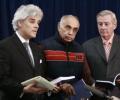
Justice John Major, head of the Public Commission of Inquiry into the 1985 Air India bombing, on Tuesday released the first volume of his report. The 211-page report is a narrative based on the testimonies of the families of Air India victims and of the Irish naval rescuers.
Willy Laurie, a former agent of the Canadian Security Intelligence Service, testified before Justice John Major on Monday that a close friend of accused Ajaib Singh Bagri, told him not to pass on her information to police as Bagri, a leader of the Babbar Khalsa terrorist group, would kill her and children.
It is now clear that the bags were not properly screened either in Toronto or in Montreal, leading to the death of 329 people.
The inquiry into the 1985 Air India bombing has been delayed for about a month due to the ongoing wrangling over the public release of government documents.
The inquiry will have done its job if it makes victims' families -- many of whom immigrated to Canada from India -- feel like real Canadians, Major said.
 © 2026 Rediff.com - Investor Information - Advertise with us - Disclaimer - Privacy Policy - Sitemap - Feedback - About us - Terms of use - Grievances