
The Jammu Police on Sunday averted a major terror attack and recovered an improvised explosive device (IED) which was targeted at a crowded area by an operative of terror outfit Lashkar-e-Tayiba (LeT).
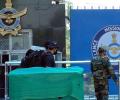
Two Indian Air Force personnel, who suffered minor injuries in two low-intensity explosions that took place at the Jammu Air Force Station earlier on Sunday, are under observation and doing fine, informed IAF officials.

Investigators are also examining the possible use of drones to drop the explosives at the airport that has various assets of the IAF, they said.
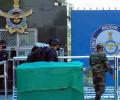
The investigators have not yet been able to find parts of any drone, sources said.

"Very soon we will have enough systems and we will target.. we will find ways to tackle this threat," the Air Chief Marshal said.

Over the last week, at least five drone activities have been reported in Jammu.
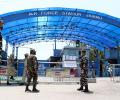
In what is the first time Pakistan-based terrorists have used drones to strike vital installations, two bombs were dropped at the Indian Air Force station in Jammu airport in the early hours of Sunday, officials said.

The Indian mission has already taken up the issue strongly with the Pakistani authorities.
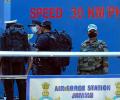
Specialists from the counter-terror drone wing of the NSG also demonstrated the functioning of its counter-UAS mechanism at the technical area of the IAF station, sources said.

The Indian Navy plans to acquire a sizeable number of unmanned aerial and underwater platforms in the next few years to significantly ramp up its surveillance capability in the backdrop of China's increasing forays into the Indian Ocean region, people familiar with the development said on Sunday.

According to a preliminary analysis, the flying object was a hexa m-copter with six wings and had a GPS device and a flight controller, the officer said.

A first information report (FIR) was registered Sunday under the Unlawful Activities (Prevention) Act after two explosives-laden drones crashed into the Indian Air Force station at Jammu airport, officials said, while indicating that the case is likely to be taken over by the terror probe agency National Investigation Agency.
The IED that pierced the rooftop of one of the IAF buildings at the Jammu airport carried less than one kg of RDX and a cocktail of other chemicals whereas the one that was dropped on the ground contained a little over one kg of the deadly explosives along with some ball bearings.
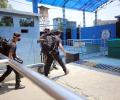
Investigators scanned CCTV footage, including from cameras installed on the boundary walls of the airport, in an effort to determine from where the drones came. However, all the CCTV cameras focused on the roadside, the officials said.
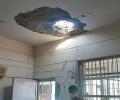
The capability of drones to evade radar, wreak devastation at strategic installations and transport weapons to terrorists has been a continuous concern for the country's security establishment, and in a maiden incident, these unmanned vehicles were used to strike an Indian Air Force base in Jammu on Sunday, officials said.

Easy availability of drones has increased the complexity of security challenges and the Indian military is developing capabilities to effectively deal with the threats, be it from State-sponsored elements or by states themselves, Army Chief Gen M M Naravane said on Thursday.
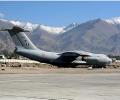
An IL-76 transport aircraft of the Indian Air Force was pressed into service to ferry the stranded passengers mostly hailing from Leh and Kargil districts of Jammu and Kashmir.

He suggested that the new structures will emerge within one year's time.
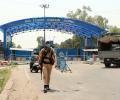
Drones have added a new dimension to security threats from terror groups and investigations into the attack on the Jammu IAF station last month show the involvement of "non-State actors" supported by State actors such as the ordnance factory of Pakistan, Jammu and Kashmir DGP Dilbag Singh said on Tuesday.
 © 2026 Rediff.com - Advertise with us - Disclaimer - Privacy Policy - Sitemap - Feedback - About us - Terms of use - Grievances