
Expect corporate houses to raise funds via IPO in second half of this year.

Initial public offerings and the profits made from it has been a hot topic of discussion in recent weeks. Here's a look at what you must know before applying for that 'hot' IPO.
With more new listings on the bourses trading at a discount to the offer price, retail investors are no longer queuing up for initial public offering applications.
Investing in IPOs and selling them at a higher price on listing day has become a surefire method of making money. However, one needs to know smart ways of investing in an IPO.

C S Ghosh, founder of Bandhan Bank, believes his unique business model is not comparable to any financial institution in India -- neither small finance banks, nor big private sector banks -- and hence the valuations are justified.
Anil Ambani Group firm Reliance Power's IPO on Thursday generated a record demand, with bids pouring in for shares worth Rs 2,34,000 crore ($ 60 billion) an amount that is over three times the money ploughed in by FIIs and mutual funds in the stock market in 2007.
The move signals a strong demand from investors.
The world's largest mobile operator by revenue has begun the year on a bold note, backing the initial public offer plans of its Indian unit and sources say the ball has already been set rolling.

The Bombay Stock Exchange today said 10 companies on its recently launched IPO index to track newly listed companies for the first two years would be excluded after completion of their term.
Multiple agencies to probe, regulatory crackdown on more companies expected.

At the heart of Paytm's slide lies the abject failure of its Super App strategy, notes Indrajit Gupta.
In each public issue, 25 per cent of the shares on offer are reserved for the retail investor.
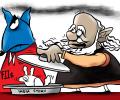
The value of FPIs (Foreign Portfolio Investors) holding in Indian equities reached $738 billion in the three months ended December 2023, marking a surge of 13 per cent from the preceding quarter, driven by the strong performance of the domestic stock market, according to a report by Morningstar. The value of FPIs investment was at $651 billion in the September quarter of the current fiscal. On a year-on-year basis, the value of such investments rose 26 per cent from $584 billion in December 2022.
Broadcaster Nimbus Communication, which operates sports channel Neo Sports, is in talks with banks to float an initial public offer for nearly Rs 300 crore (Rs 3 billion).

More than 60 small and medium enterprises (SMEs) are expected to tap the market in one year to raise equity funds for supporting their business requirements, a BSE top official said on Wednesday. These companies will get listed on the exchange's SME platform, Ajay Thakur, head of BSE SME and Startup told PTI. Last year, only 16 SMEs had tapped the initial public offering (IPO) route and raised Rs 100 crore.

The Chinese financial giant, which had invested in One 97 Communications since 2015, has seen a sharp decline of 45 per cent, or Rs 2,125 crore, in its stake value since the Reserve Bank of India (RBI) took action against Paytm Payments Bank on January 31. One 97 shares closed at Rs 422.6 a share on Monday. The Chinese company, however, had sold its stake worth Rs 8,293 crore in three tranches over one year.
Reliance Power Ltd's public issue has so far generated demand for shares worth more than $179.5 billion (Rs 706,000 crore) as bids continued to pour in on the last day of the Anil Ambani Group firm's IPO.

Even within China, economic slowdown and stiffer competition may hit growth.

Among the changes planned are removal of the Rs 4,000-crore (Rs 40-billion) minimum size criterion and an enhanced quota for the so-called anchor investors.

Why are financial-technology (fintech) players moving back to India, or doing the reverse-flipping?

With at least three IPOs in the offing this year, stock market investors have a lot to look forward to.
Maintaining that collusion between some bankers and brokers led to the multicrore IPO scam, the government on Friday promised action against those found guilty.

Lack of closure to the algo controversy could weigh on sentiment, say experts

Ministry of corporate affairs directs Registrar of Companies to conduct quarterly scrutiny

HDFC Bank's latest shareholding data showed that the room for foreign investment has fallen just 5 basis points short of the threshold set by Morgan Stanley Capital International (MSCI) to fully include the stock in its indices. Currently, the index provider has applied an adjustment factor of 0.5 since the foreign room is less than 25 per cent. Removal of the adjustment factor will result in inflows of a massive $4.8 billion (Rs 40,000 crore) into HDFC Bank, according to Brian Freitas, a New Zealand-based analyst with Periscope Analytics.
In their advertisements to attract investors to public offers, companies can be more creative and innovative as long as they are not misleading and contain necessary disclosures of associated risks and other facts, Sebi chief U K Sinha feels.

Stock market investors are betting that a new government led by Modi will be able to cut red tape and revive economic growth

In a bid to boost the dormant primary market, regulator Sebi said it is ready to review the mandatory grading of initial public offers.
The Securities and Exchange Board of India has charged HDFC Bank with not exercising due diligence, resulting in several demat accounts being opened under fictitious names leading to the IPO scam.

The scrip of the company on Wednesday ended at Rs 695.80, up 2.7 per cent, on BSE, while the benchmark Sensex ended flat at 19,345.70. Just Dial shares had seen a record high of Rs 761.80 on July 9.
IndiaBulls Power IPO's charged-up performance (the issue was subscribed 21.84 times) earlier this month had only one jarring note: the retail portion of the initial public offer barely scraped through, with a subscription of 1.09 times.

Coffee Day Enterprises Ltd is backed by KKR & Co.

IndiGo has a fleet of 98 aircraft and about 75 of them are on operating lease.
State-owned Life Insurance Corporation of India (LIC), which completes one year of its listing on Tuesday, presents a sorry scorecard as far as its stock market performance goes. Shares of the insurance behemoth are down 40 per cent over their issue price of Rs 949 to Rs 567 apiece. The Sensex, on the other hand, has risen 14 per cent in the past one year.
The Securities and Exchange Board of India has extended the market timing for Reliance Petroleum Ltd's IPO by eight hours owing to huge investor interest in the public issue.
