
Among the Sensex stocks, JSW Steel, Asian Paints, Maruti Suzuki India, NTPC, Adani Ports and Special Economic Zone, Bharti Airtel, ITC and Tech Mahindra were the major gainers. Reliance Industries, Tata Motors, Infosys, Mahindra and Mahindra, Bajaj Finance and Axis Bank were the laggards.

Given the macro setting, the outlook remains positive for each of the four key parameters - inflation, current account deficit, fiscal deficit and currency stability, says Rahul Bhushkute.

Investors with stalled projects and mounting bad debt will refinance their loans.

RBI Governor has been under pressure from Finance Ministry.

'We are going to need more technical people in government.' 'You can't expect a generalist to understand the complicated world of financial engineering.' 'I regret to say that most of our politicians have no competence to deal with these things. Nor is there a willingness to learn.'

High rates of such schemes deter banks from dropping borrowing rates - and thus lending rates

A number of non-banking financial companies (NBFCs) have tapped into the debt capital market ahead of the festival season to meet increasing credit demand as bank funding slows. On Tuesday, Aptus Value Housing Finance secured Rs 300 crore at an interest rate of 8.75 per cent through bonds maturing in five years. ICICI Home Finance Company turned to the market to raise Rs 275 crore at 7.94 per cent, alongside another Rs 300 crore at 7.95 per cent, through bonds maturing in five and three years, respectively.

Will the government now push to move away from what Mr Rajan has been doing in the last few years?

Perhaps because the Modi government had some differences of opinion with two of the economist governors (one of whom was appointed by the Manmohan Singh government), there is a view that its political leadership prefers a civil servant to head the RBI, notes A K Bhattacharya.

The Indian rupee is likely to depreciate further against the US dollar through the end of 2024. This is due to the continued strengthening of the greenback, combined with the weakening of the Chinese yuan, which is expected to keep pressure on the Indian currency.

CFO of Lanco Group, Suresh Kumar explains how interest rate hikes would affect their project.

From the 30 Sensex firms, Mahindra & Mahindra, State Bank of India, Bharti Airtel, Hindustan Unilever, Kotak Mahindra Bank, UltraTech Cement, Adani Ports, and Tata Steel were the biggest gainers. ICICI Bank, IndusInd Bank, Asian Paints, Tech Mahindra, Infosys, HCL Technologies, Tata Consultancy Services, and Larsen & Toubro were among the laggards.

Foreign investors turned net sellers in October, withdrawing shares worth Rs 58,711 crore in the month so far owing to escalating conflict between Israel and Iran, a sharp rise in crude oil prices, and the strong performance of the Chinese market. The outflow came following a nine-month high investment of Rs 57,724 crore in September. Since June, Foreign Portfolio Investors (FPIs) have consistently bought equities, after withdrawing Rs 34,252 crore in April-May.

Among the 30 Sensex firms, Asian Paints, Infosys, JSW Steel, UltraTech Cement, Power Grid, Larsen & Toubro, HCL Technologies and Tata Steel were the biggest laggards. Tata Motors, HDFC Bank, Bharti Airtel, ITC, IndusInd Bank and Axis Bank were the gainers.
A day after the Reserve Bank kept key interest rates unchanged, the International Monetary Fund on Wednesday said further interest rate increases are needed in India with monetary conditions still accommodative and credit expanding strongly.

Only borrow an amount that can be repaid comfortably. The ratio of total EMI to take-home salary should not exceed 40 per cent.
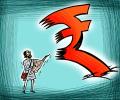
Foreign investors have continued selling in the Indian market, pulling out a massive Rs 85,790 crore (around $10.2 billion) from equities this month due to Chinese stimulus measures, attractive stock valuations, and the elevated pricing of domestic equities. October is turning into the worst-ever month in terms of foreign fund outflows. In March 2020, FPIs withdrew Rs 61,973 crore from equities.

'The central bank has highlighted that the slowdown in growth has been limited to a few sectors and overall growth is expected to pick up in the second half of the year.'

Many senior citizens 'underestimate the impact of inflation, taxation, health-related expenses, and the heavy premium they will have to pay on health insurance.'

Banks have been reluctant to transmit the entire policy rate cut by RBI to borrowers.

The exodus of foreign investments from Indian equity markets continued unabated, with FPIs pulling out nearly Rs 20,000 crore in the last five trading sessions on higher valuations of domestic stocks and shifting their allocation to China. As a result, foreign portfolio investors (FPIs) have turned net sellers in the equity market, with total outflows reaching Rs 13,401 crore for 2024 so far. Going ahead, the FPI selling trend is likely to continue in the near term till data indicate the piossibility of a trend reversal.
The government's huge borrowing to fund the high fiscal deficit could jack up interest rates, but if used efficiently, this could boost the Indian economy, reeling under a global meltdown, according to economists.

The US Fed interest rate decision, domestic inflation data and global trends would be key driving factors in dictating movement in the market this week, as the Lok Sabha elections outcome and the RBI policy decision are behind us, analysts said. The past week was a roller-coaster ride for investors as markets swung sharply in both directions before closing with strong gains.
Interest rates give an idea about the state of a national economy.
In a release on Thursday, A Sakthivel, president, TEA said, "It was a disappointment that there was no announcement on the reduction of interest rate given to the MSME Export Sector, which is urgently needed to have a competitive edge for sustaining in the global market."
From the 30 Sensex firms, Tata Consultancy Services and HCL Technologies dropped over 3 per cent each. Infosys, Tech Mahindra, Sun Pharma and Tata Motors were the other major laggards. Bajaj Finance, Bajaj Finserv, Nestle, HDFC Bank, ICICI Bank and State Bank of India were among the biggest gainers.

Benchmark Sensex rose by nearly 91 points to close at a fresh lifetime high while Nifty settled above the 25,400 level for the first time supported by firm global trends ahead of the much-awaited US Fed's decision on interest rates. Extending its record-setting spree for the second day, the 30-share BSE Sensex climbed 90.88 points or 0.11 per cent to settle at a lifetime high of 83,079.66. During the day, it rose by 163.63 points or 0.19 per cent to 83,152.41.

From the 30 Sensex firms, Tata Steel, JSW Steel, Power Grid, HDFC Bank, Tata Motors and Larsen & Toubro were the biggest gainers. Hindustan Unilever, Infosys, Bajaj Finance, Axis Bank, Kotak Mahindra Bank and UltraTech Cement were among the laggards.

These 10 stocks represent the best mix of value and growth, offering relatively low price-to-earnings and price-to-book ratios, a high return on equity, and sufficiently high potential from current levels.

Foreign investors turned net sellers in October, offloading shares worth Rs 27,142 crore in just the first three days of October due to intensifying conflict between Israel and Iran, a sharp rise in crude oil prices, and improved performance of Chinese markets. The outflow came after FPI investment reached a nine-month high of Rs 57,724 crore in September. Since June, Foreign Portfolio Investors (FPIs) have consistently bought equities after withdrawing Rs 34,252 crore in April-May.

All investors should ideally have a 10 to 15 per cent allocation to gold. Whether they invest in gold ETFs or SGBs should depend on their investment horizon.

The bond, which the Reserve Bank of India started issuing on behalf of the Union government in 2003, was considered one of the safest savings instruments for retail investors.
Finance Minister P Chidambaram on Friday sought to allay fears that interest rates will go up in the face of the decision of ICICI Bank and HDFC to hike home loan rates by 0.50 per cent.

'India's fundamentals are a lot better (than those of other emerging market economies).' 'India will suffer (witness a fall in its stock market) what I call the second order effect.' 'And the second order will happen when these funds (belonging to macro and hedge fund investors and which have leveraged Japanese yen-carry trades), because they lose money elsewhere as lot of their positions were financed by borrowing Japanese yen, will have to book profits in investment destinations where they are making money, including in markets like India.' 'They (these investors) will have to effectively sell in countries like India and which is the consequence (the crash in equity markets) that Indian markets might see.'

Foreign investors continued their relentless selling in the Indian equity markets in August, offloading shares worth Rs 21,201 crore due to the unwinding of the yen carry trade, recession fears in the US and ongoing geopolitical conflicts. This came after an inflow of Rs 32,365 crore in July and Rs 26,565 crore in June, data with the depositories showed.

If the cashless request is denied, the entire cost may need to be paid for planned treatments.
The country's largest private lender ICICI Bank on Monday said that interest rates are expected to come down in the next one-and-a-half months.

Ask rediffGURU and PF and MF expert Janak Patel your mutual fund and personal finance-related questions.
With tightening in liquidity condition and expected decline in the inflation by early 2009, there is only a remote possibility of further hike in interest rate by the Reserve Bank, the US-based investment banker Goldman Sachs said in a report. Further, given the current global environment of tight liquidity and the central banks move last week to ease liquidity conditions, any further cash reserve ratio hike is firmly ruled out, it said.

'If you invest in a rush at the last moment, you could compromise on selecting the best tax-saving options.'
 © 2026 Rediff.com - Advertise with us - Disclaimer - Privacy Policy - Sitemap - Feedback - About us - Terms of use - Grievances