
In the draft norms issued last month, the RBI said that the ultimate responsibility for the bank's performance, conduct and control rests with the Board

A tribal man in Odisha was forced to carry his sister's exhumed skeleton to a bank to prove her death and withdraw her money, sparking outrage and prompting government intervention.

Discrepancies in actor Vijay's election affidavits regarding pending criminal cases and bank accounts have surfaced, potentially leading to legal and political challenges.

A tribal man in Odisha's Keonjhar district brought the skeleton of his dead sister to a bank to withdraw money deposited in her name after bank officials insisted on the account holder's presence.
A tribal man in Odisha was forced to carry his sister's exhumed skeleton to a bank to withdraw her money, sparking widespread condemnation. The bank claims it only requested valid documents, but the incident has raised questions about the treatment of vulnerable customers.

What is the reason behind this drying up of talent for the top post in private banks?

India's privatisation push, once projected as a cornerstone of economic reform, has suffered another setback, with the Centre set to call off the IDBI Bank stake sale, highlighting the political and structural constraints shaping the country's disinvestment policy, experts say.

Led by the country's biggest lender State Bank of India (SBI), public sector banks logged a record cumulative profit of Rs 52,603 crore in the third quarter of the current fiscal, reflecting an 18 per cent year-on-year growth.

A national rollout will take place after the pilot test in which SBI, PNB, Axis Bank, Bank of Maharashtra, Canara Bank, Kotak Mahindra Bank, IndusInd Bank, ICICI Bank, HDFC Bank, Indian Overseas Bank and Punjab & Sind Bank are participating.
State Bank of India-led public sector banks posted a record cumulative profit of Rs 49,456 crore in the second quarter of the current fiscal, reflecting a 9 per cent year-on-year growth despite two lenders reporting a decline. All 12 public sector banks (PSBs) together made a profit of Rs 45,547 crore in the September quarter of FY25.

The pickup was driven partly by fresh corporate investment but more by higher working-capital demand.

'This is an area where good lending can happen, and that is one of the priorities for the next quarter.'

CPGRAMS -- an online platform available to citizens 24x7 to lodge their grievances to public authorities on service delivery -- has existed for close to two decades. But it has never been this active, points out Tamal Bandyopadhyay.

Indian Overseas Bank has informed BSE that a meeting of the board is scheduled on January 31 to take on record the unaudited financial results of the bank for the quarter ended December 31, 2002.

The Supreme Court on Friday declared JSW Steel Limited's resolution plan for Bhushan Power & Steel Limited (BPSL) "illegal" and ordered the latter's liquidation, four years after the company was acquired by JSW Steel under the Insolvency and Bankruptcy Code (IBC). Following the ruling, JSW Steel shares fell sharply.

Net NPAs increased to Rs 36,260 crore in the December quarter from Rs 34,843 crore in September and Rs 33,116 crore in December 2023, observes Tamal Bandyopadhyay.

'If you are not prudent, you may exceed your budget, and if it happens too often, you may end up in debt.'

Public sector banks (PSBs) have proposed the Finance Ministry their plan to raise Rs 54,800 crore through Additional Tier-1 (AT-1) and Tier-2 bonds in the current financial year (FY25), 37 per cent more than the Rs 39,880 crore raised in FY24
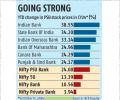
Stock Market News today, PSU banks: The year 2024 was a roller-coaster ride for Indian stock markets, marked by volatility driven by the Lok Sabha elections, Union Budget 2024, a slowdown in corporate earnings, and sticky inflation. Geopolitical tensions - particularly between Israel and Iran in West Asia - along with various stimulus announcements by China and yen carry trade rocked the equity markets throughout the year.

The Union Finance Ministry on Tuesday said that aggregate business of public sector banks (PSBs) has shown strong growth of 11 per cent in the first half of the financial year 2024-25 (H1FY25) to touch Rs 236 trillion. The operating and net profit were also robust. At Rs 1.5 trillion, operating profit grew by 14.4 per cent year-on-year (Y-o-Y) while the net profit saw an impressive 25.6 per cent jump at Rs 85,520 crore in the first half of FY25.

The finance ministry is in favour of extending the August deadline for public sector banks (PSBs) as well as insurance companies to increase their minimum public shareholding (MPS) to the mandated 25 per cent, said a senior government official. "The election results will determine the course of action. "Most likely, those who did not receive an extension to meet the minimum shareholding norm will be granted one," the senior government official said.

'It has remained around 38 per cent over the past four to five quarters.'
Public-sector lenders Indian Overseas Bank (IOB) and Uco Bank are likely to raise funds through qualified institutional placement (QIP) next month. Punjab & Sind Bank is likely to follow suit later this financial year to meet the public shareholding norm of 25 per cent. When a public-sector unit raises funds through QIP, the money goes to the company because it involves issuing new shares whereas in the case of offer for sale (OFS), the money raised goes to the government because its shares are sold.

At least 13 candidates are in the race for the position of managing director and chief executive officer (MD & CEO) of Punjab National Bank (PNB), the second-largest public sector bank (PSB), according to multiple sources familiar with the matter. "Among the candidates, some are executive directors (EDs) and managing directors in major PSBs. "Financial Services Institutions Bureau (FSIB) will conduct the interviews next month," said a source.

Major credit issuers, including the largest - HDFC Bank - have integrated their systems with the Bharat Bill Payment Systems (BBPS) for receiving credit card repayments via third-party applications.

Partha Pratim Sengupta, who will be taking charge as the MD & CEO of Bandhan Bank in early November, has his task cut out. The Kolkata-based lender, which converted itself from a microfinance institution to a universal bank, is in its 10th year of operation. The bank was able to cut down the share of the micro loan book over these years.

Mining conglomerate Vedanta Limited has received approvals from the majority of its creditors for a proposed demerger of businesses, marking an important step in the company's plan to split into six independent listed companies. "I am happy to let all of you know that we have received the 52 per cent plus the additional percentage, which is required for us to reach 75 per cent. "We have crossed that threshold as well. Most of the lenders have approved it," a senior Vedanta executive said in a recent bondholder conference call.

Kurumbur in gold-loving Tamil Nadu was once a thriving centre for goldsmiths. Today their number is down to two.

The cost of deposits is on the rise, but banks can't raise interest rate on close to 60% of their loan books, points out Tamal Bandyopadhyay.

UCO Bank, Bank of Maharashtra, Bank of India, Indian Overseas Bank, Indian Bank, and Central Bank of India don't have a non-executive chairman.

The CBI has booked Kanpur-based Rotomac Global and its directors for Rs 750.54 crore for alleged fraud in Indian Overseas Bank, officials said. The company, which was in the business of writing instruments, has a total outstanding of Rs 2,919 crore against a consortium of seven banks led by Bank of India in which Indian Overseas Bank has an exposure of 23 per cent. The agency has booked the company and its Directors - Sadhna Kothari and Rahul Kothari - under IPC sections related to criminal conspiracy (120-B) and cheating (420), besides various provisions of the Prevention of Corruption Act.

Notwithstanding the recent sharp decline in the stocks of public sector companies, analysts at Jefferies remain bullish on this segment. State Bank of India, Coal India, and NTPC are their top picks in this space, they said in a recent note. The public sector undertaking (PSU) or state-owned enterprise (SOE) index, with a 70-percentage-point outperformance versus the National Stock Exchange Nifty50 over the past 12 months, comes after a decade of underperformance before 2020.

The first quarter of calendar 2023 will see new faces heading four large public-sector banks -- Canara Bank, Bank of Baroda, Indian Overseas Bank, and Bank of India.

The rally in the equity markets in the second half of 2023 has led to a sharp surge in the cutoff for stocks to qualify as largecaps and midcaps. On the latest list put out by the Association of Mutual Funds in India (Amfi), the smallest largecap stock now has a market capitalisation (m-cap) of Rs 67,000 crore, 35 per cent higher than in July 2023. In the case of midcaps, the cutoff has surged 26 per cent to Rs 22,000 crore.

Sundararaman Ramamurthy has assumed charge as managing director and chief executive officer of leading stock exchange BSE. In a regulatory filing last year, BSE said that markets regulator Sebi has approved the appointment of Ramamurthy as its MD and CEO. "Sundararaman Ramamurthy has assumed charge as MD and CEO of BSE," the exchange said in a release on Wednesday.

Loan against gold as a product is catching on fast. Let's keep the momentum going, but aim for sustainable growth. A few bad apples should not ruin the brunch, argues Tamal Bandyopadhyay.

>It's not easy to predict the market. But there are at least two positive factors to back the PSU banks, explains Tamal Bandyopadhyay.
Stocks of public sector undertakings (PSUs) have been on fire in the past year as investors cheered an improvement in key operating metrics and embraced counters of these state-owned enterprises, analysts suggest. The S&P BSE PSU Index has gained over 90 per cent in the past year, rising much higher than the S&P BSE Sensex, which has rose nearly 19 per cent during this period, according to ACE Equity data. The BSE PSU Index, reports show, has delivered a compound annual growth rate (CAGR) of 28 per cent (including dividends reinvestments) over five years and risen by almost 60 per cent in the past year.

Diversified business conglomerate Mahindra and Mahindra (M&M) has picked up a 3.53 per cent stake in private sector lender RBL Bank for Rs. 417 crore. "We may consider further investment, subject to pricing, regulatory approvals, and required procedures. However, in no circumstance will it exceed 9.9 per cent," M&M said in an exchange notification on Wednesday. Shares of RBL Bank jumped 7.1 per cent to settle at Rs. 238.8 apiece on the BSE on Wednesday, close to their 52-week high of Rs. 242.1.

The government in the Budget 2021-22 has made an allocation of Rs 20,000 crore for the capital infusion in the state-owned banks. The capital position of banks would be reviewed in the next quarter, and depending on the requirement, the infusion will be made to meet the regulatory needs. In the current fiscal so far, all 12 public sector banks have posted a profit, which is being ploughed back to bolster the balance sheet of the banks, sources said.
 © 2026 Rediff.com - Advertise with us - Disclaimer - Privacy Policy - Sitemap - Feedback - About us - Terms of use - Grievances