
Wipro has announced the launch of a dedicated AI-Native Business and Platforms unit, leading to a leadership shuffle with Nagendra Bandaru appointed as CEO and Kanwar Singh joining as President and Managing Partner of Technology Services GBL.

Kreishh Gurbaxani defeated Pankaj Advani in the CCI Snooker Classic final, while Aditya Mehta advanced to the quarter-finals.

July 23 is the last date to apply to the Rhodes Scholarships for India.

It will overtake Brazil, Germany and Japan.
Two-year MBA programme at Symbiosis Institute of Health Sciences

'Building a whole product with the railways was challenging; we had to figure out how to load and unload a train when it stops for only about five minutes at a station.' 'We also helped them understand the revenues this would generate for them.'

The seasonally adjusted IHS Markit India Manufacturing Purchasing Managers' Index (PMI) was at 54.9 in February, up from 54.0 in January, signalling a stronger improvement in the sector's health. The February PMI data pointed to an improvement in overall operating conditions for the eighth straight month. In PMI parlance, a print above 50 means expansion, while a score below 50 denotes contraction.

India's manufacturing sector activities gained further strength in November, and witnessed the strongest increase in production and sales since February on improving market conditions, a monthly survey said on Wednesday. The seasonally adjusted IHS Markit India Manufacturing Purchasing Managers' Index (PMI), increased from 55.9 in October to 57.6 in November, signalling the strongest improvement in the health of the sector in ten months. Moreover, the headline figure was well above its long-run average of 53.6.

The development of private data sources is a hugely positive development. It should serve as a challenge to the government to improve its own record on producing timely and reliable statistics, points out T N Ninan.

The country is gripped in an unprecedented economic downturn which is certainly going to spill over into the second half of this year unless the infection rate can be brought under control.

Services sector activities in India picked up marginally in February on the back of better demand conditions and the retreat of the coronavirus pandemic but the rate of expansion was the second-slowest since last July and subdued by historical standards, according to a monthly survey. Reflecting a moderate rate of expansion, the seasonally adjusted IHS Markit India Services Business Activity Index rose to 51.8 in February from 51.5 in January. "The upturn was attributed by panellists to greater bookings, better demand conditions and the retreat of the pandemic. "That said, the latest increase was subdued by historical standards, with some companies indicating that growth was dampened by competitive pressures, COVID-19 and higher prices," the survey released on Friday said.
India's manufacturing sector activities moderated in December but output remained in the growth territory, amid slower rise in sales and new orders, even as business sentiment was dampened by concerns surrounding supply-chain disruptions, COVID-19 and inflationary pressures, a monthly survey said on Monday. The seasonally adjusted IHS Markit India Manufacturing Purchasing Managers' Index (PMI) eased to 55.5 in December, from November's ten-month high of 57.6. The December data pointed to a "substantial, albeit slower, rises in sales and output", the survey said, adding that the latest quarterly reading was at 56.3, its highest since the final quarter of fiscal year 2020/21.
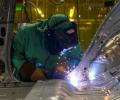
The headline seasonally adjusted IHS Markit India Manufacturing Purchasing Managers' Index (PMI) fell to a two-year low of 50.6 in October from 51.4 in September.

For Mahindra & Mahindra (M&M), which has just started executing a comeback strategy for wresting back ground it lost to rivals, this could not have come at a worse time. The maker of the Bolero Neo and the Thar models on Thursday said it would have to halt production at its automotive plant for a week due to the worsening supply situation of semiconductors.
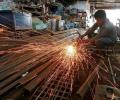
India's manufacturing sector activities improved in September as companies benefited from strengthening demand conditions amid the easing of COVID-19 restrictions, a monthly survey said on Friday. The seasonally adjusted IHS Markit India Manufacturing Purchasing Managers' Index (PMI) improved from 52.3 in August to 53.7 in September, indicating a stronger expansion in overall business conditions across the sector. The September PMI data pointed to an improvement in overall operating conditions for the third straight month. In PMI parlance, a print above 50 means expansion while a score below 50 denotes contraction.
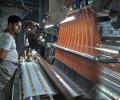
India's manufacturing sector activities gained further strength in October as companies scaled up production and stepped up input purchasing in anticipation of further improvements in demand, a monthly survey said on Monday. Robust gains in new work aided production growth in October as output and new orders expanded at fastest rates in seven months, while business optimism hit a six-month high, the survey said. The seasonally adjusted IHS Markit India Manufacturing Purchasing Managers' Index (PMI) rose from 53.7 in September to 55.9 in October, pointing to the strongest improvement in overall operating conditions since February.

Indian economy is likely to rebound with an 8.9 per cent growth in the fiscal year beginning April 2021 after economic activity showed significant improvement in the last quarter, IHS Markit said on Friday. The National Statistical Organisation (NSO) on Thursday predicted that the economy will contract 7.7 per cent in the current financial year ending in March, the worst performance in four decades.

India's manufacturing sector activity witnessed a significant loss of growth momentum in May due to the intensification of the COVID-19 crisis and its detrimental impact on demand, a monthly survey said on Tuesday. The seasonally adjusted IHS Markit India Manufacturing Purchasing Managers' Index (PMI), fell to 50.8 in May, down from 55.5 in April, as companies observed the slowest rises in new work and output in ten months amid intensification of the COVID-19 crisis. In PMI parlance, a print above 50 means expansion while a score below 50 denotes contraction.
India's manufacturing sector activities moderated in August, as business orders and production rose at softer rates due to the pandemic and rising input costs, a monthly survey said on Wednesday. The seasonally adjusted IHS Markit India Manufacturing Purchasing Managers' Index (PMI) stood at 52.3 in August, down from 55.3 in July, indicating a softer rate of growth that was subdued and below its long-run average. The August PMI data pointed to an improvement in overall operating conditions for the second straight month.
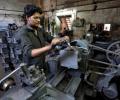
India's manufacturing sector activities witnessed the strongest rate of growth in three months in July amid improved demand conditions and easing of some local COVID-19 restrictions, a monthly survey said on Monday. The seasonally adjusted IHS Markit India Manufacturing Purchasing Managers' Index (PMI) rose from 48.1 in June to 55.3 in July, pointing to the strongest rate of growth in three months. In PMI parlance, a print above 50 means expansion while a score below 50 denotes contraction.
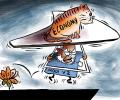
The country's new economic roadmap highlights the importance of creating a virtuous cycle of investment, savings and exports in order to sustain rapid economic growth over the next five years.

India's manufacturing sector activities lost further growth momentum and fell to a seven-month low in March as demand was constrained by the escalation of the COVID-19 pandemic, a monthly survey said on Monday. The seasonally adjusted IHS Markit India Manufacturing Purchasing Managers' Index (PMI) fell from 57.5 in February to a seven-month low of 55.4 in March. However, the latest reading was indicative of a substantial improvement in the health of the sector that outpaced the long-run series average, it said. In PMI parlance, a print above 50 means expansion while a score below 50 denotes contraction.

The IHS Markit India Services Business Activity Index stood at 5.4 in April, an extreme decline from 49.3 in March, and indicative of the most severe contraction in services output since records began in December 2005. As per the IHS Markit India Services Purchasing Managers' Index (PMI), a print above 50 means expansion, while a score below that denotes contraction.
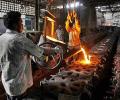
India's manufacturing sector activity was largely flat in April, as rates of growth for new orders and output eased to eight-month lows amid the intensification of the COVID-19 crisis, a monthly survey said on Monday. The seasonally adjusted IHS Markit India Manufacturing Purchasing Managers' Index (PMI) was at 55.5 in April, little changed from March's reading of 55.4. In PMI parlance, a print above 50 means expansion while a score below 50 denotes contraction.
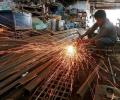
India's manufacturing sector activities eased slightly in February but firms were upbeat as they responded to increased new work intakes by stepping up production and purchasing activities, a monthly survey said on Monday. The seasonally-adjusted IHS Markit India Manufacturing Purchasing Managers' Index (PMI) fell marginally to 57.5 in February from 57.7 in January, indicating that even though the pace of growth eased from January it remained sharp in the context of historical data. The headline figure for February remained above its long-run average of 53.6, the survey noted. In PMI parlance, a print above 50 means expansion while a score below 50 denotes contraction.
The IHS Markit India Services Business Activity Index improved from 52.7 in November to 53.3 in December, highlighting the second-strongest rate of increase in output in over a year, after July. However, the overall level of positive sentiment remained below its long-run average.

Broadly stagnant sales causes the first drop in business activity in over a year.
India was already in the midst of a protracted economic slowdown before the virus hit due to a festering crisis among shadow lenders and declining consumer demand and private investment. Service sector activity in India is still effectively on hold.

According to the IHS Markit India Business Outlook, predictions of softer activity growth underpin the downward revisions of profit outlook, subdued hiring plans and relatively muted capital expenditure.
The seasonally adjusted IHS Markit India Manufacturing Purchasing Managers' Index (PMI) fell from 58.9 in October to a three-month low of 56.3 in November, indicating that the manufacturing sector growth remained strong, despite losing traction.

IndusInd Bank was the top gainer in the Sensex pack, rising nearly 6 per cent, followed by Axis Bank, SBI, Maruti, Tech Mahindra and Reliance Industries. NSE Nifty surged 183.70 points to close at 17,166.90.

Services companies reported an increase in new work intakes, which they attributed to successful marketing efforts and strengthening demand.

Manufacturers indicated that the ongoing relaxation of COVID-19 restrictions, better market conditions and improved demand helped them to secure new work in October.

Input shortages and low inventories, according to Nomura, will likely lead to production cuts and delayed shipments in the September 2021 quarter.
India's services activity expanded at the fastest rate in a year during February, while employment fell further and companies noted the sharpest rise in overall expenses, a monthly survey said on Wednesday. The seasonally adjusted India Services Business Activity Index rose from 52.8 in January to 55.3 in February, pointing to the sharpest rate of expansion in output in a year amid improved demand and more favourable market conditions. The index was above the critical 50 mark that separates growth from contraction for the fifth month in a row during February as the roll-out of COVID-19 vaccines led to an improvement in business confidence towards growth prospects.

The seasonally adjusted India Services Business Activity Index rose sharply from 34.2 in July to 41.8 in August, the highest since March, before the escalation of the pandemic.

New business received by Indian manufacturers expanded at the fastest pace since February.

India's manufacturing sector activity strengthened in December, with manufacturers stepping up production and input buying amid efforts to rebuild their inventories following business closures earlier in the year, a monthly survey said on Monday. The seasonally adjusted IHS Markit India Manufacturing Purchasing Managers' Index (PMI) was at 56.4 in December, a tick higher than November's reading of 56.3 and above the critical 50 threshold for the fifth straight month. In PMI parlance, a print above 50 means expansion, while a score below that denotes contraction.

New businesses have been secured from the public and private sectors, as well as domestic and international markets.
