
From the Sensex pack, ITC, Hindustan Unilever, Mahindra & Mahindra, HDFC Bank, Eternal, Kotak Mahindra Bank, State Bank of India and ICICI Bank were the major gainers. IndusInd Bank, Power Grid, Bharti Airtel, Infosys, and Bajaj Finserv were among the laggards.

While a giant, it's a nimble-footed one, and is growing at a speed that even some of its private sector peers find enviable.
Between FY18 and FY24, it doubled its balance sheet. Despite being a late entrant in some segments, it has been able to grab market share, observes Tamal Bandyopadhyay.

Only experienced investors with a high risk appetite, a grasp of market cycles, and comfort with volatility and timing risk should invest.

Private players continued to show strong momentum in the life insurance individual new business segment during August, 2023. On an aggregate, the industry registered 14 per cent growth year-on-year (Y-o-Y) compared to 15 per cent in July '23. Private players were up 21 per cent Y-o-Y, up from 16 per cent Y-o-Y in July '23, while public insurers' growth was muted at 3 per cent.

From the Sensex firms, Infosys declined by 3.54 per cent. Power Grid, Eternal, HCL Tech, Tata Consultancy Services, Bharti Airtel, IndusInd Bank, NTPC and HDFC Bank were the major laggards. Sun Pharma, Adani Ports, Bajaj Finance, State Bank of India and Tech Mahindra were the gainers.

There have been some cases where the entire family has perished or both spouses died in the crash, which are making the claims process particularly complex.

HCL Tech, Adani Ports, Eternal, Maruti, Reliance Industries and Asian Paints were among the gainers. HDFC Bank, ICICI Bank, Bharti Airtel and Infosys added to the rally. IndusInd Bank emerged as the only laggard.

State Bank of India (SBI) and Housing Development Finance Corporation (HDFC) will see maximum inflows from passive trackers on account of the quarterly rebalancing exercise of the National Stock Exchange Nifty Bank Index. IndusInd Bank and AU Small Finance Bank could see maximum outflows. The rejig of the Nifty CPSE Index will result in inflows in Oil and Natural Gas Corporation, NTPC, and Coal India and maximum outflows in Bharat Electronics, according to Brian Freitas, a New Zealand-based analyst with Periscope Analytics.

Highly-rated finance firms and housing finance companies are expected to benefit from the absence of Housing Development Finance Corp (HDFC) from the bond market once it merges with the HDFC Bank in early FY24. Post merger, the bond market is expected to become less crowded, which will ease fund raising conditions for other players in the field. It may perhaps also compress the spread for debt instruments floated by housing finance companies (HFCs) over 10-year government bonds, subject to demand and supply conditions.

From the Sensex pack, HDFC Bank, Maruti, Tech Mahindra, HCL Tech, ITC, ICICI Bank, Kotak Mahindra Bank and Bajaj Finance were among the biggest laggards. NTPC, Adani Ports, Mahindra & Mahindra, Tata Steel and IndusInd Bank were among the gainers.
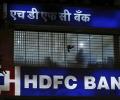
HDFC Bank Q4 review: HDFC Bank's January-March quarter (Q4) results, for financial year 2022-23 (FY23), brought no cheer to investors as elevated costs, and merger-related uncertainties continue to dent the sentiment. Moreover, analysts fear that merger-related costs may put pressure on margins and cost to income ratio in the near-term, while the return on equity could moderate owing to low leverage of the parent. Analysts, therefore, opine that the stock's re-rating may be some time away. "While the risk of a de-rating on a standalone basis appears to be quite low given that the business performance is holding up well, we believe a re-rating in the stock would happen as and when more clarity emerges on the smooth transition (merger)," said a report by Sharekhan.

From the Sensex firms, Tech Mahindra, Tata Steel, Tata Motors, Titan, HDFC Bank, IndusInd Bank, Infosys and Kotak Mahindra Bank were among the biggest laggards. On the other hand, Adani Ports, Mahindra & Mahindra, Power Grid, Eternal and Hindustan Unilever were among the gainers.
HDFC Bank Q1FY24 results analysis: Shares of HDFC Bank, the world's seventh largest financial entity, have advanced 2 per cent in two days, as against 1 per cent rise in the benchmark S&P BSE Sensex, after the lender reported its April-June quarter (Q1) results for financial year 2023-24 (FY24) on July 17. The S&P BSE Bankex index, meanwhile, has gained 1.3 per cent. While the near-term stock performance may remain sideways due to merger-related hiccups, analysts remain bullish on the stock's long-term prospects.

IndusInd Bank was the biggest gainer in the Sensex pack, rising 3.25 per cent, followed by Tech Mahindra, Wipro, Bharti Airtel, HCL Technologies, Axis Bank, HDFC Bank, RIL, TCS, L&T and Infosys. State Bank of India, NTPC, Maruti, Bajaj Finserv, Tata Motors and Power Grid were among the laggards, slipping up to 2.94 per cent.

rediffGURU Jinal Mehta answers readers' financial planning and health insurance queries

Stock market benchmark indices Sensex and Nifty tumbled over 1 per cent each on Friday as tensions soared between India and Pakistan, fuelling fears of a wider conflict.

Benchmark equity indices Sensex and Nifty surged more than 1 per cent on Monday, registering their fifth day of rally on the back of buying in banking and IT shares after encouraging quarterly earnings and foreign fund inflows. The 30-share BSE Sensex jumped 855.30 points or 1.09 per cent to settle above the 79,000 mark at 79,408.50.
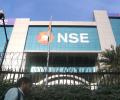
After a sharp fall in the share prices of HDFC Bank and other private sector lenders in the past three days, the BFSI (banking, financial services and insurance) sector weighting in the Nifty50 has slipped to a seven-year low of 32.03 per cent, down from nearly 36.6 per cent at the end of March 2023 and 34.5 per cent at the end of December 2023.
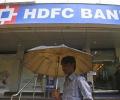
Largest private sector lender HDFC Bank on Monday reported a 29.13 per cent jump in consolidated net profit for the June quarter at Rs 12,370.38 crore. The bank, which recently merged mortgage financier parent HDFC into itself, had reported a net profit of Rs 9,579.11 crore in the year-ago period and Rs 12,594.47 crore in the preceding March quarter.

Mahindra & Mahindra, Bharti Airtel, Tata Consultancy Services, Infosys, ICICI Bank, and ITC were the biggest laggards. Foreign portfolio investors (FPIs) offloaded equities worth Rs 4,294.69 crore on Friday, according to exchange data.

Ask rediffGURU and PF and MF expert Janak Patel your mutual fund and personal finance-related questions.

The Reserve Bank of India's (RBI) Monetary Policy Committee's (MPC) decision to cut the repo rate by 50 basis points (bps) to 5.5% was contrary to the expectations of many economists. Firstly, most of the economists expected the MPC to cut the repo rate by 25 bps citing the weakening of inflation, prospects of economic growth, geopolitical uncertainty and comfortable system liquidity.

Selected applicants will receive a monthly stipend of Rs 4,500 from the government and an additional Rs 500 from participating companies as a part of the Prime Minister Internship Scheme (PMIS) 2025.
The Securities Appellate Tribunal (SAT) has quashed a Sebi order against HDFC Bank, whereby the regulator had imposed a penalty of Rs 1 crore on the lender in a case pertaining to invoking securities pledged by stockbroker BRH Wealth Kreators. In addition, the regulator had directed to transfer Rs 158.68 crore along with seven per cent interest per annum into an escrow account till the issue of settlement of clients' securities is reconciled. These directions were issued by Sebi in January 2021 as HDFC Bank invoked securities pledged by BRH Wealth Kreators in violation of the regulator's interim order passed in October 2019.
Global fund managers remain bullish on the Japanese stock markets, which is now their most preferred destination in the Asian region. Both Morgan Stanley and Jefferies in their recent reports, have cited their preference for the Land Of The Rising Sun, which is fast becoming the land of the rising equities, too.

The RBI on Monday said state-owned SBI, along with private sector lenders ICICI Bank and HDFC Bank continue to be Domestic Systemically Important Banks (D-SIBs) or institutions which are 'too big to fail'. SIBs are perceived as banks that are 'too big to fail (TBTF)'. This perception of TBTF creates an expectation of government support for these lenders in times of distress.

Tata Motors, State Bank of India, UltraTech Cement, Tata Consultancy Services, Tata Steel and Asian Paints were among the other laggards from the 30-share pack. Maruti, Bharti Airtel, Power Grid, Hindustan Unilever and HDFC Bank were among the gainers.
The country's largest housing finance company HDFC Ltd will merge with the country's largest private sector lender HDFC Bank, according to a regulatory filing. The scheme of amalgamation will be subject to various regulatory approvals, including from the Reserve Bank of India (RBI) and the Securities and Exchange Board of India (Sebi), HDFC Bank said in the filing on Monday.
Bharti Airtel, ICICI Bank, Eternal, Mahindra & Mahindra, HCL Technologies, HDFC Bank, Kotak Mahindra Bank, Tata Consultancy Services and Bajaj Finance were also among the laggards.

Without changes to the taxation rules, buybacks are expected to remain scarce.

The data for individual weighted received premium (WRP) showed divergent trends for life insurers in December 2024. Overall, the industry's individual WRP grew 4.8 per cent year-on-year (Y-o-Y); LIC's individual WRP declined 13 per cent while private players saw 11.4 per cent growth.

Ask rediffGURU and PF and MF expert Janak Patel your mutual fund and personal finance-related questions.
State Bank of India, HDFC Bank and ICICI Bank have again been named as Domestic Systemically Important Banks (D-SIBs) by the Reserve Bank of India. The Reserve Bank on Wednesday came out with the list of D-SIBs.

Corporate earnings from blue-chips like HDFC Bank, ICICI Bank, Donald Trump's swearing-in as the US President, and trading activity of foreign investors are the key factors to drive equity markets this week, analysts said. Trump will be sworn in as the US president for a second term on Monday. This week, several key Nifty-50 companies, including BPCL, HDFC Bank, Hindustan Unilever, Dr Reddy's, UltraTech Cement, JSW Steel and ICICI Bank are scheduled to announce their financial results.

HDFC Bank, the country's largest private-sector lender, lost to competition wholesale loans of around Rs 50,000 crore after it increased interest rates in May, said Chief Financial Officer Srinivasan Vaidyanathan in an analyst call. "There were some customers who were offered lower rates by other market participants. "But we decided not to cut back on our rates," he said while addressing analysts after the announcement of the bank's Q1 earnings.

Gold prices tumbled by Rs 1,550 to Rs 91,450 per 10 grams in the national capital on Monday amid heavy selling by jewellers and stockists as well as weak global trend, according to the All India Sarafa Association. On Friday, the precious metal of 99.9 per cent purity had finished at Rs 93,000 per 10 grams.

After opening close to 1,500 branches in 2022-23, HDFC Bank, the country's largest private sector lender, will continue expanding its branch network at the same speed in the current financial year. The lender says branch expansion is crucial for deposit mobilisation. As of March 31, 2023, HDFC Bank had 7,821 branches, up from 6,342 a year ago.

From the Sensex pack, Power Grid, HDFC Bank, HDFC, Tech Mahindra, Tata Consultancy Services, Wipro, Reliance Industries and Larsen & Toubro were the major gainers. Mahindra & Mahindra, ITC, IndusInd Bank, Axis Bank, Bajaj Finance and Maruti were among the laggards.

Despite rising interest rates, leading home loan players SBI and HDFC have announced discounted interest rates beginning at 8.40 per cent as part of their festive offerings. SBI in a statement said that its home loan book has topped the Rs 6 lakh crore mark, a first in the industry. The leading lender said it is offering up to 25 bps discount on interest rate to new home loan borrowers, making the entry level rate at 8.40 per cent and the offer will run up to January 31, 2023.

From the Sensex pack, NTPC, Tech Mahindra, Zomato, Axis Bank, Bajaj Finance, Infosys, Maruti, State Bank of India, Kotak Mahindra Bank, Reliance Industries, Hindustan Unilever, and HDFC Bank were the losers. IndusInd Bank, HCL Tech, Titan, Mahindra & Mahindra and Power Grid were the gainers.
