
Tata Motors' 2026 Tiago facelift is a tech-loaded and safety-focused entry-level hatchback, with prices starting at Rs 4.69 lakh.

Tata Motors Passenger Vehicles Ltd (TMPV) announced a price hike of up to Rs 25,000 across its ICE and electric vehicle models, effective September 1, to mitigate rising input costs and inflationary pressures.

Tata Motors Passenger Vehicles Ltd (TMPV) has launched its new brand identity, TATA.CARS, aiming to appeal to a younger demographic with a focus on smarter, greener, and more connected mobility experiences.

Bengaluru's draft GBA (Parking) Rules, 2026, propose annual residential parking fees ranging from Rs 15,000 to Rs 25,000, depending on vehicle type. The rules aim to regulate on-street parking, requiring permits for residents and setting specific road-space requirements, with violations leading to penalties.

Maruti Suzuki has discontinued its Ignis hatchback due to weak sales and a shift towards SUVs, while simultaneously facing supply chain issues for its popular S-Presso and WagonR models, leading to booking halts at some dealerships.

Maruti Suzuki, India's leading passenger vehicle manufacturer, is experiencing robust growth in the June quarter, driven by a recovery in the entry-level segment, easing supply constraints, and significant market share gains. Despite potential headwinds from El Nio, analysts remain optimistic about the company's future performance.

With features usually seen in more expensive cars and segment-first paddle shifters, the Tiago offers excellent value for money, says Rajesh Alva/Rediff.com.

The 2026 Tata Tiago EV has faster charging, is more spacious, has more features and a lifetime battery warranty. So how is st still so affordable, wonders Rajesh Alva.

'In the January-August period, the share of hatchback in the overall PV industry sales was about 22.4 per cent. In the September-October period, the share of hatchbacks has come down to 20.4 per cent. In just October, their share was just 20 per cent. This is simple wholesale data from industry body SIAM.'

Since the Indian government reduced GST on small cars on September 22, the small car segment's share in Maruti's overall sales has risen to more than 25 per cent, up from 16.6 per cent earlier in FY26.

The new City hybrid might seem expensive at Rs 21 lakh but offers a hybrid powertrain with excellent efficiency plus more aggressive styling.

Japanese automaker Honda plans to introduce over 10 new models, including electric vehicles and compact SUVs, in India by 2030, identifying India as one of its three key markets for future growth.

A tourist from Bhopal died in a road accident in North Goa after his car was hit by an SUV allegedly driven by a 19-year-old. Police are investigating the incident and have arrested the driver for rash and negligent driving.
Tata Motors emerged as the biggest gainer in the passenger vehicles (PV) market in the second half of FY25, following a GST rate cut in September, achieving the highest growth among major OEMs and overtaking Mahindra & Mahindra in volumes.

Despite its sub-4m footprint, the Gravite offers impressive cabin space, three usable rows, and practical storage solutions making it ideal for budget-conscious families, says Somnath Chatterjee.

In 2025, the Maruti Suzuki Dzire has emerged as India's top-selling car, while sport utility vehicles continue to rule the broader passenger vehicle market, capturing almost 55 per cent of the segment.

Data from used-car platforms suggest that buyer preferences have remained broadly stable post-GST, with SUVs retaining their dominance even as price adjustments played out across segments.

It is after seven years that a sedan has claimed the top spot -- Dzire had last achieved the No.1 position in 2018.

In absolute terms, both types of cars must cut emissions by about 28-29 g/km. But in percentage terms, the lighter 900-kg car must reduce emissions by 27 per cent, while the 1,500-kg car needs a 22 per cent cut. And the target becomes progressively stringent for both -- but, once again, the tightening is sharper for the 900-kg car than for the 1500-kg car.

Indian automakers are reviving legacy nameplates to leverage brand recall and stand out in a crowded market, as classic badges like Sierra, Safari, Baleno and Scorpio return to attract buyers.

In October, small car wholesales of the auto industry -- excluding Tata Motors -- went up by 8.4 per cent Y-o-Y to 116,601 units, the data showed. However, the utility vehicle (UV) segment which includes sports utility vehicles (SUVs) as well as multi-purpose vehicles (MPVs), saw a bigger growth in October.

For hatchbacks and sedans, offers range between Rs 40,000 and Rs 80,000 while SUVs and multi-purpose vehicles carry benefits exceeding Rs 1 lakh.

'GST reduction will help larger and high-end cars too.'

Sales growth of entry-level cars or hatchbacks like WagonR and Alto have seen a decline during the past few years due to changing consumer preference. Maruti Suzuki chairman R C Bhargava had on October 28 said that he does not expect hatchback unit sales to grow in the fourth quarter (Q4FY23) or in the next fiscal year.
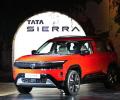
Tata Motors Passenger Vehicles Ltd expects contribution of SUVs to its overall sales to go beyond 70 per cent with it making foray into the fast growing mid-sized segment with a premium positioning of its Sierra model, according to its Managing Director & CEO, Shailesh Chandra.

Multiple tailwinds for the automobile sector, including a cut in goods and services tax (GST) rates, are keeping analysts bullish on auto stocks from a long-term perspective, even as they see the rally running its course in the near term.

The demand for passenger vehicles (PVs) is expected to sustain even beyond the ongoing festival season as a new set of customers, those who gained confidence to buy cars following the recent GST rate cuts, will begin to visit dealerships now, said Shailesh Chandra, president of the Society of Indian Automobile Manufacturers (Siam), on Wednesday.

The GST Council on Wednesday approved two slabs of 5 per cent and 18 per cent effective from September 22, the first day of Navaratri.

The country's largest carmaker Maruti Suzuki India on Thursday announced a reduction in vehicle prices by up to Rs 1.29 lakh effective September 22 to pass on the GST rate cut benefit to customers.

The small sports utility vehicle (SUV) segment - comprising models less than 4 metres in length - could witness the "maximum" growth among all categories in the coming months following the recent goods and services tax (GST) rate rationalisation, Tarun Garg, chief operating officer of Hyundai Motor India (HMIL), said.

The growing rift between MSIL and rival automakers has complicated the government's efforts to finalise the CAFE norms.

'Some buyers get carried away by festival offers and purchase higher variants or larger vehicles than they truly need, which impacts running cost and long-term affordability.'
Maruti Suzuki, India's largest producer of small cars, stands to benefit the most.
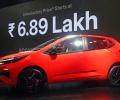
When it comes to the "all-new" Tata Altroz unveiled on Thursday, one might wonder if it's truly a complete overhaul or just a refreshed take on the familiar.

In terms of safety, the Victoris has scored 5 stars in both GNCAP and BNCAP tests and that's a first for Maruti, observes Somnath Chatterjee.
Tata Motors on Friday reported a 62.2 per cent decline in consolidated net profit to Rs 4,003 crore in the June quarter, impacted by volume decline across segments, drop in JLR profits due to US tariffs and high base effect due to gain from sale of discontinued operations. The auto major had posted a consolidated net profit of Rs 10,587 crore in the April-June quarter of the previous fiscal, Tata Motors Ltd (TML) said in a regulatory filing.

Sluggish urban demand, a high base effect, and weak sales of hatchbacks and sedans weigh down passenger vehicle sales in FY25.
Siam argues that a 2040 ban could destabilise ongoing and future investments and threaten millions of jobs in the automotive value chain.

South Korean automaker Kia Motors says it will look to be a premium only brand and stay away from the entry level segment like sedans and hatchbacks. Hardeep Singh Brar, the company's India Vice-President and Head (Sales and Marketing), said that customers have accepted Kia as a premium brand. In the mass market Kia is considered to be the most premium brand. "Customers like the features and they are willing to pay for them. So, we have consciously decided that if customers like us a premium brand, let's stick to that. It is a conscious decision to stay premium and operate in that segment of the mass market," Brar said.

77 per cent of all transactions in the January-March 2025 period took place digitally, indicating continued preference for online car purchases.
